Alternatives to declawing a cat are not soft suggestions for owners who enjoy scratched furniture. They are practical tools for solving a normal feline behavior without removing part of the cat’s toes. Scratching is how cats stretch, mark territory, condition claws, release tension, and interact with their environment. The fix is not to erase the behavior. The fix is to redirect it, manage the claws, protect target surfaces, and make the right scratching locations more rewarding than the couch.
For homes already using structured pet routines, a 2L smart pet feeder for regular feeding can help reduce food-related stress, but scratching needs its own system. The best alternatives to declawing a cat combine nail care, scratching surfaces, placement, training, enrichment, furniture protection, and calm owner consistency.
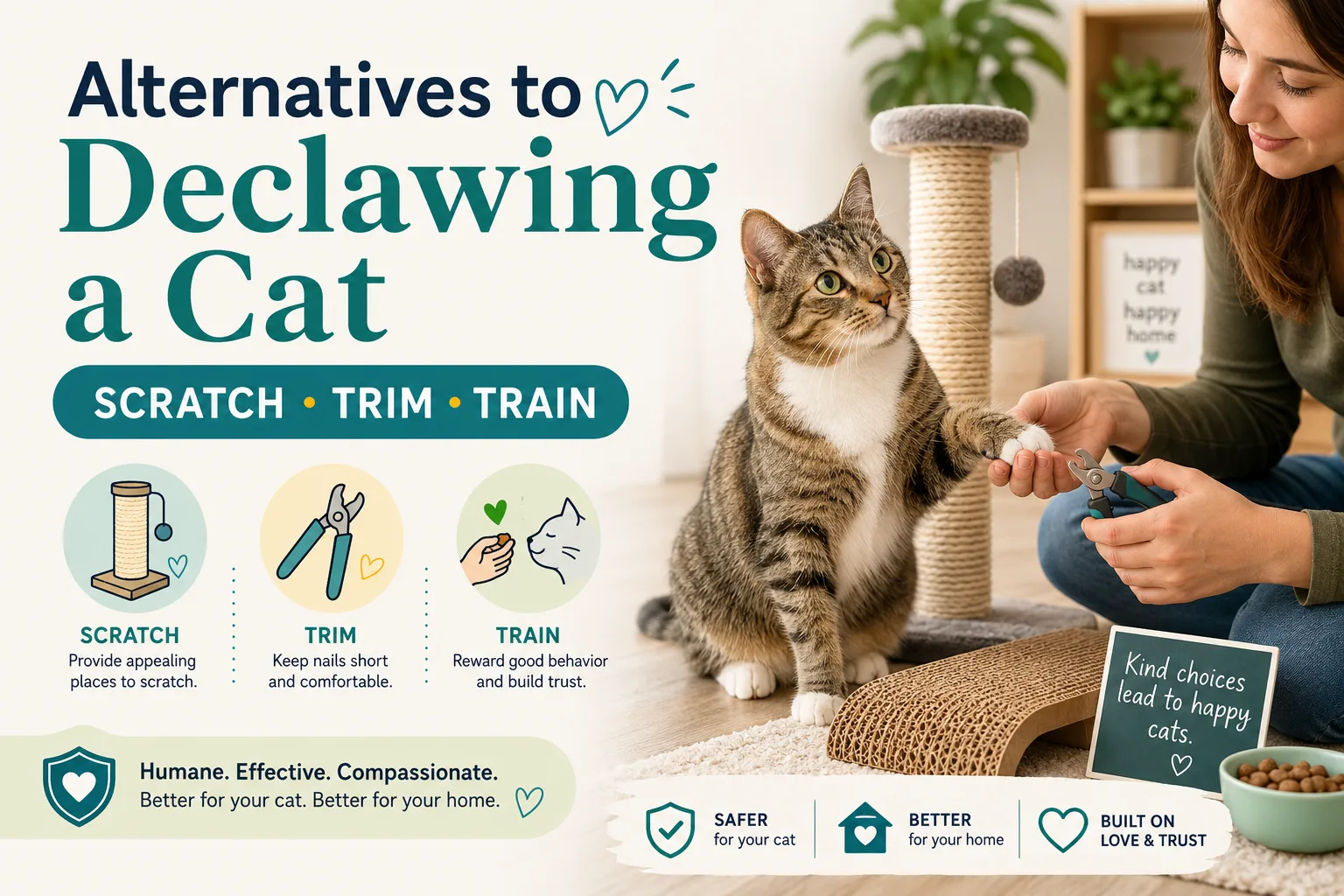
Direct Answer: Alternatives to Declawing a Cat
The best alternatives to declawing a cat are regular nail trimming, multiple scratching posts and pads, correct post placement, cat-safe nail caps, furniture covers, double-sided deterrent tape, positive reinforcement, more play and enrichment, separate safe spaces, stress reduction, and veterinary or behavior-professional support when scratching is severe or sudden. Declawing is not a simple nail trim. It is a surgical amputation procedure, so owners should exhaust non-surgical options before considering any irreversible procedure.
The fastest practical plan is this: trim the nails, place a tall stable scratching post beside the damaged furniture, add a horizontal cardboard scratcher, reward the cat for using both, block the couch temporarily, and stop punishing the cat for scratching. Punishment usually teaches the cat to scratch when the owner is not watching.
Why This Happens
Cats scratch because scratching is normal. It is not revenge, spite, or bad manners. A cat may scratch furniture because the texture feels right, the location is socially important, the object is stable, the cat is stretching after sleep, or the owner placed the scratching post in a dead corner nobody uses.
The AAFP’s position statement on declawing identifies scratching as a normal feline behavior and lists non-surgical management steps such as claw trimming, scratching surfaces, and temporary nail caps. The ASPCA’s position statement on declawing cats also emphasizes that owners should be informed about alternatives to manage destructive scratching.
That is why alternatives to declawing a cat must work with the behavior instead of pretending the behavior should disappear. A cat still needs to scratch. The owner decides where, when, and what surface earns the reward.
What To Do First
Start by identifying the target. Is the cat scratching a couch arm, rug, door frame, mattress, chair back, curtain, carpeted stair, or human skin? The surface tells you what the cat likes: vertical or horizontal, fabric or cardboard, rough or smooth, high or low, private or social.
Next, trim the nails if the cat allows safe handling. Sharp nail tips cause more damage. If nail trimming is difficult, ask a veterinary clinic, groomer experienced with cats, or trained professional to demonstrate the technique.
Then place replacement scratchers where the cat already scratches. Do not hide the new post across the room. Put the alternative directly beside the problem spot first. Once the cat uses it reliably, move it gradually if needed.
The Behavior Loop Behind Furniture Scratching
The scratching loop starts when the cat scratches the couch and feels an immediate reward. The couch is stable, tall, textured, and located where the household spends time. The owner buys a small scratching post and places it in a corner. The cat ignores it because the couch is still better.
The owner scolds the cat. The cat waits until the owner leaves and scratches again. The owner becomes more frustrated and starts considering declawing. The real problem is that the cat has not been given an equally useful scratching target.
Effective alternatives to declawing a cat break the loop by making the correct object better than the wrong one. The post must be tall, stable, textured, and placed at the point of need.
The Emotional Trigger Owners Miss
The emotional trigger is property damage. Owners often reach a breaking point after seeing shredded upholstery, scratched doors, or marks on expensive furniture. That frustration is understandable, but it can lead to rushed decisions.
A better response is to treat scratching like a design problem. The cat has a behavior requirement. The home needs approved outlets. The furniture needs temporary protection. The owner needs a measurable plan.
For broader cat routine control, use training cat to use feeder. The same principle applies: cats adopt new equipment faster when the owner controls placement, rewards, and timing.
The Addiction Mechanism
The addiction mechanism is texture reward. Scratching feels good. If the couch gives the best stretch and the best resistance, the cat will return. A weak post that wobbles cannot compete. A scratcher hidden near the litter box cannot compete. A tiny kitten post cannot compete with a full-body couch stretch.
Some cats also learn that scratching gets attention. If the owner rushes over every time the claws touch fabric, the cat may use scratching as a button. Attention can reinforce the behavior even when the attention is negative.
Strong alternatives to declawing a cat remove both rewards: protect the furniture so scratching it feels less useful, and reward the approved scratcher so the cat has a better option.
Alternative 1: Regular Nail Trimming
Nail trimming reduces sharp tips and limits damage. It does not stop the need to scratch, but it makes scratching less destructive. Many cats do best with short sessions: one or two nails at a time, paired with treats or calm praise.
Use a proper cat nail trimmer. Press the paw gently to extend the claw. Cut only the clear tip and avoid the pink quick. If the cat resists, stop before the session becomes a fight. The goal is long-term cooperation, not winning one dramatic trim.
Nail trimming is one of the most important alternatives to declawing a cat because it directly reduces furniture and skin damage while keeping the claw intact.
Alternative 2: Tall Stable Scratching Posts
A vertical scratching post should be tall enough for the cat to stretch fully. It should not wobble. Cats often reject posts that move under pressure because furniture feels safer and more stable.
Place the post near sleeping areas, doorways, windows, and the damaged furniture. Cats often scratch after waking and when moving through socially important spaces. A post in a hidden corner is usually a human preference, not a cat preference.
Use sisal, cardboard, wood, or carpet texture depending on what the cat already likes. If the cat scratches the couch arm, a vertical sisal post beside that arm is more logical than a flat scratcher in another room.
Alternative 3: Horizontal Scratching Pads
Some cats prefer horizontal scratching. These cats may target rugs, carpet edges, yoga mats, and flat upholstery. A vertical post will not solve the whole problem if the cat wants a floor-level scratch.
Add horizontal cardboard pads or sisal mats near the target area. Anchor them so they do not slide. If the pad moves too much, the cat may return to the rug because the rug gives better resistance.
Good alternatives to declawing a cat match the cat’s scratching angle. Vertical cats need vertical posts. Horizontal cats need horizontal pads. Many cats need both.
Alternative 4: Nail Caps
Temporary synthetic nail caps can reduce damage from scratching. They are glued over the claws and replaced as the claws grow. They can be useful for homes where furniture damage, fragile skin, or transition periods make extra protection necessary.
Nail caps are not maintenance-free. They must be applied correctly, monitored, and replaced. The cat still needs scratching surfaces. Nail caps should not be used to avoid solving the environment.
For some households, nail caps are one of the strongest alternatives to declawing a cat because they protect surfaces while the cat learns new scratching locations.
Alternative 5: Furniture Protection
Protect the target furniture during retraining. Use washable covers, tight-weave throws, plastic corner guards, clear scratch shields, or double-sided cat deterrent tape where appropriate. The goal is to make the old target less rewarding while the new target becomes more rewarding.
Do not rely on deterrents alone. If the couch becomes unpleasant but no good scratcher exists nearby, the cat may move to another piece of furniture. Deterrents must be paired with approved alternatives.
A practical rule for alternatives to declawing a cat: every blocked scratching spot needs an approved scratching spot within reach.
Alternative 6: Reward-Based Scratching Training
Reward the cat when it uses the correct surface. Use treats, praise, play, or catnip if the cat responds to it. Reward immediately after scratching the post. Do not wait five minutes and expect the cat to connect the reward.
You can gently lure the cat near the post with a toy, but do not force the paws onto the post. Forced paw placement can make some cats avoid the object. Let the cat discover that scratching the post pays.
Training works best when the owner rewards the right behavior more often than they punish the wrong one. Punishment suppresses behavior temporarily. Reinforcement builds a replacement habit.
Alternative 7: More Play and Enrichment
Understimulated cats scratch more destructively because scratching becomes one of the few available outlets. Add daily play sessions, climbing space, window access, puzzle feeding when appropriate, hiding spots, and predictable interaction.
Use wand toys to let the cat chase, grab, and release energy. End play with a small meal or scheduled feeding when possible. This creates a healthier hunt-eat-groom-rest rhythm.
Use scientific pet feeding schedule if your cat becomes most destructive before meals. Feeding rhythm, play, and scratching behavior often overlap.
Alternative 8: Better Feeding Routine
Food stress can worsen household behavior. A cat that begs, wakes the owner, steals food, or waits near the kitchen may also scratch high-value furniture for attention. Feeding does not cause every scratching problem, but unstable routines add pressure.
Use measured meals at predictable times. Avoid manual snacks every time the cat acts demanding. If using an automatic feeder, keep the schedule consistent and do not turn manual feed into an attention button.
A smart automatic pet feeder with app control can help separate food timing from owner emotion. That makes other alternatives to declawing a cat easier to apply calmly.
Alternative 9: Manage Multi-Cat Stress
In multi-cat homes, scratching can increase when cats compete over territory, food, litter boxes, windows, resting spots, or owner attention. Scratching marks space visually and through scent glands in the paws.
Add more resources: multiple scratchers, multiple resting areas, separated feeding zones, and safe vertical space. Do not expect one scratching post to serve three cats in a tense home.
Use how to stop one cat from eating the other’s food if food competition is part of the household stress. Declawing does not solve conflict between cats.
Alternative 10: Protect People With Fragile Skin
Some owners consider declawing because of scratches to children, older adults, or people with fragile skin. The safer first steps are nail trimming, nail caps, supervised handling, teaching people not to roughhouse with hands, and creating escape routes for the cat.
Do not let children chase, corner, carry, or grab the cat. Many scratches happen because the cat is trying to escape. A cat tree, shelf, or safe room can prevent conflict before claws are used.
If a household member has a medical risk related to scratches, speak with both the person’s physician and the cat’s veterinarian. The goal is risk management without assuming surgery is the only tool.
Alternative 11: Rework the Room Layout
Sometimes the room itself creates the scratching problem. The cat wakes on the sofa, stretches on the sofa arm, walks to the window, scratches again, then sleeps there. The sofa is located at the center of the cat’s routine.
Put a scratching post at the exact transition point: beside the sleep spot, near the window path, next to the damaged corner, or by the door. Move furniture slightly if needed. Add a mat or scratcher where the cat naturally lands after jumping down.
Use smart feeder placement for the same environmental principle. Placement changes behavior before training has to work hard.
Alternative 12: Veterinary and Behavior Help
If scratching is sudden, extreme, or paired with hiding, aggression, litter box changes, appetite changes, overgrooming, or conflict with another pet, treat it as a possible stress or health signal. Pain, anxiety, new pets, moving, new furniture, or schedule disruption can change scratching behavior.
A veterinarian can check for pain or medical contributors. A credentialed behavior professional can help build a scratching plan when simple post placement has failed.
The strongest alternatives to declawing a cat are not always products. Sometimes the best alternative is diagnosing why the cat’s behavior changed.
What Not to Do
Do not hit, spray, shout, chase, or throw objects at the cat. These methods increase fear and may make scratching happen when the owner is absent. Do not remove all scratching opportunities. That creates frustration, not training.
Do not buy one tiny post and call the plan complete. Do not use unstable scratchers. Do not hide all scratchers in low-value rooms. Do not punish the cat for using furniture before giving a better alternative.
Do not confuse claw trimming with declawing. Nail trimming removes only the sharp tip. Declawing is surgery. They are not comparable procedures.
Common Failure Pattern
The most common failure pattern is offering the wrong scratcher. The cat scratches a tall vertical couch arm, and the owner buys a short horizontal pad. The cat ignores it. The owner concludes scratching posts do not work.
The second failure is bad placement. A perfect post in the wrong room will lose to a couch in the cat’s preferred territory.
The third failure is giving up too quickly. Scratching habits take repetition. Furniture protection and reward-based redirection need time to shift the cat’s routine.
Real-World Impact
The real-world impact of good alternatives to declawing a cat is a home that works for both furniture and feline behavior. The cat keeps normal claw function. The owner gets fewer shredded surfaces. Scratching becomes predictable instead of chaotic.
The impact of poor management is frustration: damaged furniture, owner resentment, hidden scratching, stress between cat and human, and rushed decisions about surgery. Most scratching problems need a system, not one product.
For cat households building more predictable routines, compare the cat feeders collection. Feeding stability does not replace scratching outlets, but it reduces one source of household pressure.
Can This Be Fixed?
Yes, most furniture-scratching problems can be improved with a structured thirty-day reset. Trim nails. Add vertical and horizontal scratchers. Place them beside the damaged targets. Protect the furniture. Reward approved scratching. Increase play. Stabilize meals. Reduce multi-cat stress. Track which surfaces the cat chooses.
During the reset, do not remove protection too early. Keep the old target less rewarding while the new target becomes familiar. Once the cat reliably uses the scratcher, gradually move it only if the new location still fits the cat’s routine.
For broader routine support, start with the smart feeders collection. A stable feeding routine can support calmer behavior while the scratching plan does its main work.
Who Should Walk Away and Who Should Use This
Walk away from thinking declawing is equivalent to clipping nails. Walk away from punishment, unstable posts, hidden scratchers, and expecting one product to reverse months of couch scratching. Also walk away from ignoring sudden behavior changes that may signal stress or pain.
Use these alternatives to declawing a cat if your cat scratches furniture, rugs, doors, curtains, people, or other household surfaces. They are especially useful for kittens, newly adopted cats, indoor cats, multi-cat homes, renters, owners with expensive furniture, and households trying to protect both the cat and the home.
For scheduled meals during behavior resets, a timed slow feed automatic feeder can help keep feeding consistent. Consistency matters because cats respond better when the environment stops changing every day.
Mini FAQ
What are the best alternatives to declawing a cat?
The best alternatives to declawing a cat are nail trimming, scratching posts, horizontal scratchers, nail caps, furniture protection, reward-based training, enrichment, and stress reduction.
Do scratching posts really work?
Scratching posts work when they match the cat’s preferred texture, height, angle, stability, and location. A short wobbly post in a corner usually fails because the furniture is still more rewarding.
How often should I trim my cat’s nails?
Many indoor cats need nail checks every one to two weeks, but the right interval depends on claw growth, activity, age, and scratching habits. Trim only the clear sharp tip and avoid the quick.
Are cat nail caps a good alternative to declawing?
Cat nail caps can be a useful temporary alternative when applied correctly and monitored. They reduce damage while the cat keeps its claws and learns appropriate scratching surfaces.
How do I stop my cat scratching the couch?
Place a tall stable scratcher directly beside the couch, protect the couch surface, reward the cat for using the scratcher, trim nails, and keep the setup in place until the new habit is reliable.
Is declawing the same as trimming nails?
No, declawing is not the same as trimming nails. Nail trimming removes the sharp tip of the claw. Declawing is an irreversible surgical procedure involving the end of the toe.
The strongest alternatives to declawing a cat are practical, not symbolic. Trim the nails, give the cat better scratching surfaces, protect the furniture during retraining, reward the right behavior, reduce stress, and make the home work with feline behavior instead of fighting it. Scratching is normal. Destructive scratching is a setup problem that can usually be redirected.