

Training cat to use feeder is not about forcing a cat to eat from a machine. It is about making the feeder feel predictable, safe, quiet, clean, and connected to the cat’s normal meal routine. Most cats reject a feeder because the owner introduces too many changes at once: new device, new bowl, new noise, new location, new schedule, and sometimes new food.
For daily dry-food feeding, a 2L smart pet feeder for regular feeding works best when the cat has time to trust the station before the owner fully depends on automation. The feeder should become familiar before it becomes the main food source.
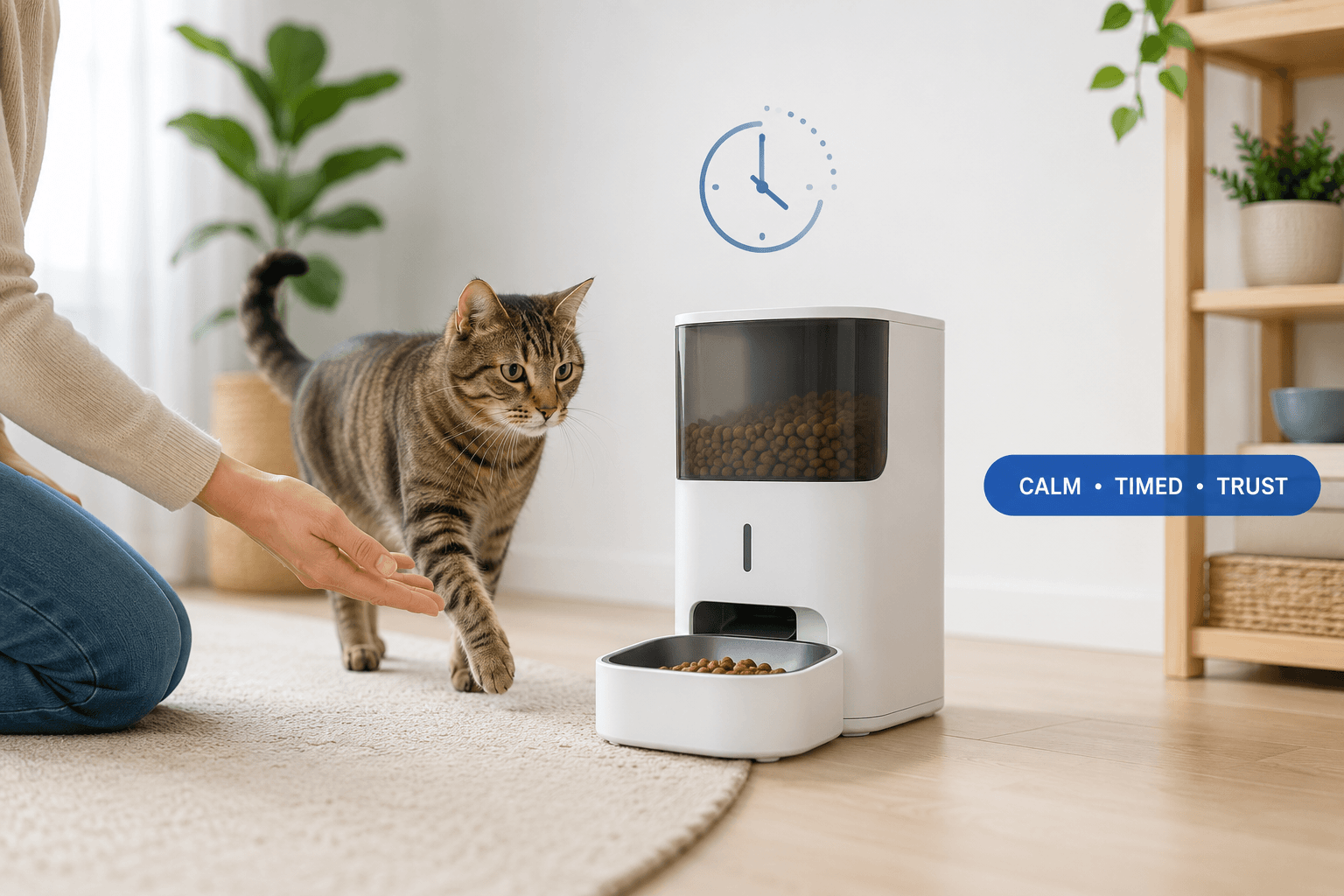
Direct Answer: Training Cat to Use Feeder
Training cat to use feeder means introducing the feeder slowly, placing it in a calm location, using the cat’s current food, starting with manual meals near the feeder, adding timed dispensing only after the cat eats comfortably, and avoiding punishment, hunger pressure, or sudden schedule changes. The goal is trust first, automation second.
The strongest training plan uses gradual exposure. Let the cat smell the feeder while it is turned off. Serve normal meals beside it. Move food into the feeder bowl only after the cat approaches calmly. Then test one small dispense while the cat is nearby but not forced to eat. A good training cat to use feeder routine protects appetite, confidence, and feeding accuracy at the same time.
Why Cats Reject Automatic Feeders
Cats reject feeders for practical reasons. The feeder may be noisy. The bowl may feel strange. The location may be too exposed. The food may smell different because it sat in the tank. The dispense sound may startle the cat. Another pet may crowd the station. The owner may hover too much and make the moment feel stressful.
The Cornell Feline Health Center’s feeding your cat guidance explains that feeding choices should support the cat’s nutritional needs and routine. A feeder is useful only when it helps the cat eat the right food in a stable way.
Training cat to use feeder fails when owners expect instant acceptance. Cats often need time to inspect new objects. A feeder that suddenly moves, clicks, drops food, or changes the meal location can look suspicious. Training should reduce surprise, not create it.
What To Do First
Start with the feeder turned off. Place it near the existing feeding area but not directly on top of the old bowl. Let the cat investigate. Do not push the cat toward it. Do not pick up the cat and place it in front of the machine. Do not run the motor repeatedly to “show” how it works.
A practical training cat to use feeder sequence has five steps: familiar object, familiar food, familiar place, quiet test, then timed routine. If the cat backs away at any step, return to the previous step for one or two days instead of forcing progress.
Use smart feeder placement before training starts. Location mistakes are one of the easiest ways to make a good feeder look unsafe to a cat.
The Feeding Loop Behind This Problem
The feeding loop starts when the owner buys the feeder to solve a real problem: early-morning begging, portion control, travel, shift work, or missed meals. The owner sets up the device quickly and expects the cat to adapt. The cat hesitates. The owner worries and gives food elsewhere. The feeder becomes optional.
Then the cat learns that avoiding the feeder brings the old bowl back. The owner thinks the cat “hates” the feeder, but the real lesson was simple: refusal restored the previous routine. This is why training cat to use feeder needs a controlled transition instead of a sudden replacement.
The better loop is clear. The feeder appears without pressure. Normal food stays the same. Meals gradually move closer. The cat eats calmly. The feeder becomes the predictable source of food. The old bowl disappears only after the new station is accepted.
The Emotional Trigger Owners Miss
The emotional trigger is impatience disguised as care. Owners want the feeder to work because they bought it to improve the cat’s life. When the cat hesitates, the owner feels rejected or worried. That emotion leads to too much talking, too much coaxing, too many treats, and too many schedule changes.
Cats do better with quiet repetition. A calm feeder station beats a dramatic introduction. The cat should not feel watched, chased, or tested every time it approaches the bowl.
For schedule design, use scientific pet feeding schedule. A training cat to use feeder plan works faster when the meal times are consistent instead of changing every day.
The Addiction Mechanism
The addiction mechanism is emergency rewarding. If the cat refuses the feeder and the owner immediately gives hand-fed treats, wet food upgrades, or extra portions elsewhere, the cat learns that feeder refusal produces better rewards. The feeder becomes the boring option.
This is not stubbornness in a human sense. It is reinforcement. Food appeared after avoidance, so avoidance becomes more likely.
A controlled training cat to use feeder routine keeps rewards aligned with the feeder. Treats can be placed near the feeder at first, but the best food should gradually come from the feeder bowl. The old bowl should not become the premium restaurant while the feeder becomes the backup station.
Step 1: Make the Feeder Familiar
Place the feeder in the room for one or two days before using it. Keep it clean, unplugged or silent, and stable. Let the cat smell it. Put a small amount of familiar kibble in the bowl area by hand. The goal is to make the feeder ordinary.
Do not activate the motor while the cat has its face in the bowl during the first exposure. A sudden food drop or mechanical sound can create a negative association. For nervous cats, the first successful step is simply walking past the feeder without alarm.
Good training cat to use feeder starts with low drama. The feeder should become part of the room before it becomes part of the schedule.
Step 2: Use the Same Food
Do not change food and feeder at the same time. Use the cat’s current dry food if it is compatible with the feeder. If the feeder requires a different kibble size, transition the food separately and gradually before depending on the feeder.
The AVMA’s pet nutrition guidance treats feeding decisions as part of routine health care. For feeder training, that means food changes should be deliberate, measured, and not hidden inside a device transition.
During training cat to use feeder, familiar scent matters. Old food in a new machine is easier than new food in a new machine. Keep the first training meals boring and predictable.
Step 3: Control the Sound
The dispense sound is often the biggest barrier. Some cats run away from the motor, rotating parts, or kibble dropping into the bowl. Start by running the feeder when the cat is several feet away. Let the sound happen before the cat approaches the food.
Then allow the cat to eat after the sound stops. Over several sessions, the cat can learn that the noise predicts food instead of danger. Do not repeatedly trigger the sound for entertainment. The feeder sound should mean one thing: a meal is available.
A smart training cat to use feeder plan uses low-volume exposure, not shock. If the cat startles badly, pause and return to hand-placed food in the feeder bowl for another day.
Step 4: Move From Manual to Timed Meals
At first, place food in the feeder bowl by hand. Then use the manual dispense button while the cat is nearby. After that, schedule one small meal from the feeder at a time when the cat is normally hungry but not frantic.
Do not replace every meal on day one. Start with one predictable feeder meal. Once the cat eats that meal calmly for several days, move another meal into the schedule. The transition should be boring, repeated, and measured.
For app-based models, use how to use a smart pet feeder. A training cat to use feeder routine should include correct time settings, portion checks, and app verification before the owner leaves the feeder unattended.
Step 5: Test Portions Before Trusting the Schedule
Training is not complete until the feeder gives the correct amount. The cat may accept the feeder, but the portion may still be wrong. Kibble size, feeder design, and app settings can change how much food lands in the bowl.
Use a kitchen scale. Weigh several test portions. Calculate the average. Build the schedule from real grams, not from the app’s portion label. This is especially important for cats on weight-control plans.
Use pet feeder calibration before making the feeder the main food source. Training cat to use feeder should create both trust and measured intake.
Placement Rules for Nervous Cats
Nervous cats need escape routes. Do not trap the feeder in a tight corner where the cat has to turn its back to the room. Avoid loud laundry rooms, garage doors, busy kitchens, litter boxes, trash cans, and dog traffic.
A cat feeder should sit in a calm area where the cat can approach, eat, and leave without being ambushed. If another cat or dog stands nearby, the feeder becomes a conflict point instead of a feeding tool.
Cat owners can compare the cat feeders collection when bowl height, portion size, station stability, and quiet operation are important for training cat to use feeder.
Multi-Cat Homes
Multi-cat homes need stricter training. One confident cat may take over the feeder while a shy cat avoids it. Training each cat separately prevents the feeder from becoming a food-control weapon.
During the transition, watch who actually eats from the feeder. Camera checks help, but direct observation is still useful. If one cat steals from another, the issue is not feeder training alone. It is access control.
Use how to stop one cat from eating the other’s food before blaming the device. In shared homes, training cat to use feeder must include territory, timing, and supervision.
Common Failure Pattern
The common failure pattern is replacing the old bowl too quickly. The owner removes the normal feeding station, installs the feeder, schedules meals, and expects acceptance. The cat refuses. The owner gives food by hand. The feeder loses authority immediately.
The second failure is using the feeder only when the owner is away. The cat never builds normal daily confidence with the machine. Then the first serious test happens during a work shift or overnight window. That is poor training timing.
The third failure is poor hygiene. If the feeder smells like old kibble, dust, plastic, or damp food, the cat may avoid it. Use clean smart pet feeder before assuming the cat dislikes automation.
Real-World Impact
The real-world impact of good training cat to use feeder is a calmer feeding routine. The cat knows where food appears. The owner stops being the direct meal trigger. Early-morning begging can decrease. Portion control becomes easier. Workdays and short trips become less stressful.
The impact of poor training is the opposite: feeder fear, skipped meals, extra manual feeding, weight drift, household conflict, and owner frustration. The feeder becomes another object the cat avoids instead of a routine support tool.
For cats that beg after meals or pressure owners for food, why is my cat always hungry even after eating helps separate real intake problems from learned demand behavior.
Can This Be Fixed?
Yes, feeder refusal can usually be fixed by slowing down the transition and rebuilding trust around the station. Turn the feeder off. Clean it. Move it to a calmer location. Add familiar food by hand. Let the cat eat from the bowl area without motor noise. Reintroduce sound later. Then restart timed meals one at a time.
Run a seven-day reset. Record whether the cat approaches, sniffs, eats, startles, leaves food, waits for the old bowl, or avoids the station when another pet is nearby. Do not change the food, location, sound exposure, and schedule all on the same day.
For product selection, start with the smart feeders collection. Choose a feeder that supports small portions, stable placement, easy cleaning, and quiet enough operation for the cat’s temperament.
Who Should Walk Away and Who Should Use This
Walk away from sudden full automation if the cat is sick, not eating normally, extremely fearful, recovering from stress, or already avoiding the feeding area. Do not use hunger pressure to force a cat into accepting a feeder. A cat that is not eating needs immediate attention to appetite and routine before feeder training continues.
Use training cat to use feeder when the cat eats dry food reliably, the owner needs timed meals, the household wants fewer early-morning wakeups, portions need control, or feeding needs to stay stable during work and travel. It is especially useful for indoor cats, measured feeding, single-cat apartments, and multi-cat homes with supervised access.
A smart WiFi pet feeder with camera can help verify whether the cat actually eats from the feeder, but camera features do not replace slow training. The final rule is direct: training cat to use feeder works when the cat learns that the feeder is safe, predictable, clean, and worth trusting.
Mini FAQ
How long does training cat to use feeder take?
Training cat to use feeder can take a few days for confident cats and one to two weeks for cautious cats. Nervous cats need slower exposure to the feeder shape, bowl, sound, and timed dispensing.
Why is my cat afraid of the automatic feeder?
Your cat may be afraid of the automatic feeder because of the motor sound, falling kibble, new smell, bowl shape, exposed location, or pressure from another pet. Turn it off first, add familiar food by hand, and reintroduce the sound slowly.
Should I remove the old bowl immediately?
Do not remove the old bowl immediately if the cat has not accepted the feeder. Move meals gradually toward the feeder, then shift food into the feeder bowl after the cat approaches calmly.
Can I train a kitten to use a feeder?
You can train a kitten to use a feeder when the portions, kibble size, bowl height, and schedule are suitable. Kittens need careful meal planning, so feeder use should support age-appropriate feeding rather than reduce supervision.
Can a senior cat learn to use a smart feeder?
A senior cat can learn to use a smart feeder when the bowl is easy to reach, the sound is not startling, and the station is placed in a calm accessible area. Keep the transition slow and watch appetite closely.
What if my cat only eats when I am nearby?
If your cat only eats when you are nearby, start by sitting quietly near the feeder while food is placed in the bowl by hand. Gradually reduce your involvement so the feeder becomes the meal source instead of your direct attention.
The best feeder transition is quiet, measured, and predictable. Do not rush the cat, do not reward refusal with better food elsewhere, and do not trust automation before the cat trusts the station. That is how training cat to use feeder becomes a stable feeding routine instead of a daily argument.