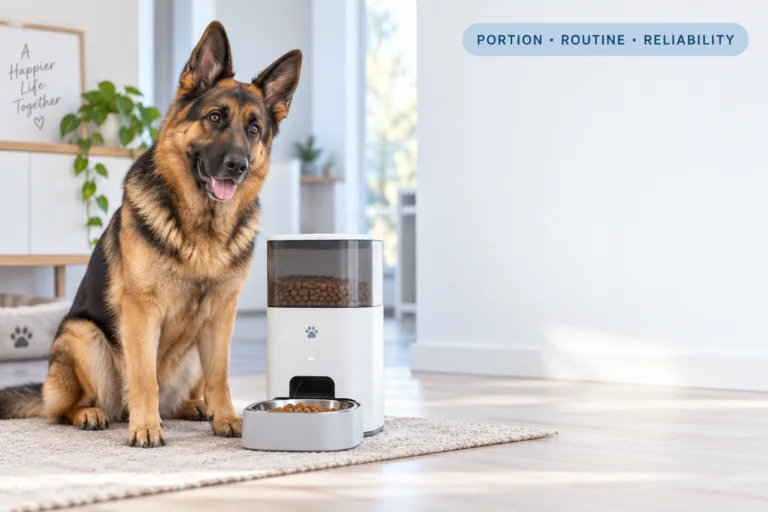
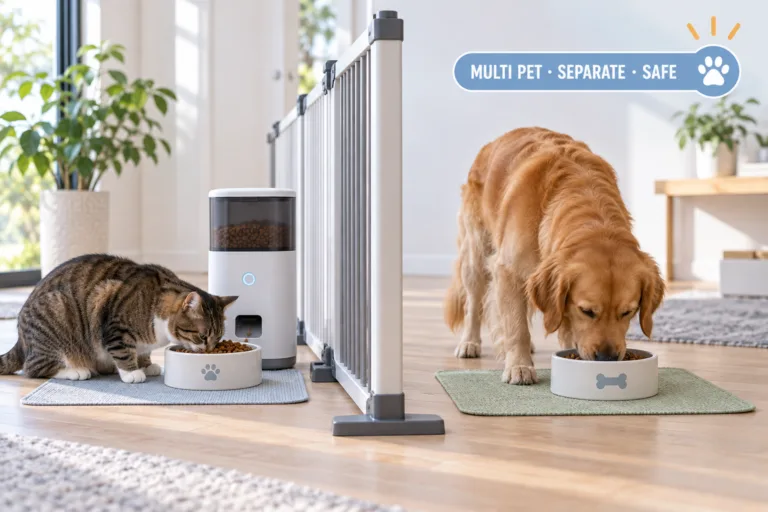
A heavy duty automatic dog feeder should remain stable, secure, and accurate when used by a large, food-motivated, or physically strong dog. The important question is not whether the feeder looks rugged. It is whether the lid stays closed, the base stays in place, the dispensing system handles the dog’s kibble, portions remain consistent, and the machine keeps working when the owner is away.
For households that need more food capacity and a simpler feeding routine, a large-capacity automatic pet feeder can be a practical starting point. Capacity helps, but a strong feeding setup still depends on placement, calibration, cleaning, and household rules.
Direct Answer: Heavy Duty Automatic Dog Feeder
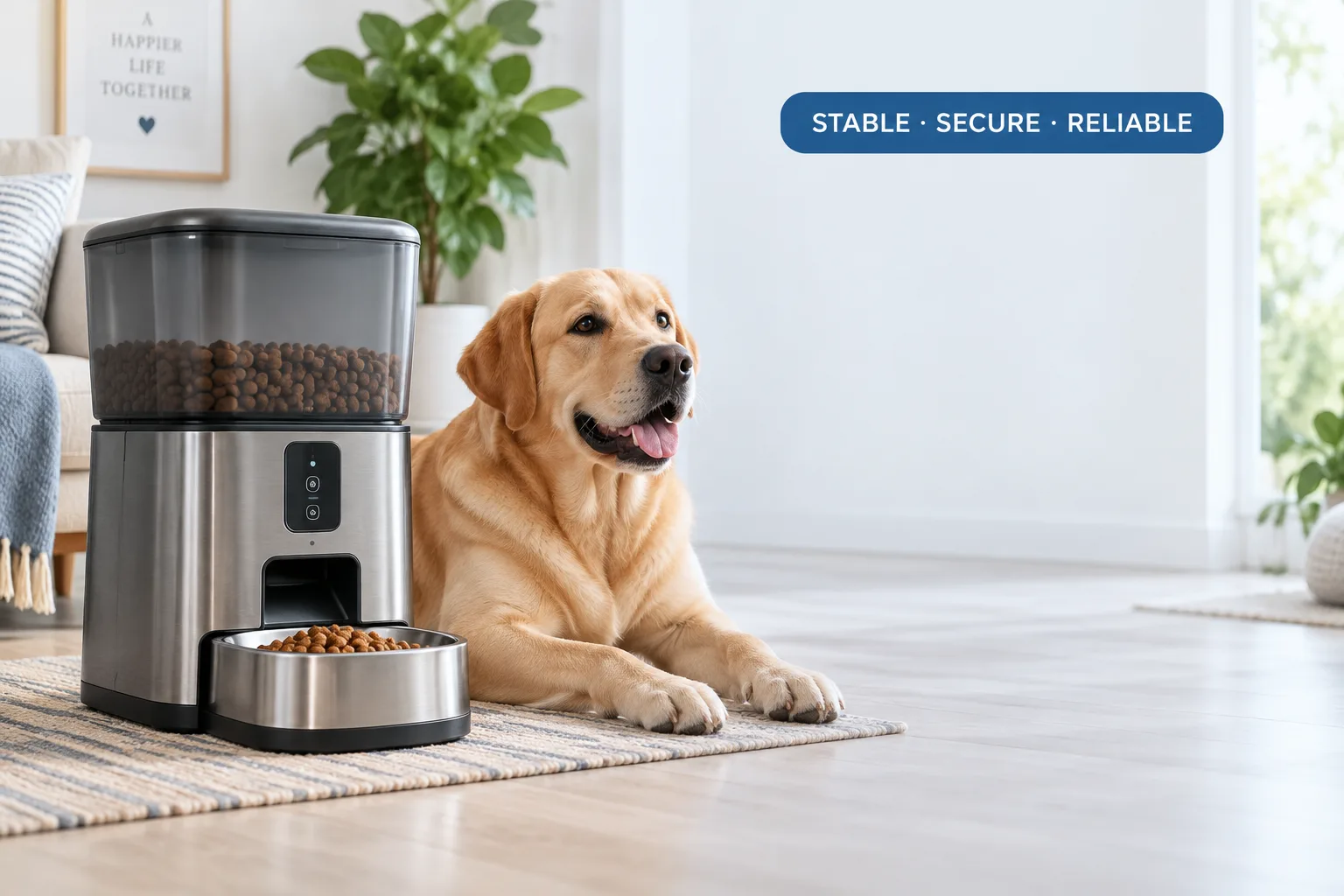
A heavy duty automatic dog feeder should combine a stable base, secure hopper, reliable portion control, suitable kibble compatibility, easy-clean food-contact parts, and dependable backup options. A feeder is not heavy duty because it has a large hopper or thick-looking plastic. It earns that role when it can handle repeated daily use without tipping, opening, jamming, or delivering inconsistent meals.
For large dogs, these weaknesses appear faster. A strong dog can push a light feeder across the floor, paw at the food outlet, bump the hopper, or discover a loose lid. Larger meal volumes also magnify portion errors. That is why durability and feeding accuracy must be evaluated together.
Why Large and Food-Motivated Dogs Stress Feeders More
A small feeder can work perfectly in a calm household and fail quickly when placed in front of a powerful dog. The dog may lean into the bowl, paw the dispenser, nose the lid, or move the entire machine while trying to reach food. If the feeder shifts every day, cables become exposed, bowls separate from the chute, and the dog learns where weak points are located.
The same problem occurs inside the machine. Larger kibble can bridge inside a narrow hopper or catch in a rotor. Larger meal volumes mean more dispensing cycles, more mechanical movement, and more opportunities for crumbs and oils to build up around the chute.
A heavy duty automatic dog feeder therefore needs to manage both physical pressure and feeding consistency. Owners comparing equipment for bigger dogs can also review this automatic dog feeder for large dogs guide before choosing capacity or control features.
What To Do: Check These 6 Features Before Buying
1. Test Stability Before You Trust Capacity
A large hopper does not help if the whole unit slides across the floor. Look for a broad footprint, a low center of gravity, non-slip contact points, and a bowl area that does not detach easily during normal eating. Place the feeder on a level surface and test it while the dog is supervised.
If the dog pushes the machine several inches during a meal, change the placement before relying on it alone. A wall can help prevent backward movement, but do not wedge the feeder into a tight space where the dog cannot stand naturally.
2. Check Whether the Lid Is Actually Secure
Food-motivated dogs quickly discover lids that lift, twist, or flex under pressure. A heavy duty automatic dog feeder needs a hopper closure that cannot be casually opened with a nose or paw. The food outlet should also limit direct access to the stored kibble.
Do not test security by intentionally encouraging the dog to attack the feeder. Instead, observe normal behavior during supervised meals. If the dog immediately starts pawing, biting, or lifting parts, the setup needs a stronger boundary or different placement.
3. Match the Dispensing Mechanism to the Kibble
Kibble compatibility matters more than advertised hopper volume. Large, irregular, oily, or unusually shaped pieces can feed poorly through some mechanisms. Before using the machine unattended, run several complete meal cycles with the exact food your dog eats.
If output becomes inconsistent, review how anti-jam pet feeders work and check whether kibble dimensions match the feeder’s supported range. A strong housing cannot compensate for a dispensing path that does not fit the food.
4. Calibrate Portions With Real Measurements
Automatic feeder portions are not universal. One programmed unit can deliver a different amount depending on kibble size and density. Dispense several test meals, weigh each one, calculate the average, and compare the result with the dog’s actual daily feeding plan.
This pet feeder calibration guide explains why owners should measure real output instead of assuming the display equals a standard cup or gram amount. For a large dog, small errors repeated twice a day can become meaningful over several weeks.
5. Build in a Failure Backup
A heavy duty automatic dog feeder still depends on power, batteries, moving parts, and available food. A durable shell does not prevent a power outage or an empty hopper. Use fresh backup batteries when supported, check food level regularly, and confirm that the feeder actually dispensed rather than assuming the schedule ran correctly.
Owners concerned about outages can compare their setup with a pet feeder with battery backup. Backup power should be treated as one layer of reliability, not permission to stop checking the device.
6. Choose Parts You Will Actually Clean
A feeder used by a large dog handles more food and usually produces more crumbs. Removable bowls, accessible chutes, and washable food-contact parts make routine cleaning realistic. If cleaning requires dismantling the entire unit every time, owners are more likely to postpone it.
Follow a regular automatic pet feeder cleaning routine before odor, grease, or old crumbs affect food quality or dispensing performance.
The Feeding Loop Behind a Strong Dog and a Weak Feeder
The feeding loop often begins with one successful attempt to access extra food. The dog paws the feeder, the hopper shifts, and a few pieces fall out. That accidental reward teaches the dog that physical pressure can produce food. The next attempt becomes stronger and more persistent.
The owner then reacts by standing near the feeder, pushing the dog away, or handing over food to stop the behavior. That attention creates a second reward. The dog now learns that attacking the feeder can produce either kibble or human interaction.
A heavy duty automatic dog feeder should reduce this loop by limiting movement and access, but the household still needs clear rules. Do not reward pawing with food. Move the feeder to a more secure position, protect exposed cords, and use scheduled portions rather than manual bonus feeding.
The Emotional Trigger Owners Miss
Owners often assume that a large dog standing beside the feeder must still be hungry. That assumption leads to extra portions even when the scheduled meal was complete. The dog then learns that remaining near the machine or staring at the owner can produce another reward.
Food interest is not an accurate portion measurement. Use the dog’s planned daily calories, body condition, activity level, and actual feeder output. The AAFCO consumer resources can help owners understand feeding directions, nutritional adequacy statements, calorie information, and pet-food labeling.
A predictable routine makes the feeder less emotionally charged. The machine dispenses, the dog eats, and the feeding event ends. Attention after that can come through walking, training, play, or calm interaction instead of extra food.
The Addiction Mechanism: Why Feeder Attacks Can Become a Habit
This is not chemical addiction. It is reinforcement through repeated reward. The dog paws the feeder, hears kibble move, smells food more strongly, and occasionally receives a piece. Even an inconsistent reward can keep the behavior active because the dog learns that another attempt might work.
Owners can reinforce the same cycle accidentally. They hear the feeder being pushed, enter the room, talk to the dog, and add food to redirect attention. The behavior has now produced both interaction and calories.
Break the pattern by removing access to weak points and making failed attempts unrewarding. A heavy duty automatic dog feeder should support that goal through stability and security, while the household maintains consistent rules around meals.
Common Failure Pattern: Buying the Biggest Hopper First
A family chooses the largest feeder available because their dog eats large meals. The capacity is excellent, but the base is light, the lid is easy to lift, and the kibble occasionally jams. Within days, the dog learns to push the unit against the wall and paw at the outlet. The family starts manually topping up missed meals and the automatic routine collapses.
The failure came from using capacity as a substitute for system quality. The fix is to evaluate stability, lid security, kibble fit, portion accuracy, and backup reliability before treating hopper size as the deciding feature.
Real-World Impact of Choosing the Wrong Feeder
A weak setup creates problems slowly. Extra kibble falls out after the dog paws the machine. Missed portions are compensated by hand. The household loses track of how much food was actually eaten. Over time, the feeder that was supposed to improve consistency creates more uncertainty.
Weight gain is one of the clearest consequences. Large dogs can accumulate excess calories quickly when scheduled meals are combined with treats and manual top-ups. The AVMA healthy pet weight guidance emphasizes monitoring body condition, nutrition, and activity together rather than relying only on package feeding directions.
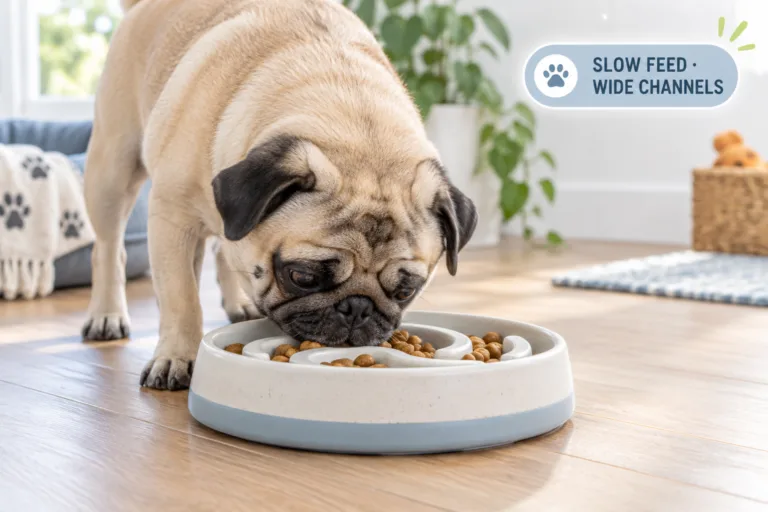
Fast eating can also remain a problem even when portions are accurate. A feeder controls when food appears, not how quickly the dog swallows it. Owners dealing with rapid eating can combine smaller scheduled portions with a slow feeder strategy for large breeds.
Can a Weak Heavy Duty Feeding Setup Be Fixed?
Yes, when the problem comes from placement, calibration, cleaning, kibble compatibility, or household inconsistency. Empty the feeder, clean the dispensing path, verify the kibble size, measure several test portions, secure the location, and confirm backup power before rebuilding the schedule.
If the dog can open the hopper, the physical setup needs to change. If meals jam, address kibble compatibility. If portions vary, recalibrate. If weight increases while the machine dispenses correctly, review total daily calories rather than blaming the feeder.
A useful system should let the owner answer four questions quickly: Is there enough food in the hopper? Did the scheduled meal dispense? Was the correct amount released? Did the dog actually eat it?
Who Should Use This and Who Should Choose Another Feeding Method?
A heavy duty automatic dog feeder is well suited to households with large dogs, strong food motivation, changing work hours, or several family members who need one controlled feeding schedule. It is especially useful when measured dry-food portions need to appear at predictable times.
Choose another setup when the dog repeatedly destroys feeders, chews electrical parts, requires food that cannot be dispensed safely, or needs direct observation at every meal. Dogs with severe food guarding also require management that goes beyond automatic dispensing.
Owners comparing models for larger dogs can explore the dog feeder range for scheduled feeding and match the device to the dog’s actual food, strength, and daily routine rather than buying by hopper volume alone.
Mini FAQ
What makes a heavy duty automatic dog feeder different?
It should tolerate repeated use while remaining stable, secure, and accurate. A strong feeder needs more than a large hopper. Check the base, lid, dispensing mechanism, bowl connection, kibble compatibility, and backup options.
Is a large hopper enough for a big dog?
No. Capacity only determines how much food can be stored. The feeder must still dispense the dog’s kibble consistently and resist tipping or forced access. Evaluate reliability before choosing the largest container.
Can a strong dog break into an automatic feeder?
Yes, when the lid, outlet, or base provides an accessible weak point. Supervise initial use, correct unstable placement, and stop using a model that the dog can open or damage repeatedly.
How do I know whether the portions are accurate?
Measure several real dispensing cycles. Weigh each portion with the dog’s normal kibble and calculate the average. Adjust the programmed amount until the actual output matches the feeding plan.
Does a heavy duty automatic dog feeder stop fast eating?
Not by itself. It can divide the daily allowance into smaller scheduled meals, but it does not control swallowing speed. Use a suitable slow-feeding bowl when rapid eating continues.
Should a heavy duty feeder have battery backup?
Backup power is useful when meal timing must continue during short outages. It does not protect against an empty hopper, jammed food, or mechanical damage. Keep manual food available and inspect the feeder regularly.
For owners prioritizing food capacity and a straightforward schedule, a large-capacity automatic pet feeder can support measured daily meals. A heavy duty automatic dog feeder succeeds when the entire system stays predictable under real household use. Choose stability over appearance, secure food access, verify portion output, test the actual kibble, and build a backup plan before relying on the feeder alone.