
A feeding guide for Ragdoll cats should begin with calories and body condition, not the cat’s impressive size. Ragdolls are large, slow-maturing cats with substantial frames, but a large body does not automatically require an unlimited bowl. The correct feeding plan changes with age, activity, reproductive status, food energy density, and current weight.
For households that need consistent portions, a smart automatic feeder with app control can divide measured dry food into scheduled meals. It supports the routine, but it does not decide how many calories a particular Ragdoll needs.
What a Feeding Guide for Ragdoll Cats Should Actually Measure
The most useful feeding guide for Ragdoll cats measures daily calories, body condition, and weight trend. A food label gives you a starting amount, but the label is written for an average cat. A calm indoor Ragdoll that sleeps most of the day can need fewer calories than a highly active young cat, even when both cats are the same breed.
VCA describes Ragdolls as large, muscular cats that can take up to four years to fully mature. Some males can reach about 20 pounds, but that figure is not a target weight for every Ragdoll. The breed is also prone to obesity when activity is low. A full food bowl can therefore create excess weight long before the owner realizes that the cat is carrying too much fat.
Use the VCA Ragdoll breed profile to understand the breed’s frame and maturity pattern, then judge your own cat by rib coverage, waist shape, muscle condition, and weight history.
Portions by Life Stage
A Ragdoll kitten, adult, and senior cat should not automatically receive the same food or meal frequency. The following framework gives you a useful starting structure:
- Kittens under six months: Three measured meals per day usually support growth better than one large meal. Use food labeled complete and balanced for growth or all life stages.
- Kittens from six to twelve months: Two or three meals can work, depending on appetite, growth, activity, and body condition. Continue weighing the food rather than filling the bowl by eye.
- Adults from about one year: One or two scheduled meals are suitable for many cats. Indoor Ragdolls often benefit from controlled portions because low activity makes free feeding risky.
- Senior Ragdolls: Keep the routine stable while monitoring muscle, weight, appetite, thirst, and litter-box habits. A sudden change in eating behavior requires professional assessment.
Ragdolls can continue developing physically after their first birthday, but that does not mean they should receive unlimited kitten food for years. Choose food according to the nutritional adequacy statement and life-stage guidance on the package. The Cornell feline nutrition guide explains why complete and balanced food matters more than marketing language or ingredient trends.
Wet Food, Dry Food, or a Combination?
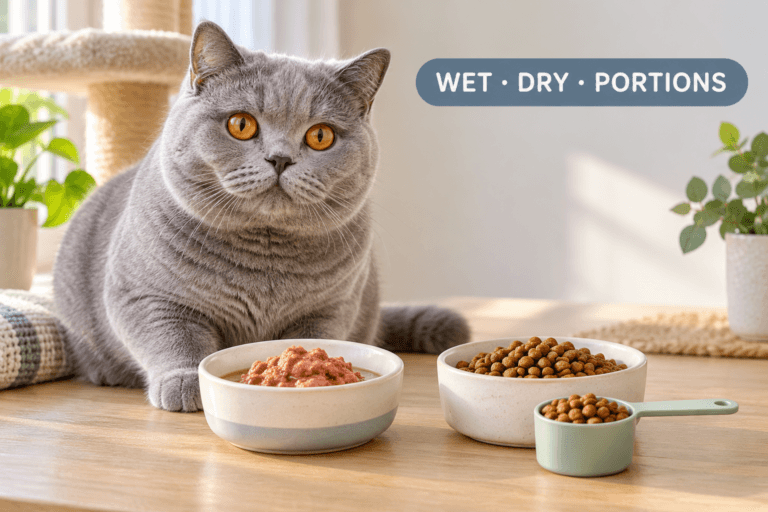
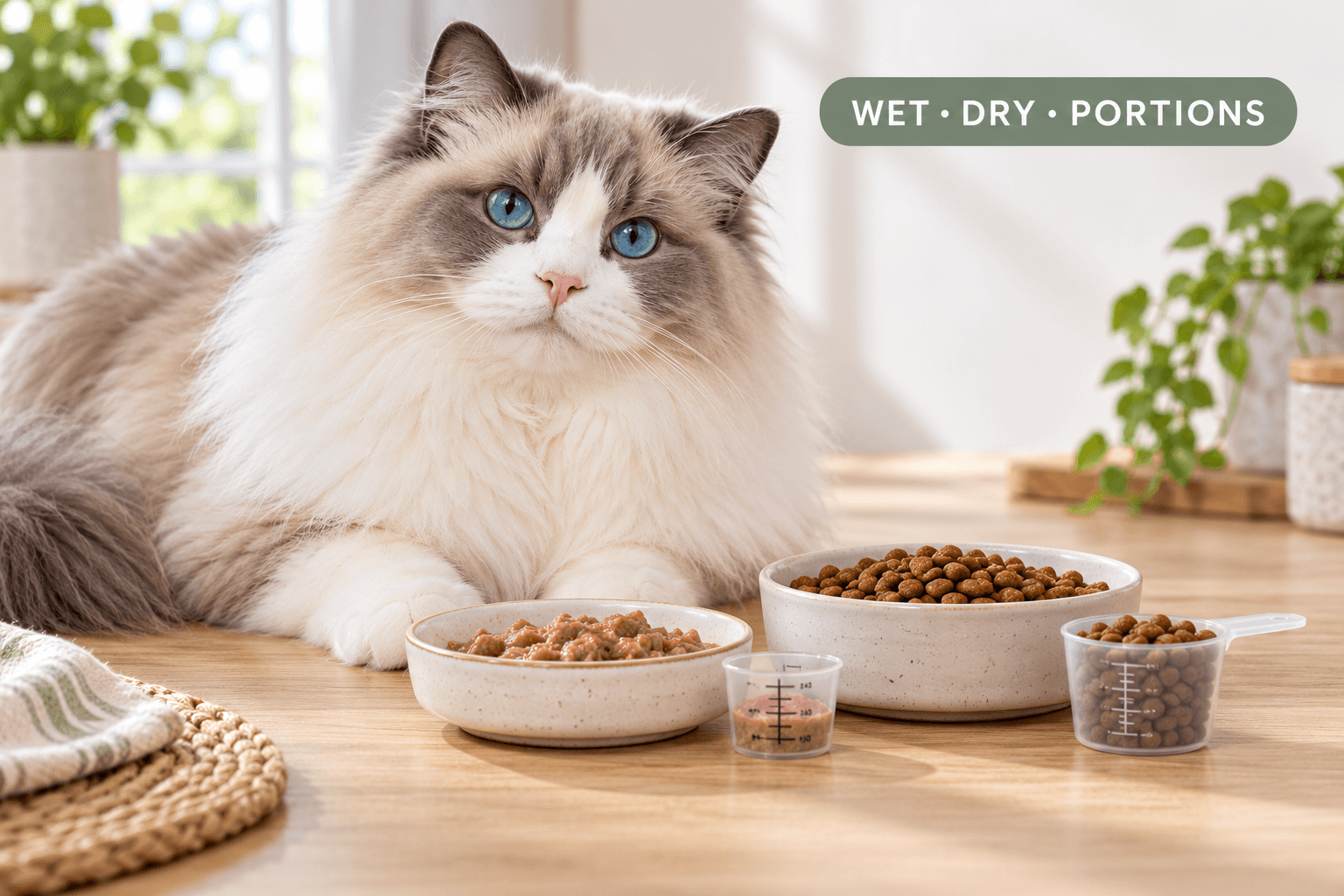
Wet food and dry food can both fit a healthy Ragdoll feeding plan when the total diet is nutritionally complete and balanced. The important difference is calorie density. Dry food contains little water and can deliver many calories in a small volume. Wet food contains much more moisture and often creates a larger-looking meal for fewer calories.
Wet food can support water intake, which is useful for cats that drink very little. Dry food is convenient and works well in measured automatic feeders. A combination of both can provide variety, but calculate the total daily calories across the two foods instead of adding a full dry-food portion to a full wet-food portion.
Read the calorie information on both labels. One can of food is not automatically one meal, and one scoop of kibble is not automatically one serving. A kitchen scale gives more reliable portions than a measuring cup, especially when kibble size and shape change between formulas.
How to Check Whether the Portion Is Working
A feeding guide becomes useful only when you compare it with the cat in front of you. Check your Ragdoll from above and from the side. You should be able to feel the ribs beneath a light layer of fat, see some narrowing behind the ribs, and notice an abdominal tuck rather than a continuously rounded underside.
Long fur can hide weight gain. Run your hands over the ribs and spine instead of judging only by appearance. Weigh the cat regularly under consistent conditions and record the result. A slow upward trend matters even when the cat still looks attractive and fluffy.
The Cornell guide to feline obesity explains how rib checks, profile checks, and overhead checks help identify excess body fat. These checks are more useful than comparing your cat with photographs of other Ragdolls.
The Free-Feeding Trap
Free feeding looks convenient because the cat always has access to food. It becomes a problem when the owner cannot tell how much the cat is eating. A quiet Ragdoll can graze throughout the day, receive treats from several family members, and gain weight without any single feeding looking excessive.
The behavior loop is straightforward: the cat approaches the bowl, finds food, and repeats the visit whenever it feels bored or mildly hungry. The owner interprets the repeated visits as proof that the cat needs more food. The result is an inconsistent calorie surplus.
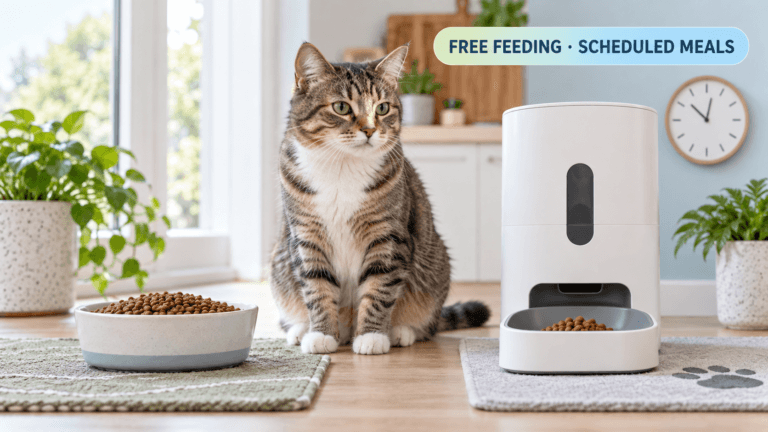
Scheduled meals create a clearer boundary. Divide the daily ration into two or more portions, offer food at predictable times, and avoid topping up the bowl simply because the cat asks. A structured pet feeding schedule also makes it easier to notice when appetite changes.
Common Failure Pattern: Feeding to Match the Cat’s Appearance
A common mistake is feeding a Ragdoll according to how large the cat looks. A broad chest, heavy coat, and long body can create the impression that the cat needs a large portion. That visual judgment is unreliable because frame size and body fat are not the same thing.
The correction is to weigh the food, record the cat’s weight, and assess body condition every few weeks. If the cat is gaining fat, reduce the daily calorie intake gradually with guidance from a veterinary team. Never place an overweight cat on a sudden starvation diet because rapid food restriction can trigger serious liver problems.
Treats count as calories too. Cornell recommends keeping treats to roughly 10 to 15 percent of daily calorie intake. Set aside part of the regular kibble for training, grooming cooperation, or interactive play instead of adding treats on top of every meal.
Using an Automatic Feeder for a Ragdoll
An automatic feeder is useful when the challenge is consistency. It can divide dry food into smaller servings, prevent different family members from serving duplicate meals, and maintain a routine when nobody is home at the usual feeding time.
Calibrate the device with the actual food you plan to use. Weigh several dispensed portions, calculate the average, and compare the result with the daily amount in your feeding plan. The pet feeder calibration guide can help prevent a small programming error from becoming a daily calorie surplus.
Clean the bowl and food pathway regularly. If you use wet food, choose equipment designed for that purpose and follow its storage limits. An automatic feeder should improve portion control, not encourage you to fill the hopper and ignore the cat’s changing condition.
Mini FAQ
How much food should a Ragdoll cat eat?
Start with the calorie guidance on a complete and balanced food. Then adjust the measured daily portion according to age, activity, reproductive status, body condition, and weight trend.
How many times a day should I feed a Ragdoll?
Adults often do well with one or two scheduled meals, while kittens need more frequent meals. Divide the total daily ration instead of giving a separate full portion at every feeding.
Are Ragdoll cats prone to obesity?
Yes, especially when activity is low and dry food is freely available. Use measured meals, provide daily play, and check the ribs and waist regularly.
Is wet food better for Ragdoll cats?
Wet food can support hydration and portion awareness, but it is not automatically superior. Choose complete and balanced food, compare calories, and include wet food within the total daily ration.
Can Ragdolls eat dry food only?
Some Ragdolls can remain healthy on a complete and balanced dry diet. Measure the food carefully, provide fresh water, and monitor body condition because dry food is calorie-dense.
Should I feed my Ragdoll based on its expected adult weight?
Expected adult size can help select a food, but it should not determine an unlimited portion. Use the label as a starting point and adjust based on current growth, weight, and body condition.
The best feeding guide for Ragdoll cats is a repeatable system: choose complete and balanced food, measure calories, divide meals by life stage, count treats, and check body condition beneath the coat. A regular-feeding smart pet feeder can keep the schedule consistent, but healthy portions still come from ongoing observation rather than the cat’s size alone.