
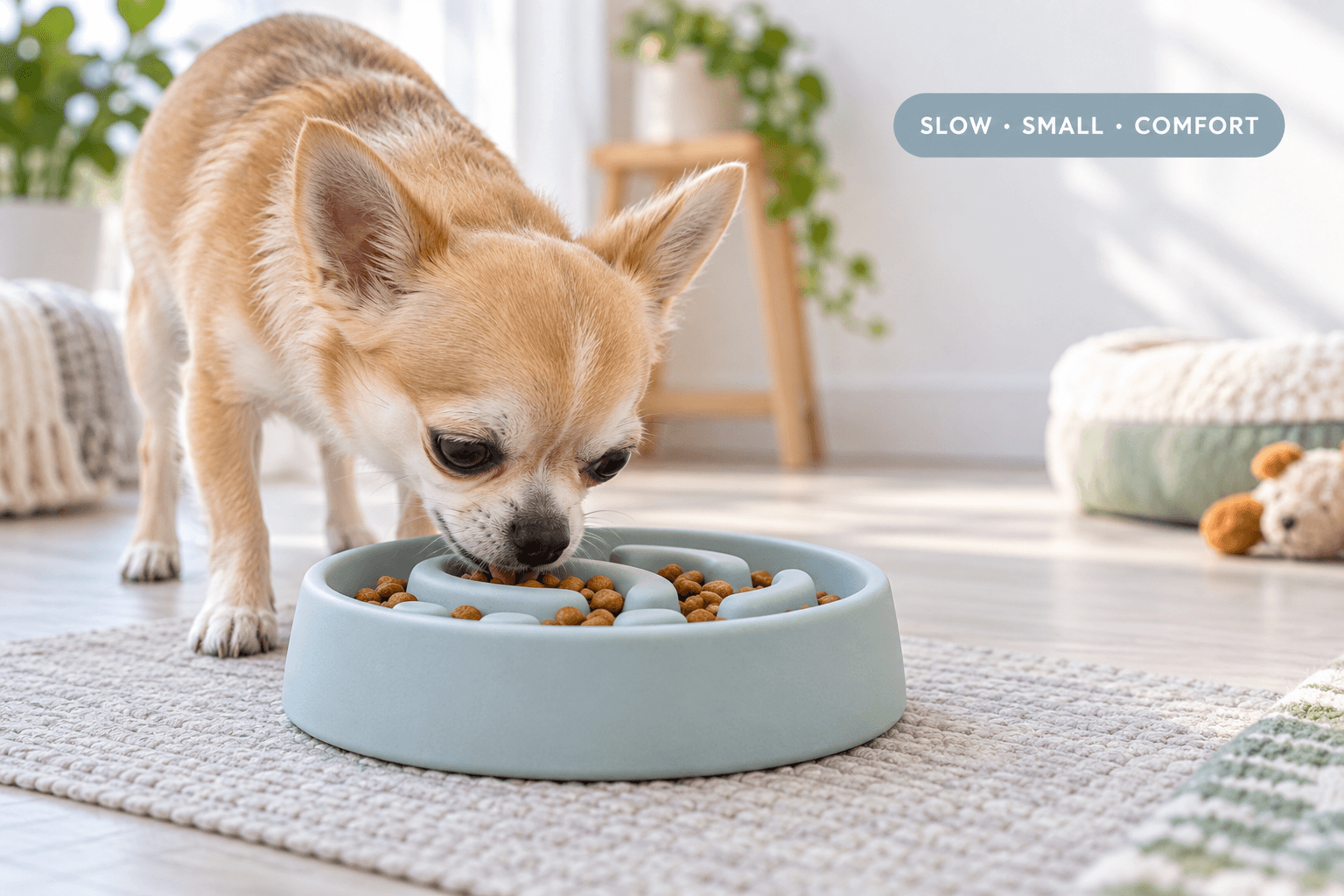
A Chihuahua slow feeder bowl can make a fast meal last longer, but an oversized or tightly grooved design can turn dinner into a frustrating puzzle. For a tiny dog, check that the bowl stays put, the kibble fits through the channels, and your Chihuahua can reach every piece without pushing or pawing at the bowl.
If your Chihuahua gulps meals, a timed slow-feed bowl is one option to test. Start with supervision and a normal measured meal—the goal is a calmer pace, not simply the longest possible eating time.
Direct Answer: Chihuahua Slow Feeder Bowl
A Chihuahua slow feeder bowl is worth trying when it has shallow, accessible channels sized for the dog’s kibble. Avoid deep mazes that trap pieces or force a small dog to shove its nose into narrow gaps. Test the bowl during a regular meal, watch for signs of frustration, and switch to a simple plate or another feeding method if your Chihuahua struggles to finish.
Why This Happens
Slow feeders use ridges or compartments to interrupt rapid eating. But Chihuahua sizes, muzzle shapes, kibble sizes, and eating styles vary. A bowl designed for a medium or large dog may have channels that are too deep or wide for a Chihuahua’s small mouth and portion.
There is also a difference between slowing a meal and making food difficult to reach. If kibble lodges in corners, the dog may paw at the bowl, flip it, or leave pieces behind. A bowl that takes longer because the dog is frustrated is not a successful solution.
A small study published through the University of Bristol found that a tested slow-feeder design reduced eating speed in the dogs studied, although the dogs became faster with experience. That does not establish that every design works for every breed. Read the study summary at the University of Bristol’s slow-feeder research record.
Fast eating can also have other causes, including competition or irregular meal routines. VCA notes that interactive feeders and other pacing approaches may help some fast eaters. Its guide to slowing a fast-eating dog offers several options beyond a maze bowl.
What To Do
Match the channels to the kibble
Measure several pieces of your Chihuahua’s regular food and inspect the feeder’s narrowest spaces. Kibble should move through the channels without wedging. If you feed more than one food shape, test each separately; a bowl that works with small round pieces may trap larger or irregular kibble.
Look for a compact, low-profile design
Choose a bowl that does not overwhelm the dog’s feeding area. Broad, low ridges are usually easier to navigate than tall, intricate dividers. There is no single bowl dimension that fits every Chihuahua, so use your dog’s reach and comfort as the test.
Check stability and cleanability
A light bowl may slide as a small dog nudges it around. Look for a non-slip base and a shape that does not tip easily. Check that you can reach every groove with a brush or sponge; trapped oily crumbs make the feeder harder to keep clean.
Introduce it gradually
Begin with part of the measured meal in the slow feeder and the rest in your Chihuahua’s familiar bowl. If the dog stays relaxed and reaches the food easily, increase the amount in the new bowl. If your Chihuahua avoids it, paws repeatedly, or leaves food trapped, change to an easier design.
Keep the daily amount measured
A slow feeder changes how the food is delivered, not how much the dog needs. Measure the full daily ration and include treats and training rewards. The smart dog-feeding guide can help keep portions and meal timing consistent.
Try a simpler alternative if needed
If even a shallow maze is awkward, spread the same measured meal across a flat tray or divide it into several smaller servings. These approaches can slow access without requiring the dog to reach around tall ridges. See more ways to slow a dog that inhales food.
Common Failure Pattern: The Bowl Was Bigger Than the Meal
An owner buys a large maze bowl because it looks more challenging, but a Chihuahua’s small serving covers only a few sections. The dog finishes those pieces quickly while the rest of the bowl adds no useful pacing. A compact design matched to the portion and kibble gives the dog a fair chance to work through the meal without wasting space or trapping food.
The Feeding Loop Behind This Problem
The loop often begins when a Chihuahua sees food and gulps it before another pet can approach. The bowl empties quickly, the owner worries about the speed, and a more complicated feeder is introduced. If that feeder is hard to use, the dog may paw at it or eat awkwardly, turning the meal into a new source of stress.
A Chihuahua slow feeder bowl should interrupt rapid eating while preserving comfortable access. If competition is driving the speed, feed the dog separately; a puzzle bowl will not remove pressure from another animal nearby.
The Emotional Trigger Owners Miss
It is tempting to choose the most elaborate bowl because it promises the biggest slowdown. But difficulty is not the same as benefit. Owners may also worry that a simple plate means the dog is “winning” or that the problem has not been solved.
Judge the setup by what happens at mealtime: the dog can reach the food, remains reasonably calm, and finishes the measured portion. If those conditions are not met, make the setup easier rather than pushing through frustration.
The Reinforcement Mechanism
Fast eating is not an addiction. It can become a repeated habit when meals are exciting, competitive, or delivered inconsistently. If the dog learns that gulping secures food before another pet arrives, that pattern may continue.
Use predictable meal times, separate pets when necessary, and keep portions steady. Give your Chihuahua time to learn a new bowl, but do not reward frantic pawing by adding extra food or repeatedly changing the meal.
Real-World Impact
A poor fit can leave food uneaten, frustrate the dog, or make cleaning difficult. A good fit may slow some dogs, but no bowl guarantees prevention of choking, vomiting, or other medical problems. If your Chihuahua coughs, repeatedly gags, regurgitates, or has trouble swallowing, treat that as more than a bowl-selection issue.
Small dogs also need carefully measured portions because even a modest extra snack can matter relative to their daily intake. The VCA Chihuahua care overview notes that small snacks can add up for a small dog. Keep treats within the overall daily plan.
For broader food choices and portion habits, use the pet nutrition guide. A slower bowl does not compensate for an oversized ration.
Can This Be Fixed?
Yes, fast eating can often be managed with a bowl that fits, a measured routine, and less competition at meals. Test one change at a time so you can tell whether the bowl, serving size, or feeding location is helping.
If the Chihuahua slow feeder bowl makes the dog struggle, stop using that design. Move to shallower channels, a tray, or smaller scheduled servings. Persistent coughing, gagging, regurgitation, or an abrupt change in appetite calls for professional assessment rather than another bowl experiment.
Who Should Walk Away and Who Should Use This
Skip deep maze bowls if your Chihuahua cannot reach the bottom, gets kibble stuck, slides the bowl across the floor, or becomes distressed while eating. Also avoid a design that cannot be cleaned thoroughly or does not fit the dog’s food.
A compact slow feeder may suit a Chihuahua that eats quickly but can comfortably navigate shallow channels. Supervise the first meals and check that the dog finishes the planned portion. A product such as a timed slow-feed bowl can support that routine when its size and design fit the individual dog.
Mini FAQ
What kind of Chihuahua slow feeder bowl should I choose?
Choose a compact bowl with shallow channels that match your dog’s kibble. Deep or narrow grooves can trap food and frustrate a small dog. Test a normal measured meal and switch designs if your Chihuahua cannot reach the pieces easily.
Can a slow feeder be too difficult for a Chihuahua?
Yes, an overly complex maze can make eating harder instead of calmer. Tiny portions may sit awkwardly in a large bowl, and narrow spaces can trap kibble. Use a simpler, smaller design or spread the food on a tray.
Will a slow feeder stop my Chihuahua from choking?
No bowl can guarantee that a dog will not choke. A slow feeder may change the pace of eating, but it does not diagnose swallowing or breathing problems. Stop using a design that causes coughing or gagging and seek professional assessment for persistent symptoms.
How do I know if the bowl fits my Chihuahua?
The bowl fits when your dog reaches all the food without pawing, straining, or repeatedly giving up. Kibble should not wedge in the grooves, and the bowl should stay stable. Watch a full meal and adjust the design based on what you see.
What can I use instead of a Chihuahua slow feeder bowl?
A flat tray or several smaller measured meals can be easier alternatives. These methods spread out access without tall dividers. Keep the total daily ration unchanged and supervise the first attempts.
A Chihuahua slow feeder bowl can help when it fits the dog, the kibble, and the portion. Choose compact, shallow channels; test the bowl during a normal meal; and switch to a simpler surface if food gets trapped or your dog becomes frustrated. The best bowl is not the most complicated one—it is the one your Chihuahua can use comfortably and consistently.