
A microchip pet feeder review should start with the real problem: food access. A microchip feeder is not mainly about feeding on a timer. It is about controlling which pet can open the bowl. That makes it useful in multi-pet homes where one cat steals another cat’s food, a dog raids the cat bowl, or one pet needs a special diet that should not be shared.
For owners who need scheduled meals instead of identity-based access, a smart automatic pet feeder with app control may solve the routine better. The point of this microchip pet feeder review is to separate access control from timing control so owners do not buy the wrong feeder for the wrong problem.
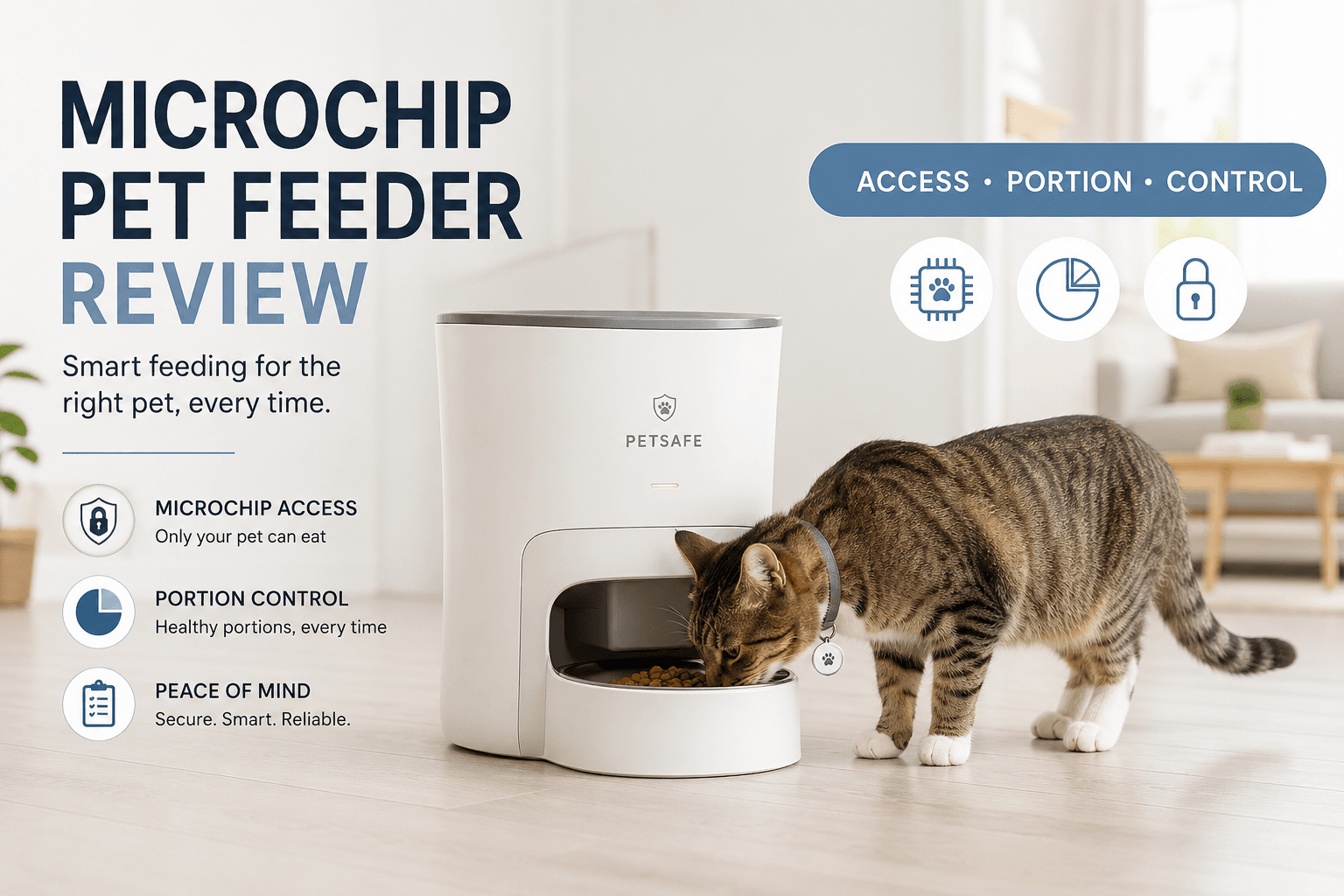
Direct Answer: Microchip Pet Feeder Review
A microchip pet feeder is best for multi-pet homes where the main problem is food stealing, diet separation, or protecting one pet’s bowl from another pet. It uses an implanted microchip or RFID collar tag to open only for the assigned pet. It is less useful when the owner mainly needs timed meals, remote app control, camera verification, large dry-food capacity, or automatic portion scheduling.
The strongest conclusion from this microchip pet feeder review is simple: choose a microchip feeder when the right pet must access the right bowl. Choose a timed smart feeder when the right meal must appear at the right time. Choose a camera feeder when the owner needs proof that the pet actually ate. These problems overlap, but they are not identical.
Why This Happens
Multi-pet feeding problems are rarely solved by a normal bowl. In a shared home, the fastest pet may eat first, the boldest cat may guard the station, a dog may steal cat food, or a shy pet may leave food because another animal is nearby. The owner may think one pet is “not hungry,” when the real problem is access pressure.
The AVMA’s microchipping FAQ explains that pet microchips are identification devices and are not GPS trackers. For feeder use, that distinction matters. A feeder does not track the pet’s location. It reads an ID signal at close range and uses that ID to open the feeding area.
A microchip pet feeder review should also be clear about compatibility. Not every feeder reads every chip type, and some pets use RFID collar tags instead of implanted microchips. Owners should check the feeder’s compatibility list, test the reader before relying on it, and keep backup feeding access ready during training.
What To Do First
Start by identifying the failure point. Is one pet stealing food? Is a dog eating cat food? Is one cat on a prescription diet? Is one pet overweight because it raids bowls? Is a shy cat not eating because another pet crowds the feeding station? If yes, a microchip feeder deserves serious consideration.
If the problem is early-morning feeding, shift work, travel, missed meals, or remote meal scheduling, a microchip feeder may not be the first solution. A microchip pet feeder review should not pretend that identity access replaces a feeding schedule.
Use how to stop one cat from eating the other’s food before buying. Access control, placement, supervision, and meal timing should be evaluated together.
The Feeding Loop Behind Multi-Pet Bowl Problems
The feeding loop starts when one pet eats faster or behaves more boldly. That pet finishes its own food and moves to another bowl. The slower pet leaves or waits. The owner sees an empty bowl and assumes both pets ate correctly. The wrong pet gains weight, while the right pet may miss food.
Then the owner adds more food because one pet seems hungry. The stealing pet receives even more calories. The shy pet still may not get a protected meal. The bowl looks full, but the access system is broken.
A microchip pet feeder review must judge whether the feeder breaks that loop. A good microchip feeder gives the assigned pet a protected eating window and blocks other pets from turning the household into a shared buffet.
The Emotional Trigger Owners Miss
The emotional trigger is fairness. Owners want every pet to eat comfortably. When one pet steals food, the owner often responds with more bowls, more food, more locations, or more treats. That can create more confusion instead of more fairness.
A microchip feeder can make feeding feel more fair because it gives the assigned pet private access. But fairness still requires measurement. If the protected bowl is always full and never checked, the owner still lacks control.
For measured daily feeding, use scientific pet feeding schedule. The best microchip pet feeder review outcome is not only “the right pet can open the bowl.” It is “the right pet gets the right amount.”
The Addiction Mechanism
The addiction mechanism is stealing reward. If a cat or dog repeatedly steals food and succeeds, the behavior becomes stronger. The pet learns which bowl is easiest, which owner reacts slowly, and which feeding station has the best reward.
Microchip feeders reduce this reward by blocking access. That is the real behavioral advantage. The stealing pet can approach, but the lid does not open. Over time, the reward pathway weakens because the behavior stops paying.
A proper microchip pet feeder review should score this highly for multi-pet homes. The feeder does not train with words. It changes the food-access result. That is often more effective than repeatedly telling a pet to leave another pet’s bowl alone.
How a Microchip Feeder Works
A microchip feeder usually has a covered bowl and a reader near the front. When the assigned pet approaches, the feeder reads the pet’s implanted microchip or approved RFID collar tag. If the ID matches the stored profile, the lid opens. If another pet approaches, the lid stays closed.
Some feeders use only microchips. Some support RFID collar tags. Some include training modes that slowly increase lid movement. Some track access in an app. Some are simple access-control bowls without remote features.
This microchip pet feeder review uses one core standard: the reader must work reliably for the actual pet in the actual feeding location. A feeder that opens perfectly in a product video but fails when the cat approaches at an angle is not ready for unsupervised feeding.
Microchip Feeder vs Timed Feeder
A microchip feeder controls who can eat. A timed feeder controls when food appears. This is the most important comparison. Many owners confuse the two and then feel disappointed.
If the pet needs breakfast at 6:00 a.m., a timed feeder is the better tool. If the pet needs its own food protected from another pet all day, a microchip feeder is the better tool. If both problems exist, the owner may need a combined system, separate stations, or a different feeding plan.
Use digital timed pet feeder comparison when the main question is timer, app, camera, or battery backup. A balanced microchip pet feeder review should not force a selective feeder into a timing role it was not built to handle.
Microchip Feeder vs Camera Feeder
A camera feeder helps the owner see what happened. A microchip feeder controls who can access food. These are different forms of control. A camera may show that the wrong pet is stealing food, but it does not stop the stealing by itself.
A microchip feeder may stop stealing, but it does not always show the owner how much the pet ate unless the model includes tracking features. The owner still needs to inspect leftovers and measure food.
A smart WiFi pet feeder with camera is useful when meal verification matters. This microchip pet feeder review favors camera feeders for observation, but microchip feeders for physical access control.
Best Use Cases for a Microchip Feeder
A microchip feeder makes the most sense when one pet needs food separated from another pet. Common examples include a cat on a special diet, an overweight cat stealing food, a dog raiding the cat bowl, a senior cat that eats slowly, or a shy pet that needs protected access.
It also helps when pets eat at different speeds. The slow eater can return to the bowl without losing food to the faster animal. This can reduce owner pressure to supervise every meal manually.
The most practical microchip pet feeder review score is high for access protection and moderate for convenience. The feeder solves a real household conflict, but it still needs training, cleaning, and portion checks.
Where a Microchip Feeder Falls Short
A microchip feeder is not ideal for every feeding problem. It may not offer large food capacity. It may not support full scheduling. It may require training for nervous cats. It may be slower than a normal bowl. It may fail if the pet approaches at the wrong angle or if the tag is not positioned correctly.
It can also become expensive in multi-pet homes if several pets need separate stations. Owners should compare the cost of multiple microchip bowls against a simpler layout change, supervised meals, timed feeders, or camera verification.
A serious microchip pet feeder review should also mention noise and lid movement. Some cats need slow training because a moving lid near the face can be startling.
Training Matters More Than Owners Expect
Do not expect every pet to trust a microchip feeder on day one. The pet has to learn that the lid opens safely, food remains inside, and the feeder will not trap or scare it. Training mode is useful when available.
Start with the lid open or moving minimally. Use familiar food. Place the feeder in the normal feeding area or a calm protected location. Let the pet approach without force. Do not push the cat’s head into the feeder or repeatedly trigger the lid for entertainment.
Use training cat to use feeder. A microchip pet feeder review should not judge the feeder only by hardware. Training design strongly affects whether the product succeeds.
Portion Control Still Requires Measurement
A microchip feeder can protect the bowl, but it does not automatically set the correct daily food amount. If the owner fills the bowl freely, the assigned pet may still overeat. Access control is not the same as portion control.
Use a kitchen scale or measured scoop. Record how much food goes in and how much remains. If the pet is on a weight-control plan, do not let the protected bowl become an unlimited feeding station.
Use pet feeder calibration for measured output in automatic systems. The main lesson for this microchip pet feeder review is clear: protected access still needs measured intake.
Cleaning and Food Safety
Microchip feeders have lids, hinges, bowls, seams, and sometimes removable mats. These parts can trap crumbs, saliva, dust, and food residue. A feeder that closes over old food can smell worse than an open bowl if it is not cleaned regularly.
The FDA’s tips for safe handling pet food and treats recommends washing pet food bowls and scooping or measuring utensils with soap and hot water after each use. For a microchip feeder, that hygiene standard should extend to removable bowls, lids, and food-contact surfaces.
Use clean smart pet feeder. A microchip pet feeder review should reward feeders with removable bowls, smooth surfaces, easy lid access, and parts that owners will actually clean.
Microchip and Registry Confusion
A microchip feeder reads an ID number from the pet’s chip, but it does not manage the pet’s registry information. Registration still matters for lost-pet recovery, not feeder access. Owners should not confuse feeder pairing with microchip registration.
The AAHA microchip registry lookup tool lets users enter a pet microchip number to identify which registry may hold the record. That is separate from feeder setup, but it is useful for confirming the chip information is known and accessible.
This microchip pet feeder review therefore separates two tasks. Pair the chip or RFID tag with the feeder for access control. Keep the microchip registration updated for identification and reunion if the pet is lost.
Placement Rules for Selective Feeders
Placement affects whether the feeder works. Put the microchip feeder where the assigned pet can approach calmly and straight enough for the reader to detect the chip or tag. Avoid tight corners where the pet has to twist its neck or where another pet can ambush from behind.
In multi-pet homes, the feeder should not sit in the middle of a conflict zone. A shy cat may avoid the feeder if a bold cat waits nearby, even when the lid blocks stealing.
Use smart feeder placement. A microchip pet feeder review should score location fit because access control fails when the target pet feels unsafe approaching the station.
Common Failure Pattern
The common failure pattern is buying a microchip feeder after food stealing has already become a strong habit, then expecting instant peace. The stealing pet keeps testing the feeder. The protected pet is nervous. The owner removes the lid or gives food elsewhere. The feeder loses authority before training is complete.
The second failure is using the feeder without measuring food. The wrong pet is blocked, but the assigned pet still gets too much food because the owner keeps filling the bowl freely.
The third failure is ignoring compatibility. If the feeder does not read the pet’s chip reliably, or the RFID collar tag hangs at the wrong angle, the feeder becomes frustrating. A strong microchip pet feeder review must include a real-world reader test before the feeder becomes the main food station.
Real-World Impact
The real-world impact of a good microchip feeder is access clarity. The correct pet gets a protected bowl. The stealing pet receives fewer rewards. The owner can stop policing every meal. Special diets become easier to manage. Slow eaters get more time.
The impact of a poor setup is frustration: lid fear, failed scanning, dirty parts, food left inside, continued food stealing, and owner distrust. A microchip feeder is not a magic shield. It is a controlled access station that needs training and maintenance.
For owners who need timed feeding instead of selective access, the smart feeders collection may fit better. This microchip pet feeder review supports microchip feeders when access is the core problem, not when timing is the main problem.
Can This Be Fixed?
Yes, most microchip feeder problems can be improved with a setup reset. Confirm chip or RFID tag compatibility. Move the feeder to a calmer location. Use familiar food. Start with slow lid movement. Supervise the first meals. Measure food amounts. Clean the bowl and lid. Watch whether the wrong pet can still interfere.
Run a seven-day review. Record which pet approaches, whether the lid opens, whether the assigned pet eats calmly, whether another pet waits nearby, how much food remains, whether the bowl smells, and whether weight or begging changes. If the feeder blocks stealing but the pet still avoids the station, the problem is likely training or placement.
For cat-specific feeding layouts, compare the cat feeders collection. For homes where dogs steal food or need larger feeding control, compare the dog feeders collection. A practical microchip pet feeder review should always connect the feeder type to the household conflict it is supposed to solve.
Who Should Walk Away and Who Should Use This
Walk away from a microchip feeder if the main problem is simply timed meals, remote feeding, early-morning wakeups, travel scheduling, or app-based portion control. Also walk away if the pet is extremely fearful of moving lids and the owner will not train gradually.
Use a microchip feeder if the home has food stealing, special diets, multi-cat conflict, a dog raiding cat food, a slow eater that needs protected access, or a pet that needs its bowl separated without closing the animal in a separate room every meal. This is where a microchip pet feeder review becomes positive.
A 2L smart pet feeder for regular feeding is better when the goal is scheduled dry-food delivery. The final choice should be based on the problem: identity access, timed meals, visual verification, or portion control.
Mini FAQ
What is a microchip pet feeder?
A microchip pet feeder is a selective feeding bowl that opens only for a registered pet microchip or RFID collar tag. It is designed to control access so the correct pet can eat from the correct bowl.
Are microchip pet feeders worth it?
Microchip pet feeders are worth it when food stealing, special diets, or multi-pet access problems are the main issue. They are less useful when the owner mainly needs timed meals or remote app control.
Will a microchip feeder stop one cat eating another cat’s food?
A microchip feeder can help stop one cat from eating another cat’s food by opening only for the assigned cat. Placement and training still matter because a bold cat may continue crowding the station.
Can dogs use microchip pet feeders?
Some selective feeders can work for small dogs or for protecting cat food from dogs, depending on size and design. Large dogs usually need stronger physical separation, supervised feeding, or dog-specific feeding equipment.
Do microchip feeders work with every pet microchip?
Microchip feeder compatibility depends on the feeder model and the pet’s chip type. Check the product compatibility list and test the reader before relying on it as the pet’s main feeder.
What is the biggest downside in a microchip pet feeder review?
The biggest downside is that a microchip feeder solves access control, not every feeding problem. It still needs training, cleaning, measured portions, correct placement, and compatibility testing.
The bottom line of this microchip pet feeder review is direct: buy one when the wrong pet is eating the wrong food. Do not buy one just because it sounds advanced. A microchip feeder is strongest as an access-control tool, while timed smart feeders, camera feeders, and app-controlled feeders are stronger for schedule, verification, and routine management.