Start 2027 on schedule — the gift that feeds them every day. · US & EU delivery: estimated 30–51 days (about 4–7 weeks). See Shipping for details. Shop feedersStart 2027 on schedule — the gift that feeds them every day. Shop feeders


Direct Answer: Yes — But Only in the Right Kind of Feeder
Yes, you can put wet food in an automatic feeder — but only in one designed for it. A rotating-tray feeder with a sealed lid handles wet food safely: each meal sits in its own covered compartment and is uncovered only at serving time. A regular hopper feeder, the kind built for dry kibble, cannot. Wet food smears through its mechanism, clogs the dispenser, and leaves residue that spoils within hours. If your feeder has a hopper and an auger, keep wet food out of it.
Why Regular Automatic Feeders Fail with Wet Food
Most automatic feeders move food the same way: kibble drops from a hopper into an auger or a rotating dispenser, which pushes out a measured portion on schedule. That mechanism works because kibble is hard, dry, and free-flowing. Wet food is none of those things.
Put wet food in a hopper and three things go wrong. First, it sticks: soft food coats the hopper walls and the auger, and the mechanism jams or dispenses unevenly. Second, it dries: the exposed surface forms a crust within an hour or two, and the food underneath turns unappetizing long before the next meal. Third, it spoils: residue trapped in corners and seams is warm, damp, and out of sight — ideal conditions for bacteria. The U.S. Food and Drug Administration’s rule for perishable food is to discard anything left at room temperature for longer than two hours (FDA food safety guidance). A hopper full of wet food breaks that rule by design.
The same applies to gravity feeders, which are worse: food sits in an open reservoir all day with no portion control and no cover at all. If a feeder’s product page talks about kibble size and hopper capacity but never mentions wet food, assume it cannot handle it.
What a Wet-Food-Safe Feeder Looks Like
A feeder that handles wet food skips the hopper entirely. Instead, it uses a rotating tray divided into separate compartments, each with its own lid. You fill the compartments, set the timer, and the tray turns to uncover one meal at a time. Nothing is pushed, crushed, or left sitting open all day.
Three features matter most. A sealed lid that sits tight against the tray — a loose cover slows drying but does not stop it. Compartments you can clean properly — stainless steel is the easiest to keep hygienic because it does not hold odors the way plastic does. And a timer you can actually set in the increments you use every day, ideally one that works without Wi-Fi so the schedule holds when the internet drops.
Our own wet-food feeder, the 5-Meal Automatic Wet Food Feeder, follows this design: five 260 ml stainless steel compartments under a sealed lid, with an onboard timer and no app required. If you are comparing models, our guide to the best automatic wet food feeder covers what to check before buying, including the sealed-lid versus ice-pack choice.
How Long Wet Food Can Sit in a Feeder
The FDA’s two-hour rule is the safety baseline for any perishable food left at room temperature. A sealed lid extends the practical window by limiting air exposure, but it does not refrigerate the food — it slows spoilage, it does not stop it. The manufacturer of our 5-Meal feeder states its sealed lid keeps food fresh for 6–8 hours; treat that as a manufacturer claim, not a food-safety guarantee, and use the shorter end of the range on warm days.
Three habits keep the window honest. Load food cold, straight from the fridge, so it starts the clock at a safe temperature. Do not pre-fill beyond the window — if you will be away longer than the lid can cover, an ice-pack feeder or a pet sitter is the safer choice. And clean the tray between fills: dried residue from yesterday’s meals shortens today’s fresh window. Our guide to keeping pet food fresh in a feeder covers storage and cleaning in more detail.
What to Do If You Only Have a Dry-Food Feeder
If your current feeder is a hopper model, do not try to force wet food through it — you will end up with a jammed mechanism and spoiled food. You have two practical options.
The first is to split the job: feed wet meals by hand at the times you are home, and let the automatic feeder handle dry kibble while you are out. Many cats eat wet food morning and evening and graze on kibble midday, which fits this split naturally.
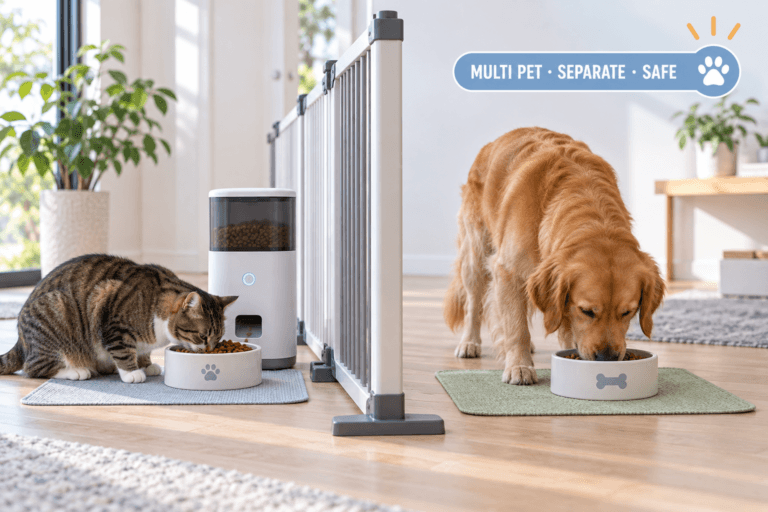
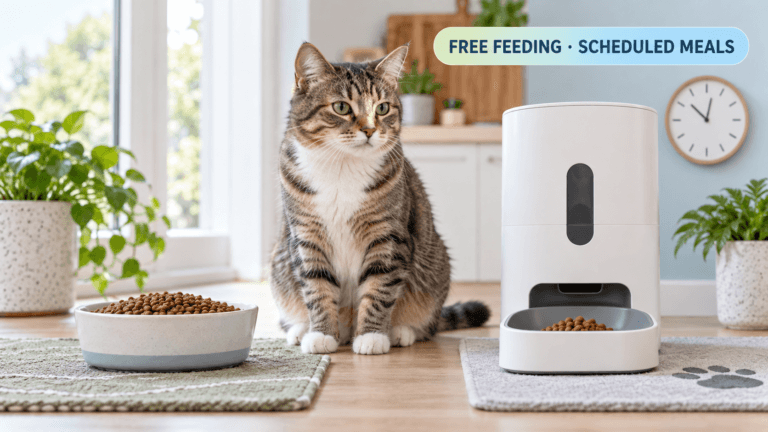
The second is to add a rotating-tray feeder for wet meals alongside your dry-food feeder. The two feeders serve different jobs — one for kibble, one for wet portions — and together they cover a full day of timed feeding. You can see both types in our feeder shop.
Frequently Asked Questions
Can I put wet food in a gravity feeder?
No. A gravity feeder holds food in an open reservoir with no timer and no cover, so wet food dries out and spoils within hours. Gravity feeders are for dry kibble only.
Will wet food clog my automatic feeder?
It will clog any feeder that moves food through a hopper and an auger. It will not clog a rotating-tray feeder, because the food never passes through a mechanism — it sits in a compartment until the tray turns to uncover it.
How do I keep wet food fresh in a feeder?
Use a sealed lid, load the food cold from the fridge, do not pre-fill beyond the fresh window, and wash the tray between fills. Stainless steel compartments are easier to keep clean than plastic ones.
Can I mix wet and dry food in one feeder?
Not in the same compartment or hopper — the wet food will soak the kibble and clog the mechanism. Feed them as separate meals, or use a dry-food feeder and a wet-food feeder side by side.
Final Thoughts
Wet food and automatic feeders are not incompatible — they just need the right design. A rotating-tray feeder with a sealed lid gives your cat timed wet meals without the clogging, drying, and spoilage that hopper feeders cause. If you are choosing one, start with our best automatic wet food feeder guide, which compares sealed-lid and ice-pack models and explains the freshness windows in full.