
International pet travel is where many careful owners still make expensive mistakes. They book the flight, reserve the hotel, pack the carrier, and only then discover that the pet needs a country-specific document, microchip check, vaccine timing, airline approval, or return-entry form. The trip does not fail because the owner loves the pet less. It fails because pet travel is a compliance process before it is a travel plan.
For feeding stability before departure and after arrival, a 2L smart pet feeder for regular feeding can help protect meal timing while the household handles packing, documents, and schedule changes. The feeder is not a travel document. It is a routine anchor around a stressful trip.
Direct Answer: International Pet Travel
International pet travel requires official destination rules, correct identification, vaccine records, health documents, airline-compliant carrier preparation, controlled feeding, water planning, and a return-entry checklist. The strongest plan starts with government requirements before flights are booked, because the pet’s document timeline can control the human travel timeline.
The main mistake is assuming one pet travel rule works everywhere. A dog entering the United States, a cat moving to the European Union, or a pet traveling from the U.S. to another country can face different forms, inspections, and timing. A serious international pet travel plan treats the route as a system: departure country, transit airports, destination country, return country, airline, carrier, documents, food, water, and arrival setup.
Why International Pet Travel Gets Complicated
Pet travel rules exist because countries control animal disease risk, identification, rabies status, and animal import conditions. The difficulty is that the owner usually thinks in human travel terms: ticket, passport, luggage, hotel, arrival. The pet side runs on another timeline: microchip, rabies record, health certificate, official endorsement, import form, airline acceptance, and inspection.
The USDA APHIS domestic and international pet travel guidance is a primary starting point for U.S.-based owners because it organizes travel requirements by destination and route. For exports from the United States, APHIS also explains that a USDA-accredited veterinarian helps determine destination requirements and complete the required health certificate or other paperwork.
Good international pet travel planning also protects the pet’s daily routine. Travel changes food timing, water access, sleep, bathroom breaks, owner attention, noise level, and confinement. If the pet already has an unstable feeding routine at home, the trip begins with a weaker baseline.
What To Do First
Start with a route map. Write down the departure country, destination country, transit countries, airline, airport connections, travel dates, return date, and final home address. Then verify the official rules for every country where the pet enters border control or animal inspection. Do not rely on old forum posts, screenshots, or another traveler’s route.
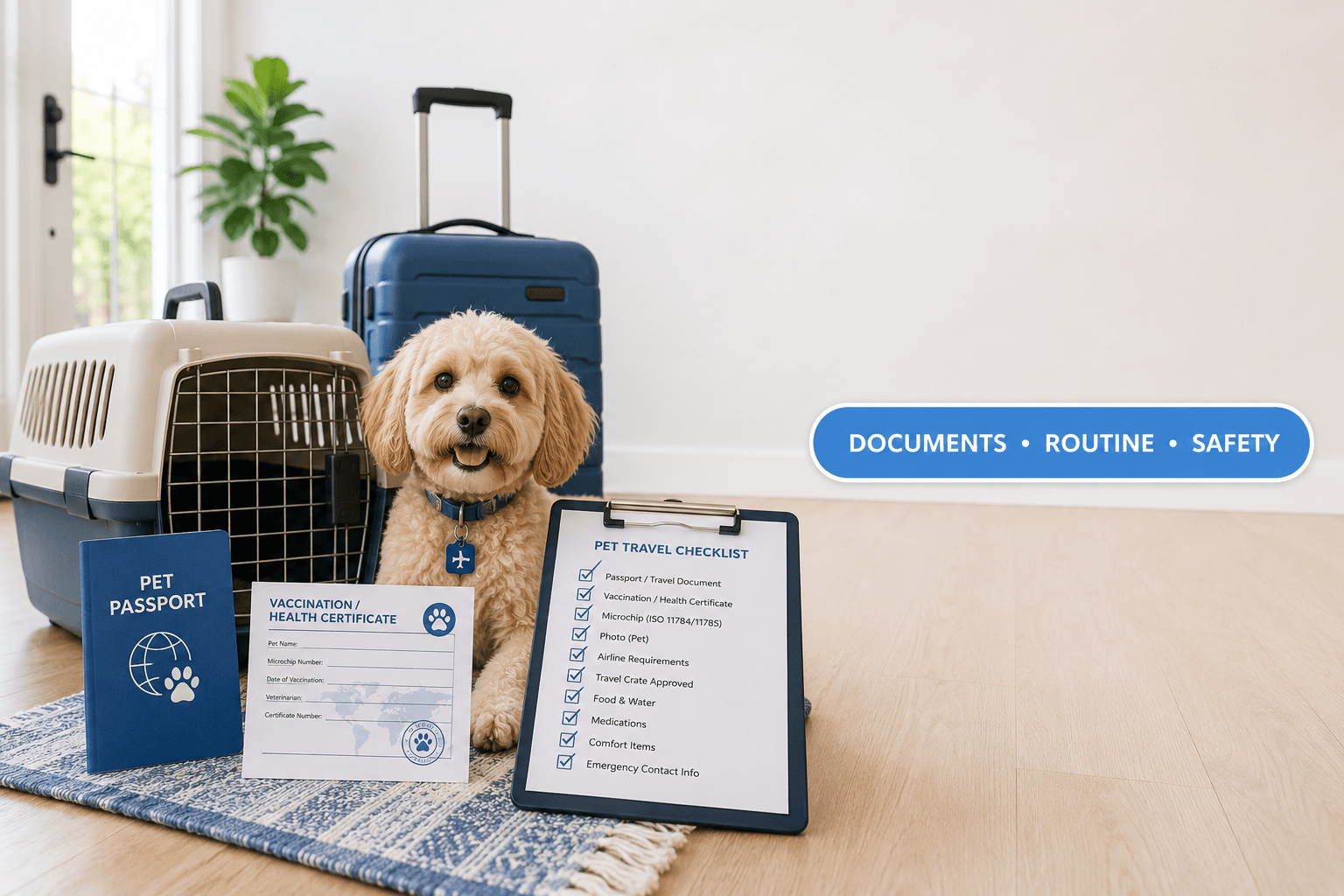
A practical international pet travel checklist should include identification, vaccination history, health certificate, import permit when required, airline carrier rules, food plan, water plan, medication record, emergency contact, and return-entry rules. The pet needs paperwork and care planning at the same time.
For packing and home preparation, use moving with pets tips. International trips are more complex than local moves, but the same base rule applies: reduce last-minute change before travel day.
Documents and Identification
The document layer decides whether the pet can legally travel. Many routes require a readable microchip, rabies vaccination details, health certificate, official endorsement, and destination-specific forms. Some countries also require parasite treatment, rabies antibody testing, import permits, quarantine booking, or designated entry points.
For U.S. owners taking a pet abroad, USDA APHIS provides a dedicated take a pet from the United States to another country page. This should be checked before ticket purchase because certificate timing, endorsement, and destination rules can determine whether the pet is ready to leave.
For international pet travel, keep printed and digital copies of the pet’s records. Store the health certificate, vaccine records, microchip number, import forms, airline booking, destination address, and emergency contacts in a separate travel folder. Do not pack original documents inside checked luggage.
Return Rules Are Not Optional
Many owners prepare for the destination and forget the return. A pet that leaves one country still has to enter another country later. Return rules can include separate forms, dog import requirements, rabies risk rules, microchip verification, or arrival inspection.
The CDC dog importation FAQ states that all dogs entering or returning to the United States must have a CDC Dog Import Form receipt. CDC also explains that dogs from dog rabies-free or low-risk countries must appear healthy, be at least 6 months old, and have a detectable microchip.
A complete international pet travel plan treats the return as a second trip. Before departure, confirm what the pet needs to come home. This prevents a common failure: the pet reaches the destination but cannot return on the owner’s preferred schedule.
EU Travel Rules Need Separate Attention
Travel to or within the European Union has its own structure. The EU rules on travelling with pets and other animals explain requirements for dogs, cats, and ferrets, including the European pet passport system for eligible EU residents.
EU-related travel commonly centers on microchip identification, rabies vaccination, and approved documentation. Some routes include tapeworm treatment for dogs or additional national controls. The owner should check the official EU page and the destination-country page together, because one “Europe trip” can involve several borders.
For international pet travel, regional labels are not enough. “Europe,” “Asia,” or “South America” is not a compliance answer. The exact country, entry airport, and transit route control the final checklist.
The Travel Loop Behind Delays
The travel loop starts with human convenience. The owner chooses a cheap fare, fast route, or ideal departure date. Then pet requirements appear late. The owner rushes documents, carrier training, vaccines, feeding changes, and packing during the same week. The pet becomes unsettled, and the paperwork becomes fragile.
Then the owner compensates with random treats, new foods, new calming products, and repeated carrier handling. These changes feel helpful, but they create more variables before a trip that already has strict rules.
A controlled international pet travel plan breaks the loop. Requirements come first. Carrier training starts early. Food stays familiar. Water access is planned. Documents remain visible. The travel day becomes a managed sequence instead of a last-minute rescue operation.
The Emotional Trigger Owners Miss
The emotional trigger is reassurance. Owners want to prove care through visible action, so they buy new treats, change food, replace bedding, add supplements, or keep opening the carrier to check the pet. These actions create stimulation when the pet needs stability.
A pet preparing for international movement does not need ten new things. It needs familiar food, a familiar carrier, clean water, predictable handling, readable identification, and calm repetition. Strong international pet travel planning reduces change instead of adding it.
Use the scientific pet feeding schedule before travel week. Keep meal timing stable, measure portions, and avoid turning every travel reaction into a food reward.
The Addiction Mechanism
The addiction mechanism is stress-reward pairing. If a pet receives rich treats, table scraps, or extra meals every time it vocalizes near the carrier, resists packing, or follows the owner around luggage, the pet learns that travel stress creates food upgrades.
This creates trouble during the trip. The pet can start rejecting normal food because the owner trained the travel period as a special-food window. The owner then adds more changes, and the feeding plan becomes unstable.
Better international pet travel preparation keeps the menu predictable. Use familiar food. Count treats. Keep water clean. Practice carrier exposure without making every reaction a snack event.
Carrier and Airline Preparation
The carrier is the pet’s travel room. It should not appear for the first time on departure day. Place it in the home early, add familiar bedding, and let the pet enter without force. For dogs, practice calm entry and quiet exit. For cats, keep the carrier open in a low-stress area so it becomes ordinary before travel.
Airlines control carrier dimensions, cabin eligibility, cargo procedures, breed restrictions, temperature rules, and check-in requirements. IATA’s traveling with pets guidance explains that cabin travel is not always available and that some pets travel in the cargo hold depending on airline and animal conditions.
For international pet travel, airline approval and destination approval are separate. A pet can meet airline rules and still fail destination entry rules. The route must satisfy both systems.
Feeding Before the Trip
Feeding before international movement needs discipline. Do not introduce a new food right before departure. Do not overfeed because the pet will be away from the bowl later. Do not use a full stomach as emotional reassurance before a long drive, airport check-in, or flight.
A useful international pet travel feeding plan uses familiar food, measured portions, and a travel-day schedule that fits the airline and route. Pack enough of the pet’s usual food for the first several days after arrival because local stores may not carry the same formula.
For owners managing irregular work hours before departure, automatic feeder for shift workers helps protect meal timing while packing, appointments, and document tasks disrupt the household routine.
Hydration and Bathroom Planning
Hydration cannot be improvised. Travel reduces normal drinking because pets are confined, distracted, or stressed. Water access depends on driving breaks, airport rules, carrier setup, transfer time, and arrival timing. Cats need fast litter access after arrival. Dogs need bathroom timing planned around check-in, security, transfers, and landing.
The AVMA traveling with your animal guidance emphasizes records, planning, and safety for pet travel. In practical feeding terms, that means water, food timing, safe restraint, and observation belong in the travel plan from the beginning.
Use pet hydration tips to build water habits before departure. During international pet travel, water should stay planned without turning the carrier or vehicle into a messy feeding zone.
Arrival Routine
Arrival is not the end of the trip for the pet. The first hours in a new country can include noise, unfamiliar smells, different housing, new water sources, and a changed feeding location. Set up the pet’s safe area before offering full access to the space.
Place food, water, bedding, litter box or dog rest area, and the carrier in one controlled room. Keep meals familiar. Avoid switching to local food on the first day unless it is the same formula. Let the pet rebuild the routine before expecting normal behavior.
For placement after arrival, use smart feeder placement. A clean, quiet feeding station helps the pet understand the new home faster.
Common Failure Pattern
The most common failure pattern is late document discovery. The owner books the flight, then learns that the pet needs a health certificate within a specific time window, an endorsed form, an import permit, or a vaccine record that does not match the destination rules.
The second failure is feeding chaos. Packing disrupts meals. The owner gives extras. The pet becomes selective. Travel day begins with an unstable stomach and a stressed owner. A feeder can help, but only when portions stay measured and manual extras stop.
The third failure is assuming a camera or app solves travel stress. A WiFi pet feeder with camera can verify meals before departure or after arrival, but it does not replace documents, carrier training, hydration, or arrival setup.
Real-World Impact
The real-world impact of weak international pet travel planning is serious: denied boarding, border delays, quarantine, extra document appointments, missed flights, stressed pets, and disrupted feeding. Most of these problems start before the travel day because the checklist was built in the wrong order.
Good planning creates control. The owner knows which official rules apply, which documents are printed, when the pet eats, where water is packed, how the carrier is handled, and how the pet will settle after arrival. That structure reduces stress for both the owner and the animal.
For temporary housing, unstable outlets, or travel-day schedule gaps, pet feeder with battery backup helps protect meal timing when power, adapters, or daily rhythm change after arrival.
Can This Be Fixed?
Yes, international pet travel problems can be fixed when the owner rebuilds the plan around official rules and pet routine instead of flight convenience. Start with destination requirements. Then build the veterinary timeline, airline booking, carrier practice, feeding schedule, water plan, and arrival setup around those requirements.
Run a travel-readiness check before booking. Confirm species eligibility. Confirm microchip status. Confirm rabies timing. Confirm certificate requirements. Confirm airline rules. Confirm return rules. Confirm food, water, carrier, and arrival station.
For product selection around routine control, start with the smart feeders collection. Cat owners can compare the cat feeders collection, while dog owners should use the dog feeders collection when bowl size, portion volume, and stability matter after arrival.
Who Should Walk Away and Who Should Use This
Walk away from international pet travel when the pet cannot meet destination rules before departure, the airline cannot accept the pet safely, the route creates unnecessary transfers, or the owner has no arrival plan for food, water, bathroom access, and quiet recovery.
Use this system when the documents can be completed, the carrier is accepted, the route is practical, and the destination housing supports the pet’s daily routine. It is especially useful for relocations, long stays, international students, remote workers, military moves, and families moving abroad with cats or dogs.
A smart automatic pet feeder with app control can help restore scheduled feeding in apartments, temporary housing, family homes, or new routines after the international move. The feeder helps rebuild consistency after the documents and travel steps are complete.
Mini FAQ
What is required for international pet travel?
International pet travel requires official destination rules, pet identification, vaccination records, health documents, airline approval, and a return-entry plan. The exact checklist changes by country, route, species, and travel history.
Do pets need a microchip for international travel?
Many international pet travel routes require a readable microchip. Some routes also require the microchip to be in place before the rabies vaccination is recorded, so identification timing should be checked early.
Can cats travel internationally?
Cats can travel internationally when they meet destination rules, airline rules, and health-document requirements. Carrier training, litter access after arrival, familiar food, and a quiet first room are essential for a cleaner transition.
Can dogs travel internationally?
Dogs can travel internationally when microchip records, rabies rules, health documents, airline approval, and return-entry requirements are completed correctly. Dog rules can change based on country risk status and recent travel history.
Should I feed my pet before an international flight?
Feed familiar food on a controlled schedule before travel and avoid sudden overfeeding before departure. The goal is a calm stomach, stable routine, and enough packed food for the first days after arrival.
What is the biggest mistake in international pet travel?
The biggest mistake is booking the human trip before confirming pet entry and return requirements. Documents, vaccines, endorsements, permits, and waiting periods can control the timeline more than flight availability.
The final rule is direct: international pet travel works when official documents, airline rules, carrier training, feeding rhythm, hydration, and arrival setup are planned as one system. If one part is treated as an afterthought, the whole trip becomes harder to control.