
Pet feeder desiccant replacement is a small maintenance step that prevents a large feeding problem. The desiccant pack inside or near the feeder lid helps control moisture in the food tank, but it does not last forever. When it is expired, saturated, damaged, missing, or ignored, dry kibble can absorb moisture, clump, smell stale, and move poorly through the dispenser.
For daily dry-food routines, a smart automatic pet feeder with app control works best when the food tank stays dry and clean. The app controls timing, but pet feeder desiccant replacement protects the storage environment that keeps kibble flowing correctly.
Direct Answer: Pet Feeder Desiccant Replacement
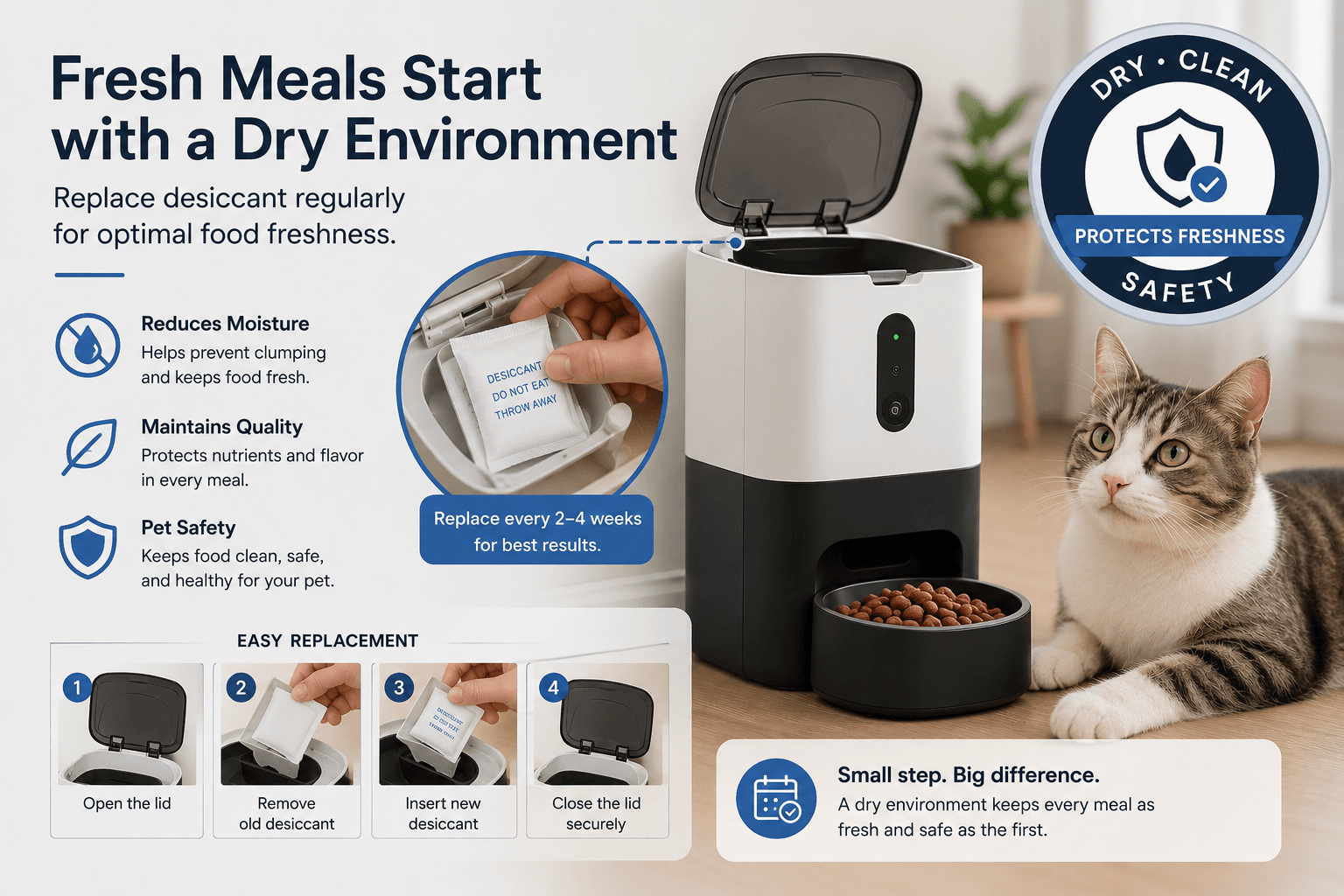
Pet feeder desiccant replacement means removing the old moisture-absorbing pack from the feeder lid or storage compartment and installing a fresh, sealed, food-safe replacement designed for that feeder model. Replace it according to the feeder instructions, after visible moisture exposure, when an indicator changes color, when odor appears, when kibble starts clumping, or when the packet is torn, swollen, dirty, or expired.
A proper pet feeder desiccant replacement routine does not mean throwing random silica gel packets into the food tank. The packet should stay sealed, secured in the correct compartment, and kept away from direct pet access. Moisture control is useful only when it does not create a chewing, choking, or contamination risk.
Why Desiccant Matters in a Pet Feeder
Automatic feeders store dry food for repeated dispensing. That storage function creates a moisture problem. Every time the tank opens, every time food is poured in, and every time the feeder sits near humidity, water bowls, kitchens, laundry rooms, patios, or damp floors, the kibble environment changes.
The FDA safe handling guidance for pet food and treats emphasizes clean handling, safe storage, and washing practices. A feeder tank is part of pet food storage, so moisture control and cleaning both belong in the same routine.
Pet feeder desiccant replacement protects dry food texture. Kibble that absorbs moisture can soften, clump, stick to the chute, and create inconsistent portions. Owners often blame the motor or app when the real issue is food storage inside the feeder.
What To Do First
Start by turning off or unplugging the feeder according to the product instructions. Open the lid, locate the desiccant holder, and remove the old pack. Do not shake, cut, wash, or reuse a damaged packet. Inspect the lid seal, food tank, chute, and bowl area before installing the new pack.
A practical pet feeder desiccant replacement routine has five steps: remove the old pack, inspect the food tank, clean dry residue, install the correct replacement, and record the date. The date matters because desiccant performance declines over time even when the feeder still looks normal.
After replacement, use clean smart pet feeder to check the bowl, chute, tank, lid, and floor area. Desiccant cannot compensate for dirty feeder parts, old kibble dust, or moisture left after washing.
The Moisture Loop Behind This Problem
The moisture loop starts when the owner fills the feeder and forgets the desiccant. The food tank looks full, the app schedule runs, and meals still dispense. Meanwhile, humidity enters the tank. Kibble dust sticks to the inner walls. The chute becomes less smooth. Small clumps form near the outlet.
Then the feeder begins dispensing unevenly. One meal drops normally. Another meal drops less. A later meal jams. The owner increases portions or shakes the tank, but the storage problem remains. The feeder is not only dispensing food; it is holding food in a changing environment.
A consistent pet feeder desiccant replacement routine breaks this loop by keeping the tank drier and easier to maintain. It also gives the owner a fixed moment to inspect food freshness, tank residue, lid seal, and kibble flow.
The Emotional Trigger Owners Miss
The emotional trigger is trust in sealed storage. A feeder lid looks protective, so the owner assumes the food inside stays fresh. That assumption is weak. A lid reduces exposure, but it does not erase humidity, food oil, old dust, or poor placement.
A full tank is not proof of fresh food. A sealed lid is not proof of dry food. A working schedule is not proof of clean storage. Pet feeder desiccant replacement gives the owner a simple checkpoint: if food is being stored in the feeder, the moisture-control part must be maintained too.
For better station design, use smart feeder placement. A feeder placed near a splashing water bowl, humid laundry area, direct sun, or outdoor doorway will stress the desiccant faster.
The Addiction Mechanism
The addiction mechanism is convenience creep. The feeder makes meals easier, so the owner checks the tank less often. First, old kibble gets topped with new kibble. Then the desiccant date is forgotten. Then the lid seal gets dusty. Then clumps appear and the owner treats the feeder like the problem.
Automation reduces missed meals, but it can also hide slow maintenance failure. The feeder does not remind every owner to inspect the desiccant, smell the tank, feel the kibble, or clean the chute.
A controlled pet feeder desiccant replacement plan reverses that pattern. The feeder handles timing. The owner handles storage quality. Moisture control becomes a recurring maintenance task, not an emergency fix after clumps appear.
When To Replace the Desiccant
Replace the desiccant on the product’s stated schedule first. If the manufacturer gives a specific replacement interval, follow that interval. Replace sooner when the home is humid, the feeder is near water, the packet is torn, the lid seal is dirty, the kibble smells stale, or the feeder begins clumping and jamming.
Some desiccant packs use a color indicator. If the indicator shows saturation, replace the pack immediately. Do not dry it in an oven or microwave unless the product instructions clearly allow that method. Most pet feeder owners should treat replacement packs as disposable maintenance parts.
A good pet feeder desiccant replacement schedule should be tied to refilling and cleaning. For example, inspect the desiccant every time the tank is emptied, and replace it during deep cleaning or after any moisture event.
What Not To Use
Do not use loose silica beads, damaged packets, fragrance packets, medicine-bottle desiccants, industrial moisture packs, or random packaging inserts from unrelated products. These can create safety and contamination problems. The desiccant should be sealed and designed for use around food storage.
The ASPCA Animal Poison Control resource is a useful emergency reference when a pet chews or swallows something suspicious. For feeder maintenance, the safer rule is prevention: keep desiccant sealed, secured, and inaccessible to pets.
Pet feeder desiccant replacement should never place the packet loose inside the kibble pile if the feeder has a dedicated holder. A loose pack can block food flow, tear inside the tank, or become reachable when the feeder is opened.
Cleaning Before Replacement
Replacing the desiccant without cleaning the feeder is only half a fix. Old kibble dust, oil residue, and damp crumbs can continue to hold odor. Before installing a fresh pack, empty the tank, remove loose dust, wipe safe surfaces, and dry every part fully.
Do not install a new desiccant pack into a damp lid or wet tank. That wastes the pack immediately and can trap moisture near the food. A dry feeder gives the replacement pack a clean starting point.
For portion accuracy after cleaning, use pet feeder calibration. Moisture and cleaning can both affect how kibble flows, so a quick portion test after maintenance protects the schedule.
Food Storage Rules
The desiccant pack inside the feeder is not a substitute for proper food storage outside the feeder. Keep the main food supply sealed, dry, cool, and away from direct heat. Do not leave open food bags beside the feeder. Do not pour damp or stale kibble into a freshly cleaned tank.
A strong pet feeder desiccant replacement routine works with measured refills. Fill only the amount of dry food that fits the household’s cleaning cycle. A large tank filled to the top can become stale before it is empty, especially in humid homes.
For broader feeding control, use the scientific pet feeding schedule. Scheduled meals reduce exposed food time, while dry storage protects the food before it is dispensed.
Placement and Humidity Control
Placement controls how hard the desiccant has to work. A feeder near a water dispenser, sink, bathroom, laundry machine, humid patio, open window, or outdoor door faces more moisture exposure. The desiccant pack will saturate faster in those conditions.
A proper pet feeder desiccant replacement plan includes moving the feeder when the location is the real problem. Put the feeder on a dry, level, washable surface. Keep water close enough for the pet but far enough that splashes do not reach the food outlet or tank area.
For water station design, use automatic water dispenser for pets. Food and water routines should support each other without turning the feeder into a damp storage zone.
Common Failure Pattern
The most common failure pattern is replacing the desiccant only after the feeder jams. By then, the tank may already contain stale food, damp crumbs, and chute residue. The new pack helps future moisture control, but it does not clean old buildup.
The second failure is reusing old packets. A desiccant pack that has already absorbed moisture cannot keep protecting food at the same level. Reuse creates false confidence and weak storage control.
The third failure is ignoring outdoor or semi-outdoor exposure. A feeder in a porch, garage, shed, patio, or catio faces stronger humidity swings. For those setups, use outdoor automatic pet feeder before trusting any dry-food storage plan.
Real-World Impact
The real-world impact of weak pet feeder desiccant replacement is slow and practical: stale odor, sticky kibble, portion drift, clumps, ants, chute jams, food waste, and pet refusal. These problems look like device failure, but many start with moisture and storage neglect.
A good replacement routine makes feeding easier to interpret. If the food stays dry and the feeder is clean, appetite changes are easier to notice. If the tank is stale or damp, the pet’s hesitation may be about the food environment, not the food itself.
For pest problems linked to moisture and crumbs, ant proof pet feeder gives the correct cleaning and placement system. Ant control and desiccant replacement both start with removing food rewards and moisture triggers.
Can This Be Fixed?
Yes, feeder moisture problems can be fixed with a full pet feeder desiccant replacement reset. Empty the tank, discard stale food, remove the old pack, clean the lid and tank, dry all parts fully, install the correct new desiccant, refill with fresh kibble, and run a test dispense cycle.
During the next seven days, check for odor, clumping, ants, leftover food, portion changes, and feeder errors. If the new desiccant saturates quickly, the problem is usually placement, humidity, overfilling, weak lid sealing, or water splashing near the feeder.
For product selection and feeder maintenance, start with the smart feeders collection. Cat owners can compare the cat feeders collection, while dog owners should use the dog feeders collection when capacity and kibble size are larger concerns.
Who Should Walk Away and Who Should Use This
Walk away from random silica packets, loose beads, torn packs, reused packs, and desiccants that sit directly in pet food without a secure holder. Also walk away from any routine that fills the tank heavily but never empties and cleans it.
Use pet feeder desiccant replacement if your feeder stores dry food, the home is humid, kibble clumps, the tank smells stale, ants appear, the feeder jams, or the food tank is refilled for several days at a time. It is especially useful for smart feeders, outdoor protected setups, cat feeders, dog feeders, and homes using dry kibble schedules.
A 2L smart pet feeder for regular feeding is easier to maintain when desiccant, cleaning, placement, and portion testing stay connected. The final rule is direct: pet feeder desiccant replacement keeps kibble drier only when the owner also controls storage, moisture, cleaning, and feeder placement.
Mini FAQ
What is pet feeder desiccant replacement?
Pet feeder desiccant replacement is the process of removing the old moisture-absorbing pack from a feeder lid or holder and installing a fresh sealed replacement. It helps keep dry kibble from absorbing humidity inside the food tank.
How often should I replace pet feeder desiccant?
Replace pet feeder desiccant according to the feeder instructions, and replace sooner after moisture exposure, odor, clumping, color-indicator change, or packet damage. Record the replacement date so the pack is not forgotten.
Can I use any silica gel packet in a pet feeder?
Do not use random silica gel packets in a pet feeder. Use the correct sealed replacement designed for the feeder or for food-storage use, and keep it secured in the proper holder away from pet access.
Is pet feeder desiccant safe?
Pet feeder desiccant is safe only when it stays sealed, secured, and inaccessible to pets. A torn or chewed packet should be removed immediately. Do not let pets chew, swallow, or play with desiccant packs.
Can old desiccant cause feeder jams?
Old desiccant can contribute to feeder jams when it no longer controls moisture and kibble starts clumping. The jam can also come from dirty chutes, damp food, large kibble, or poor calibration.
Should I clean the feeder when replacing desiccant?
Yes, clean and fully dry the feeder before installing new desiccant. Replacing the pack without removing old dust, odor, and damp residue gives weak results and can make the new pack saturate faster.
The best maintenance system is simple: keep food sealed, keep the feeder dry, replace the desiccant on schedule, and test the dispenser after cleaning. That is how pet feeder desiccant replacement protects freshness, portion flow, and daily feeding reliability.