
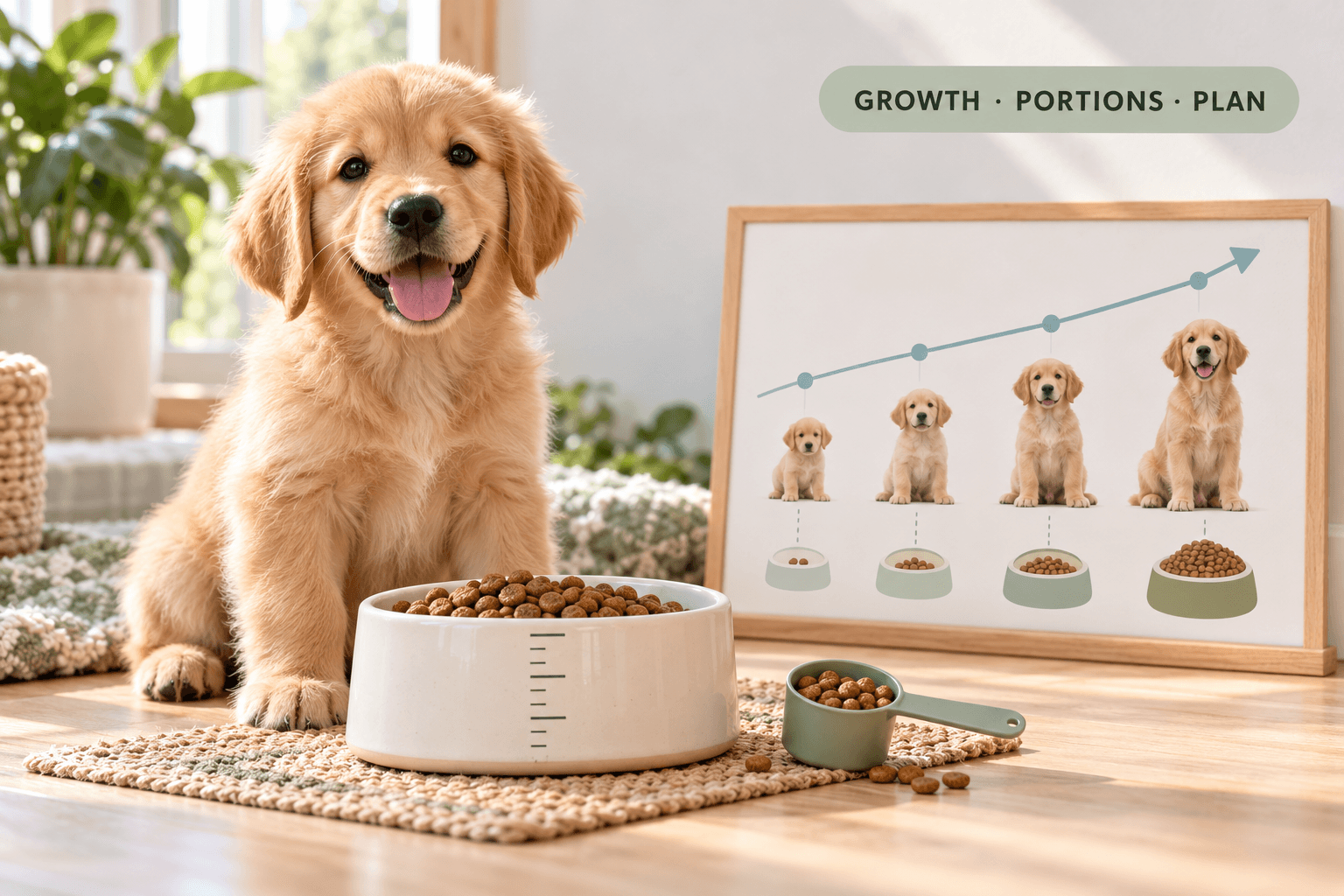
A golden retriever puppy feeding chart can organize meals, but it cannot tell you the exact amount every puppy needs. Food calories, current weight, growth rate, activity, treats, and body condition all affect the right daily portion. The useful goal is not to make a puppy grow as fast as possible. It is to support steady growth without excess weight or unnecessary strain on developing joints.
For practical portion control, a regular-feeding smart pet feeder can divide measured dry food into consistent meals. The device supports the routine, but the food amount still needs to come from a sensible feeding plan and regular body-condition checks.
The Golden Retriever Puppy Feeding Chart Is a Starting Framework
The best golden retriever puppy feeding chart gives you meal frequency and a method for adjusting portions, not one permanent cup measurement. Start with the feeding guide on a complete large-breed puppy food, then divide the daily amount according to age and meal frequency. Weigh the food in grams whenever possible because measuring cups vary and different kibbles contain different amounts of energy.
Golden Retrievers are large dogs. VCA lists typical adult weight at roughly 55 to 75 pounds, and the breed has a real tendency toward excess weight. That makes controlled growth especially important. A puppy that looks pleasantly round is often carrying more body fat than it needs, while rapid growth can place additional stress on developing bones and joints.
VCA recommends a food formulated for large-breed growth, with controlled calcium, phosphorus, and energy levels. Look for an AAFCO nutritional adequacy statement that includes growth of large-size dogs. The large-breed puppy nutrition guidance from VCA explains why adult food, random mineral supplements, and aggressive overfeeding are poor choices for a growing Golden.
A Practical Meal-Frequency Guide by Age
This age-based framework helps turn the golden retriever puppy feeding chart into a daily routine. The quantity still comes from the food label, current weight, and body condition.
- About 8 to 12 weeks: Feed four smaller meals each day. Young puppies have small stomachs and benefit from a predictable schedule.
- About 3 to 6 months: Feed three meals daily. Keep the portions measured instead of topping up the bowl when the puppy begs.
- About 6 to 12 months: Feed two or three meals, depending on appetite, stool quality, activity, and how well the puppy maintains a lean shape.
- About 12 to 18 months: Two measured meals often work well. Many large-breed dogs remain on an appropriate growth formula through roughly 18 months, with the transition based on development and professional nutritional guidance.
These age ranges are not permission to increase food simply because the puppy is older. The daily total should be divided across the meals. If the puppy receives training treats, dental chews, stuffed toys, or table food, those calories belong in the same daily budget.
What the Chart Cannot See
A printed chart cannot see the puppy’s ribs, waist, stool, energy, or growth curve. Those observations are what turn a generic recommendation into a responsible feeding plan.
Check the puppy from above and from the side. The waist should remain visible behind the ribs, and the ribs should be easy to feel under a light layer of fat. A growing puppy should gain weight consistently, but not become visibly heavy through the chest, abdomen, or hips. Weekly weighing is more useful than guessing from appetite alone.
Energy density is another common blind spot. One food can provide substantially more calories per cup than another. Switching brands while keeping the same number of cups can quietly change the daily calorie intake. The VCA guide to feeding growing puppies recommends using the food label as a starting point while monitoring growth and body condition.
Treats also matter. Keep treats below about 10 percent of daily calories, and use part of the regular meal for training when possible. This protects the feeding plan from becoming a full meal plus several hidden snacks.
The Feeding Loop That Creates an Overweight Puppy
The problem often starts with a simple loop. The puppy finishes the bowl quickly, looks for more, and receives an extra scoop because the owner reads enthusiasm as hunger. The puppy learns that intense begging produces more food. The owner then sees the behavior more often and assumes the puppy must need larger meals.
This is reinforcement, not proof of nutritional need. Food-driven breeds can remain interested in food after receiving enough calories. Free-feeding makes the loop harder to measure because nobody can tell how much the puppy consumed during the day.
A fixed routine creates a clearer boundary: measured food arrives at set times, the bowl is removed after the meal window, and extra food is not used to quiet normal begging. A structured pet feeding schedule can also make it easier to notice skipped meals, sudden appetite changes, or unusual food-seeking behavior.
Common Failure Pattern: Feeding by Cup and Guesswork
A common mistake is to choose a food, read the cup range on the bag, and repeat the same scoop without checking the puppy’s current weight. The puppy then grows, activity changes, treats increase, and the original portion quietly becomes too much.
The correction is simple but consistent: weigh the daily ration, record the puppy’s weight, divide the ration across meals, and make small changes when the body condition or growth trend moves in the wrong direction. Use a pet feeder calibration guide if an automatic feeder is involved, because the programmed serving size is not always the same as the amount displayed in the app.
Why Controlled Growth Matters for Golden Retrievers
Overfeeding a large-breed puppy does not create a healthier adult dog. It can accelerate growth, increase fat accumulation, and place avoidable stress on developing bones and joints. Large-breed puppy food is designed to support growth at a controlled rate rather than forcing the puppy toward its adult size faster.
The VCA Golden Retriever breed guide specifically recommends large-breed growth food for puppies. It also explains that this approach slows the rate of growth, not the final adult size. Good feeding control does not make a Golden Retriever small. It supports a more appropriate development pattern.
Pay attention to persistent loose stool, repeated vomiting, sudden appetite loss, extreme thirst, a swollen abdomen, or a sharp change in weight. These signs require assessment by a qualified veterinary professional rather than a simple portion adjustment.
Can an Automatic Feeder Follow the Plan?
Yes, an automatic feeder can support the golden retriever puppy feeding chart when it is used for measured dry food and checked regularly. It is especially useful for dividing the daily ration into several meals, maintaining consistent meal times, and preventing accidental second servings from different family members.
It cannot judge body condition, calculate calories from an unknown food, or decide whether a puppy is growing too quickly. Weigh one programmed serving with the actual kibble, confirm that the output is stable, and clean the hopper and bowl regularly. For puppies that eat too quickly, a timed slow-feed automatic feeder can help spread the meal, but it still needs to be tested with the puppy’s food and eating style.
Mini FAQ
How much should a Golden Retriever puppy eat each day?
Use the food label as the starting point, not the final answer. Select a large-breed growth formula, weigh the daily portion, divide it across meals, and adjust based on body condition and growth trend.
How many times should a Golden Retriever puppy eat?
Young puppies usually need more frequent meals. Four meals can suit very young puppies, three meals often work through the middle puppy stage, and two or three measured meals can suit older puppies.
Should Golden Retrievers eat large-breed puppy food?
Yes, the formula should be labeled for large-breed growth. It provides a more appropriate balance of energy and minerals for a large dog than unrestricted adult food or a random supplement plan.
When should a Golden Retriever switch to adult food?
Many Goldens transition around 18 months, but the timing follows development and body condition. Keep using an appropriate growth formula until the puppy is sufficiently mature, then make a gradual change with professional nutritional guidance.
Can I leave food out all day for a Golden Retriever puppy?
Measured scheduled meals are usually the safer choice. Free-feeding hides the actual calorie intake, encourages grazing or overeating, and makes appetite changes harder to detect.
Can treats be included in the feeding chart?
Yes, but treats must come from the daily calorie budget. Keep them limited, use regular kibble for training when practical, and reduce meal portions when extra calories are added.
The golden retriever puppy feeding chart works best as a routine for observation, not a substitute for observation itself. Measure the food, use a large-breed growth formula, divide meals by age, track weight, and keep the puppy lean. When you want consistent portions while managing a busy schedule, a smart automatic feeder with app control can make the schedule easier to follow. The final decision should still come from the puppy’s growth pattern, body condition, and nutritional needs.