
Choosing an automatic dog feeder for large dogs requires more than finding the biggest food hopper. Large breeds can empty a small bowl quickly, move lightweight feeders, pressure owners for extra meals, or jam a dispenser with oversized kibble. The right feeder must control portions, support a suitable bowl and food outlet, resist movement, and keep working when the household is busy.
For homes that need a practical starting point, a large-capacity automatic pet feeder with button control can provide a more structured alternative to an open gravity bowl. The goal is not to store unlimited food within reach. The goal is to deliver measured meals at consistent times.
Direct Answer: What Makes a Large-Dog Feeder the Right Size?
The best automatic dog feeder for large dogs has enough capacity for the planned feeding schedule, accurate portion control, a stable large-dog bowl, a food path that matches the kibble, and a dependable backup power option. Capacity should be calculated from the dog’s actual daily food volume rather than from breed size alone. A large dog needs a larger feeding system, but not unlimited access to food.
Large and giant breeds also require careful weight management. The correct daily amount is based on the food’s calorie density, the dog’s life stage, activity, body condition, and feeding plan. The large-breed nutrition guidance from VCA explains why the feeding label should be treated as a starting point rather than an automatic prescription.
Capacity Starts With Daily Food Volume
Large-dog feeders are often marketed by liters, cups, or pounds of dry food. Those measurements are not interchangeable because kibble density changes from one formula to another. A 5-liter hopper does not hold the same number of meals for every dog or every food.
Start by measuring the dog’s actual daily ration. Multiply that amount by the number of days the feeder should operate, then add a modest reserve without filling beyond the manufacturer’s line. For example, a feeder intended to cover a long weekend needs enough usable capacity for the dog’s planned meals during that period, not an oversized tank that encourages the owner to overfill it.
Models above 5 liters can be useful for large dogs, frequent meals, or short absences, but there is no universal rule that every large breed needs a 6-liter, 8-liter, or 10-liter hopper. A smaller hopper with accurate portions can be safer than a huge hopper that releases too much food or becomes difficult to clean.
Capacity also needs to match the household schedule. A dog eating two measured meals per day has a different storage requirement from a puppy receiving several smaller meals. Owners who work long shifts should calculate the number of meals between refills and keep a manual feeding option available during setup.
Portions Matter More Than the Size of the Tank
An automatic feeder is valuable because it controls access to food. If the dog’s daily amount is divided into planned meals, the feeder can reduce random refills, begging-related overfeeding, and rushed eating. If the hopper is simply kept full, the device becomes a storage container rather than a portion-control system.
Use the food label and the dog’s weight-management plan to establish the daily total. Then divide that total into the number of meals selected for the dog. Adult dogs commonly follow a regular two-meal routine, while puppies and dogs with specific feeding plans can need more frequent meals. The VCA feeding schedule guide explains why consistent timing is more useful than repeatedly reacting to begging.
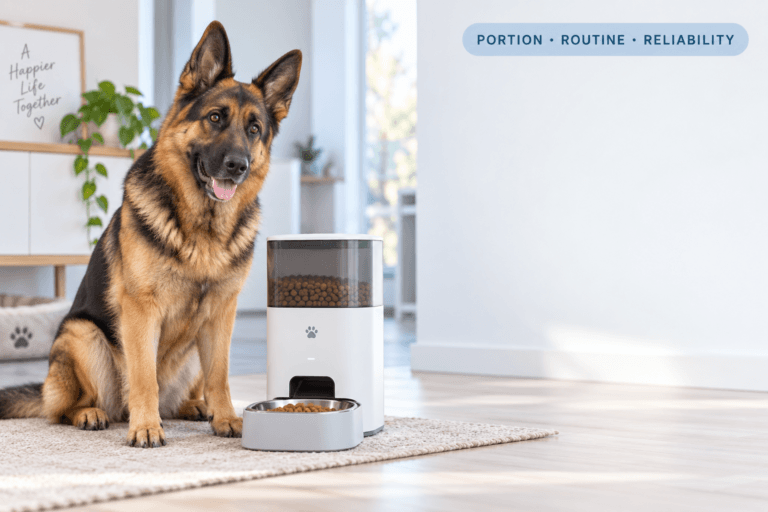
Calibrate the feeder with the real kibble. One machine “cup” or dispensing cycle is not a universal measurement. Run several portions, collect the output, and weigh it with a digital kitchen scale. Record the average result, then adjust the number of cycles or serving size. The pet feeder calibration guide is useful when the displayed setting does not match the actual food output.
Portions should also be reviewed after changing food, because different kibble shapes and densities can alter the amount released by the same mechanism. A dog’s ability to keep asking for food is not a reliable measurement of the correct meal size.
Bowl and Outlet Dimensions for Large Dogs
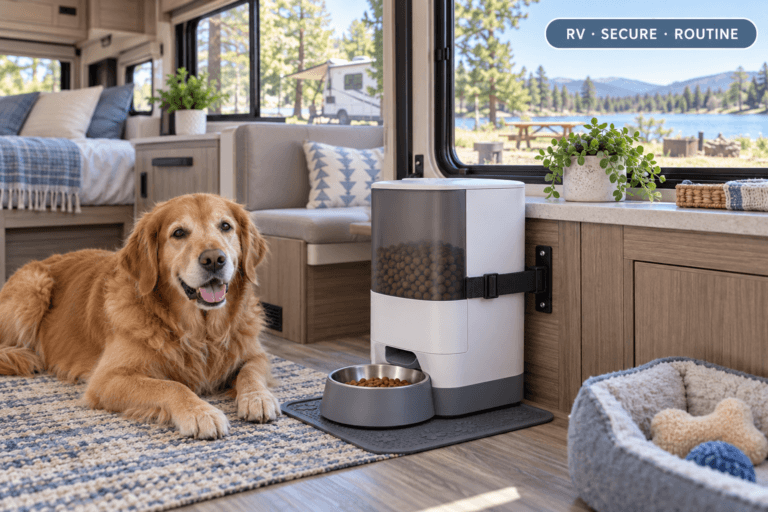
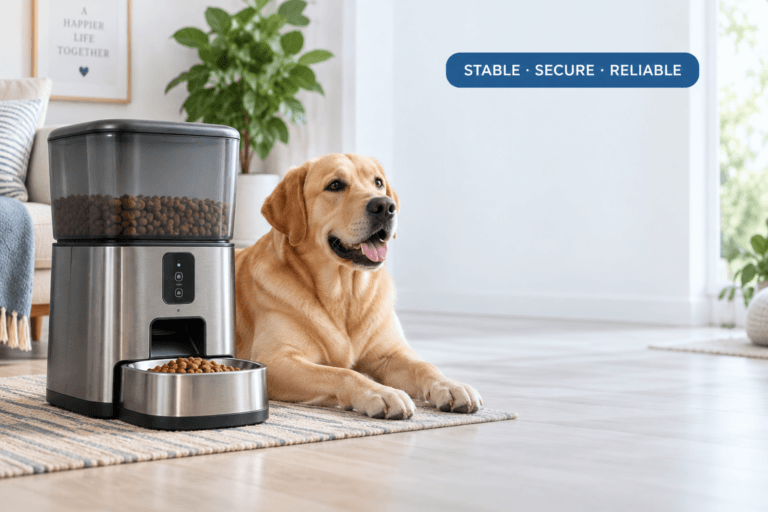
A feeder can hold enough food and still fail if the bowl is too shallow, too narrow, or easy to push. Large dogs need a bowl that allows the muzzle to reach the food without repeatedly striking the sides. The bowl should sit on a wide, stable base and remain in position when the dog eats with force.
Check the bowl’s usable width and depth rather than relying on the product label alone. A “large bowl” claim is useful only when the shape works for the dog’s muzzle and eating posture. Flat-faced breeds, long-muzzled breeds, and dogs that spread food while eating can require different bowl shapes.
The food outlet must also match the kibble. Measure the largest dimension of the dry food and compare it with the manufacturer’s stated kibble range. Oversized, irregular, dusty, or oily pieces can bridge inside the chute even when the hopper is large. The outlet should release food cleanly without requiring the dog to knock the unit for additional pieces.
A large bowl does not replace slow feeding. Dogs that inhale food need smaller releases, a compatible slow-feed bowl, or a separate feeding design. Review how to slow down a dog that eats too quickly before relying on a standard bowl.
Anti-Jam Design Is a Core Requirement
Large-breed kibble can place more demand on the motor and food path. Look for a feeder with a clear chute, a rotating impeller or auger designed for dry food, anti-bridge spacing, and food-backup detection when the model provides it. These features reduce the chance that the machine will stop after one awkward piece blocks the outlet.
Test the feeder with the actual food before leaving the dog alone. Run multiple scheduled portions, check the output weight, and inspect the chute after several cycles. Do not assume that a feeder rated for “large kibble” can handle every large-breed formula.
Keep wet food, raw food, and highly oily food out of a dry-food dispenser unless the manufacturer specifically supports them. Moisture and residue can create clumps, odors, and motor problems. If the feeder jams, unplug it before clearing the food path and follow the steps in the pet feeder jam troubleshooting guide.
Product Choice Comparison
Open Gravity Feeder
An open gravity feeder offers substantial storage but weak portion control. It fits dogs that self-regulate and do not push, guard, or overeat, but it is a poor choice for a large dog that repeatedly returns to the bowl or gains weight through free access.
Timed Dry-Food Feeder
A timed dry-food feeder is the practical middle option for most homes. It releases meals on a schedule, supports predictable routines, and can reduce owner-driven refills. It still requires accurate calibration, stable placement, compatible kibble, and regular cleaning.
Heavy-Duty High-Capacity Feeder
A heavy-duty model is better suited to strong, food-motivated dogs or households that need longer intervals between refills. Prioritize a weighted or anti-tip base, a secure lid, a wide bowl, protected controls, and a food path designed for the selected kibble. Higher capacity should come with stronger portion control, not open access.
Slow-Feed Setup With a Separate Bowl
Some dogs need a slow-feed bowl or puzzle feeder placed below a dispenser. This setup can work when the automatic unit controls timing but the dog needs additional help reducing eating speed. Choose a durable design if the dog chews or destroys feeding equipment.
The Feeding Loop Behind Begging
The feeding loop is simple: the dog expects food, applies pressure, the owner responds, food appears, and the pressure becomes stronger. Barking, staring, pawing, kitchen blocking, and bowl pushing can all become effective when they change the feeding result.
An automatic dog feeder for large dogs changes the source of the reward. Meals arrive from the feeder at fixed times instead of appearing after the dog pressures the owner. The schedule only works when the owner stops adding extra food in response to noise or demanding behavior.
Set the schedule before the usual demand period begins. If dinner is scheduled for 6:00 p.m., do not release it at 5:30 p.m. simply because the dog begins barking. Consistency makes waiting more useful than escalation.
The Emotional Trigger Owners Often Miss
A large dog can make food pressure feel urgent. The bark is louder, the body takes more space, and the owner can feel guilty about delaying a meal. Feeding early seems easier in the moment, but it teaches the dog that stronger pressure produces faster access.
A programmed feeder creates a boundary that the owner does not need to negotiate under pressure. The portion is already selected, the time is already set, and the dog cannot change the result by staring at the pantry or pushing the bowl.
Food pressure should also be separated from boredom. Daily exercise, training, rest, and enrichment give the dog additional structure. Feeding control is stronger when the bowl is not the only predictable event in the day.
The Reinforcement Mechanism
The dog is not dependent on the machine itself. The dog is responding to the reward pattern. If food appears after barking, barking becomes more valuable. If food appears after waiting for the scheduled release, calm waiting becomes more valuable.
Free feeding can strengthen repeated checking, while emotional refills can teach the dog that intensity changes meal size. A measured feeder creates the healthier dependency: the dog learns the schedule instead of learning to negotiate with the owner.
A Short Setup Example
Consider an 85-pound dog that finishes meals quickly and begins pacing before dinner. The owner first weighs the planned daily ration, divides it into scheduled meals, and checks whether the kibble fits the outlet. The feeder is placed against a wall, the bowl is tested for stability, and several cycles are run while the owner is present.
The owner then adds a battery backup, keeps a manual portion record, and uses a separate slow-feed bowl because the dog still eats too quickly. The feeder does not solve every behavior by itself, but it removes random refills and makes the feeding routine predictable.
Power Outages and Backup Feeding
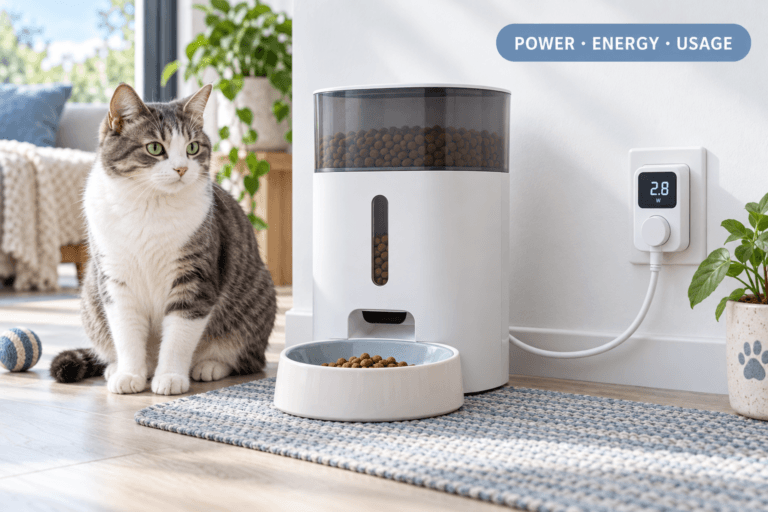
A plug-in feeder needs a clear power-failure plan. The strongest setup uses wall power as the primary source and an internal battery compartment or approved backup battery that switches on automatically. Confirm whether the feeder keeps its schedule without Wi-Fi, because cloud-dependent features can behave differently from the local feeding program.
Backup duration is model-specific. Some products use optional batteries for short-term operation, while others continue the programmed schedule offline. For example, the official Whisker Feeder-Robot specifications describe offline scheduling, anti-jam functions, and an optional battery backup for that model. The PetSafe Smart Feed specifications also list an optional battery arrangement.
Do not assume that every battery compartment provides the same runtime. Test the backup before an extended absence, replace aging batteries, protect the cord from chewing, and keep emergency portions available.
Multi-Dog Homes Need Separate Control
One shared feeder is not automatically suitable for multiple dogs. A larger or faster dog can steal the other dog’s meal, block access, or consume a prescription diet that was not intended for it. Different body sizes and feeding schedules make shared access even less reliable.
Use separate feeders when the dogs need different portions, food types, or meal times. Place the stations far enough apart to reduce crowding, use a barrier when necessary, and observe the first several meals. The guide on separate feeders for multi-pet households explains why individual feeding control is often safer than one communal hopper.
Food-aggressive dogs require additional caution. A feeder can reduce owner-to-food conflict, but it does not replace separation, supervision, or a behavior plan when a dog threatens another pet around meals.
Cleaning and Maintenance That Prevents Failure
Cleaning is part of feeder reliability. Wash the bowl on a regular schedule, especially when food dust, saliva, or residue collects around the rim. Empty and wipe the hopper before changing food types. Clean the outlet and chute when the hopper is empty, then dry every removable part completely before refilling.
Inspect the lid seal, dispensing wheel, motor area, battery contacts, and power cord. Dusty kibble can reduce portion consistency, while oil buildup can make pieces stick together. Recalibrate after changing food, moving the feeder, or replacing a dispensing component.
For a step-by-step routine, use the pet feeder maintenance guide. Regular maintenance is especially important for large dogs because a failed meal can lead to bowl pushing, chewing, and attempts to break into the hopper.
Real-World Impact of Poor Feeder Selection
A feeder that is too small creates frequent refills. A weak base invites tipping. An undersized outlet causes jams. An inaccurate portion setting encourages weight gain. A missing backup plan turns a short power outage into a missed meal. These failures are connected because the feeding system was chosen by appearance or capacity alone.
An automatic dog feeder for large dogs works best when it supports the entire routine: storage, measured portions, bowl access, kibble flow, power continuity, cleaning, and household behavior. Measured feeding also supports long-term weight management; the dog obesity prevention guide explains why uncontrolled extras are easy to underestimate.
Can This Feeding System Be Fixed?
Yes, large-dog feeding problems can be improved when the feeder is tested against the dog, food, schedule, and home environment. Start with the actual kibble, confirm the daily portion, run repeated cycles, and watch the dog use the bowl. Check whether the unit slides, tips, jams, or releases food unevenly.
Keep the feeder on a level surface with the cord routed away from chewing. Use a backup power source where outages are possible. Add a slow-feed bowl or smaller meal releases when eating speed is the main problem. If the dog shows a swollen abdomen, repeated unproductive retching, weakness, or collapse, treat those signs as an emergency rather than as a feeder issue.
Who Should Use This and Who Should Walk Away
Use an automatic dog feeder for large dogs when the dog eats dry food reliably, needs measured meals, pressures the owner before feeding, or needs a predictable routine during workdays and short absences. Start with the available dog feeder collection and compare capacity, portion control, bowl design, outlet size, stability, and power backup.
Walk away from a basic feeder when the dog eats wet food only, destroys devices, requires direct meal supervision, or becomes dangerous around food. Those situations require a supervised feeding plan, physical separation, or a more durable slow-feed setup. A feeder should reduce risk, not hide it.
Mini FAQ
How much capacity does a large dog feeder need?
The feeder needs enough usable capacity for the dog’s measured daily food amount and the planned number of days between refills. Calculate from actual grams or cups, then account for kibble density and meal frequency. Do not choose a tank size solely because the dog is a large breed.
How much should each automatic feeder portion release?
Each portion should match the dog’s planned daily ration divided across the selected meals. Calibrate the machine with the actual food and confirm the output on a digital scale. The feeder’s displayed cup or serving number is not a universal weight.
What bowl size is best for a large dog?
The bowl should give the dog enough width and depth to eat without striking the sides or pushing the feeder across the floor. Choose a stable base and compare the bowl’s usable dimensions with the dog’s muzzle and eating posture.
How do I prevent kibble from jamming?
Use kibble that fits the outlet and choose a feeder with an accessible food path, anti-jam movement, or food-backup detection. Measure the largest kibble pieces, test several cycles, and keep moist or oily food out of a dry-food feeder unless the manufacturer approves it.
Will an automatic feeder prevent bloat?
No, an automatic feeder cannot guarantee prevention of bloat or GDV. Smaller scheduled meals and slower eating can support a more controlled routine, but large-breed owners still need to monitor eating behavior, activity around meals, and urgent warning signs.
What happens if the power goes out?
A feeder with automatic battery switchover and offline schedule memory provides the strongest outage plan. Confirm the model’s battery requirements and runtime, test the backup before leaving, and keep emergency food portions available.
Can one feeder serve several large dogs?
One shared feeder is suitable only when the dogs have compatible diets, portions, and feeding behavior. Use separate feeders when one dog steals food, when portions differ, or when either dog guards the bowl. Physical separation is more reliable than expecting the faster dog to wait.
For owners who need a practical starting point, a WiFi feeder with button backup can fit homes that need remote control and an additional manual option. Compare its real capacity, kibble compatibility, battery behavior, and bowl size with the dog’s routine before purchase.
The best automatic dog feeder for large dogs is not simply the feeder with the largest hopper. It is the model that stores enough food, releases measured portions, accepts the selected kibble, keeps a large bowl stable, resists jams, continues through short power failures, and remains manageable to clean. Choose the feeding system around the dog’s daily ration and behavior, test it before relying on it, and use separate control when multiple dogs compete for food.