
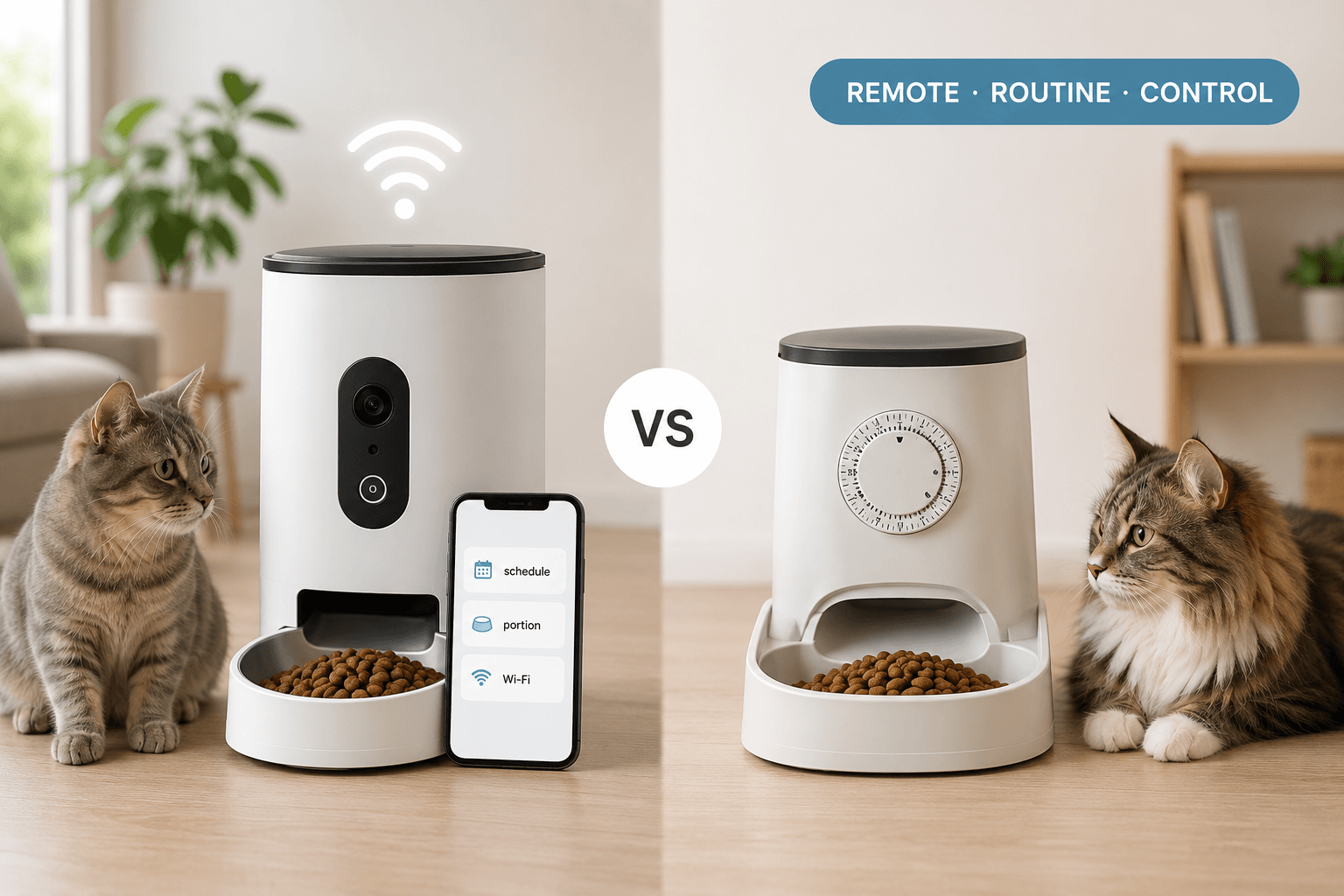
Smart app vs timed pet feeder is not a question of modern versus basic. It is a question of control. A smart app feeder gives remote access, schedule editing, and visibility when the owner is away. A timed feeder gives simpler meal release without turning every feeding decision into an app action. The wrong choice creates weak boundaries, random feeding, missed meals, or owner guilt disguised as convenience.
For homes that need remote control during workdays, late returns, or short trips, a smart automatic pet feeder with app control gives stronger flexibility than a local-only timer. The device should not become a remote snack button. It should protect the feeding schedule when the owner is not standing beside the bowl.
Direct Answer: Smart App vs Timed Pet Feeder
Smart app vs timed pet feeder comes down to remote control versus simple routine control. A smart app feeder is better when the owner needs schedule changes, remote feeding visibility, or workday flexibility. A timed pet feeder is better when the goal is strict, simple, repeatable meals without app distraction. If absence and schedule changes are the real problem, choose smart app control. If consistency without remote access is enough, choose a timed feeder.
Why This Happens
Pet feeding problems often look like hunger, but the deeper problem is a broken reward system. Pets learn when food arrives, where it appears, what sound predicts it, and which owner behaviors change the result. If food appears after begging, barking, meowing, pawing, or bowl checking, those behaviors become part of the feeding routine.
Smart app vs timed pet feeder matters because each system changes who controls the reward. A smart app feeder gives the owner more power from a distance, but that power can become emotional feeding if the owner sends extra meals from guilt. A timed feeder reduces owner interference, but it gives less flexibility when schedules change. The right tool depends on which failure is more dangerous in the household: absence without control or owner overreaction with too much control.
Before choosing either device, owners should build the feeding structure through how to use a smart pet feeder. The feeder type matters, but the schedule, portion size, food flow, and owner rules matter more.
What To Do
Choose a smart app feeder when meals need to be checked or adjusted from outside the home. This fits owners with changing work hours, travel days, delayed returns, early morning routines, or pets that need stricter monitoring. Choose a timed feeder when the schedule is stable, the owner is usually nearby, and the goal is to remove negotiation from feeding without adding app decisions.
A smart app vs timed pet feeder decision should include five controls: meal timing, portion accuracy, food-path reliability, cleaning access, and backup plan. App control does not fix a feeder that jams. A simple timer does not fix a schedule that changes every week. The feeder must match the real life pattern, not the product label.
For routine planning, connect either feeder to a scientific pet feeding schedule. A feeder works best when it enforces a known meal rhythm instead of turning the day into random dispensing.
The Feeding Loop Behind This Problem
The feeding loop is direct: the pet expects food, the pet performs a behavior, the owner or feeder delivers food, and the behavior becomes stronger. If the pet learns that pressure produces food, pressure increases. If the pet learns that waiting near the feeder at the correct time produces food, waiting becomes stronger.
Smart app vs timed pet feeder changes how this loop is reinforced. A smart app feeder can protect the loop when the owner is away, but it can also damage the loop if the owner sends random snacks after watching the pet on camera or feeling guilty at work. A timed feeder supports a cleaner loop because meals arrive by schedule, not by owner emotion.
If a cat keeps acting hungry after meals, the feeding loop has already become noisy. The guide on why cats seem hungry after eating explains how repeated reward can look like constant appetite when the real issue is learned food pressure.
The Emotional Trigger Owners Miss
The emotional trigger is guilt. Smart app feeders make it easy for owners to respond to absence with extra food. The owner sees the pet near the bowl, feels bad, and sends a meal outside the schedule. That action feels caring, but it trains the pet to keep checking the feeder because surprise food can appear.
A timed feeder creates less room for emotional feeding because the rule is simpler. Food appears at fixed times. That simplicity is useful for owners who struggle to hold boundaries. The weakness is that local timers offer less remote correction when the day changes. This is why smart app vs timed pet feeder should be judged by owner behavior, not only by features.
Dry-food feeding also needs water support. A feeder does not solve hydration, so owners should connect the feeding system with pet hydration tips. A stable food routine with weak water access is still an incomplete care system.
The Addiction Mechanism
The addiction mechanism comes from uncertain reward. When food arrives at unpredictable times, the pet keeps checking because the next visit to the bowl can produce a payoff. Random app feeding strengthens that pattern. The pet learns that the feeder is not only a schedule. It is a source of surprise rewards.
Smart app vs timed pet feeder is therefore also a reinforcement question. Smart app control is strong when it protects the schedule and weak when it feeds owner anxiety. Timed feeding is strong when the pet needs a firm rule and weak when the household requires remote adjustment. The feeder should make reward predictable, not exciting.
The correct loop is boring: wait, hear the feeder, eat the measured portion, leave the bowl. That routine dependency is useful. The pet depends on the schedule, not on begging, owner guilt, or repeated bowl checking.
Real-World Impact
The real-world impact shows up in ordinary home life. A smart app feeder helps when the owner works late and still needs to protect dinner time. A timed feeder helps when the owner keeps giving in to begging and needs a fixed boundary. Both can fail when portions are wrong, cleaning is poor, or the owner keeps adding extra food outside the system.
Weight control is a major consequence. App convenience can quietly become extra calories, and timed feeding can still overfeed if the portion is set too high. Long-term routines should stay aligned with healthy pet weight guidance, because the best feeder is still harmful when it automates the wrong amount.
For cats on controlled portions, a structured cat weight reduction plan depends on measured meals and owner discipline. A feeder should make that discipline easier, not create hidden refills. Owners away during meal windows should also review the automatic pet feeder for work guide because workday feeding exposes the difference between useful remote control and weak routine planning.
Can This Be Fixed?
Yes, a weak feeder choice can be fixed by matching the device to the real failure pattern. If the problem is missed meals during absence, choose smart app control. If the problem is owner inconsistency at home, choose a strict timed feeder. If the problem is fast eating, multi-pet stealing, wet food, or bowl guarding, neither app control nor simple timing solves the main issue alone.
A smart app vs timed pet feeder comparison should always be tested with the real food, real portions, real schedule, and real household routine. Check whether the feeder dispenses accurately, stays clean, resists jams, and supports the owner’s actual behavior. Do not trust a feature list. Trust the repeated meal result.
Who Should Walk Away and Who Should Use This
Walk away from smart app feeding if the owner will use remote control for random snacks, emotional feeding, or constant schedule changes. In that home, the app becomes the problem. Walk away from a timed-only feeder if the owner needs remote schedule control, feeding confirmation, or flexibility during work and travel.
Use a smart app feeder when the household needs remote control, visibility, and schedule adjustment. Use a timed feeder when the household needs a simple rule that does not invite constant owner interference. Owners comparing device types can start with smart feeders and screen for portion control, food-path design, cleanability, and backup support.
For cats, compare cat feeders by bowl access and meal size. For dogs, compare dog feeders by capacity, bowl stability, and portion range. In shared homes, the automatic feeder guide for multi-cat households explains why access control can matter more than app control or timer control.
Mini FAQ
Which is better in smart app vs timed pet feeder?
Smart app feeding is better for remote control, while timed feeding is better for simple fixed routines. The better choice depends on the household failure pattern. Use app control for absence and timed control for stricter daily boundaries.
Does a smart app feeder create bad habits?
Yes, it creates bad habits when owners send random extra meals. Random rewards make pets check the feeder more often. Use the app to protect the schedule, not to feed guilt.
Is a timed pet feeder enough for workdays?
It is enough when the schedule is stable and no remote changes are needed. A timed feeder releases meals without owner reaction. Choose app control when work hours shift or feeding confirmation matters.
Can either feeder help with begging?
Yes, either feeder can reduce begging when food stops coming from owner pressure. Begging continues when noise or pawing produces food. Use fixed meal times and avoid side rewards.
What should I check before choosing a feeder?
Check remote needs, portion accuracy, food compatibility, cleaning access, capacity, and backup control. A feeder succeeds when all parts support the same routine. Do not choose by app features or timer simplicity alone.
For owners who need strict meal timing without turning feeding into constant app decisions, a timed slow feed automatic feeder can support calmer routine control. Smart app vs timed pet feeder is ultimately a boundary decision: choose smart app control when distance is the problem, choose timed feeding when consistency is the problem, and make the feeder enforce a feeding system instead of turning meals into another negotiation.