
Gravity vs automatic pet feeder is not just a comparison between two food containers. It is a choice between open access and structured feeding. A gravity feeder keeps food available as the bowl empties, while an automatic feeder releases measured portions at scheduled times. The better option depends on your pet’s appetite, routine, weight, and feeding environment.
Short answer: choose a gravity feeder when your pet self-regulates well and you mainly need simple refill convenience. Choose an automatic pet feeder when you need portion control, consistent meal timing, slower feeding, early-morning scheduling, or better control in a multi-pet home. If overeating, begging, weight gain, or food stealing is already a problem, an automatic feeder is usually the more useful system.
If you need a practical way to create measured meals and a steadier routine, this smart pet feeder for portion control and routine stability shows how an automatic feeder can become part of a feeding plan rather than simply another food container.
Gravity Feeder vs Automatic Feeder: What Is the Real Difference?
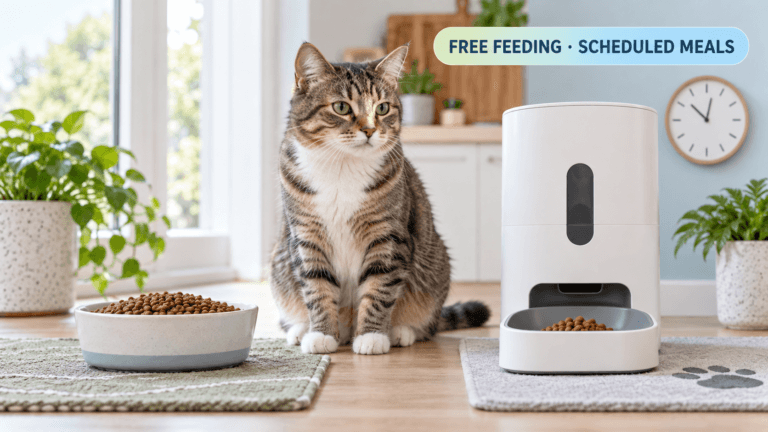
A gravity feeder uses the food level in the bowl to trigger more food. It is simple, inexpensive, and usually easy to refill. However, it does not normally know how much your pet has eaten or when a meal should end.
An automatic feeder uses a schedule and a dispensing mechanism to release food at selected times. Depending on the model, it may also support measured portions, slow feeding, app controls, voice recording, a camera, or battery backup.
| Feature | Gravity Feeder | Automatic Pet Feeder |
|---|---|---|
| Food access | Usually open or continuous | Available at scheduled times |
| Portion control | Limited after food is loaded | Measured portions are possible |
| Meal timing | Not precisely controlled | Programmable schedules |
| Weight management | Harder to track intake | Better suited to measured feeding |
| Multi-pet households | Food stealing can be difficult to prevent | Better control, especially with separate units |
| Power requirements | Usually none | Needs batteries, an outlet, or both |
| Setup | Very simple | Requires programming and testing |
How the Feeder Changes Feeding Behavior
The most important difference is not the shape of the device. It is the behavior that the device reinforces.
With open access, a pet may check the bowl repeatedly, graze throughout the day, or learn that food appears whenever the level drops. This may be harmless for a calm pet with a stable weight, but it can make intake difficult to measure for a fast eater or food-motivated animal.
A scheduled feeder changes the pattern:
- Food appears at predictable times.
- The owner can measure the daily amount more consistently.
- The pet learns that food comes from the schedule rather than constant begging.
- Meal timing becomes easier to maintain on workdays, weekends, and early mornings.
This is why the gravity vs automatic pet feeder decision should start with the feeding problem. If the problem is only refilling, gravity may be enough. If the problem is unclear portions or an unstable routine, you need more control than a gravity system normally provides.
When a Gravity Feeder Makes Sense
A gravity feeder can be a reasonable choice in a simple, low-risk feeding situation. It may work well when:
- your pet maintains a healthy weight without strict portion control;
- your pet eats slowly and does not empty the bowl immediately;
- there is only one pet using the bowl;
- you mainly want a low-tech refill solution;
- you do not need scheduled breakfast or multiple daily meals;
- you can still monitor body condition and total intake.
Gravity feeders are attractive when simplicity, low maintenance, and affordability matter more than automation. You can compare this type of product in the basic feeders category.
Even in these situations, keep the bowl and storage container clean, protect food from moisture, and check regularly that food is not clumping or blocking the outlet.
When an Automatic Pet Feeder Is the Better Choice
An automatic feeder is usually the better choice when feeding is a management problem rather than a refill problem. Consider one when:
- your pet eats too quickly or repeatedly asks for food;
- you need measured portions for weight control;
- your pet wakes you early for breakfast;
- you work long hours or keep an irregular schedule;
- you need several small meals instead of one or two large meals;
- one pet steals another pet’s food;
- you want a repeatable feeding routine.
Automation is not a substitute for checking your pet’s health. It is a way to make the feeding plan more consistent. Read how to use a smart pet feeder and how to build a scientific pet feeding schedule before changing portions or meal frequency.
Gravity vs Automatic Pet Feeder for Weight Management
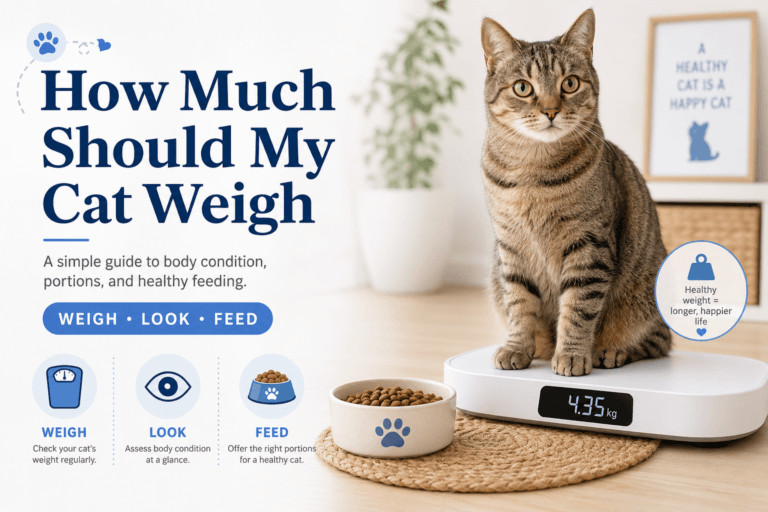
If your pet needs to lose weight, the most important issue is controlled daily intake. A gravity feeder can make it harder to see how much food is actually available and how much one pet has eaten. An automatic feeder can make measured portions easier to repeat, but it only works if the owner sets an appropriate daily amount and checks the result over time.
Weight loss plans should be discussed with a veterinarian, especially if your pet is obese, has a medical condition, or needs a major change in food intake. Guidance from VCA’s cat weight-reduction guidance and the AVMA healthy-weight guidance supports the broader principle that intake should be measured rather than guessed.
For related feeding plans, see how to prevent pet obesity and best cat feeders for weight loss.
Which Feeder Is Better for a Multi-Pet Home?
Open-access feeding becomes more complicated when two or more pets share a bowl. One pet may eat quickly, another may eat slowly, and a third may return repeatedly. The result can be unfair food access, inaccurate intake, and conflict around the feeding area.
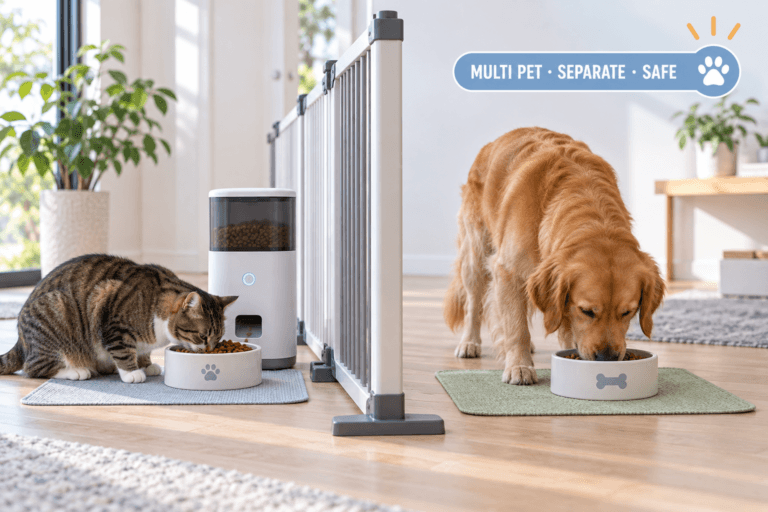
An automatic feeder can improve structure, but a single shared feeder may still not solve food stealing. In a multi-pet home, consider separate feeding stations, microchip access control, or multiple feeders placed in different areas.
The goal is not just to release food automatically. The goal is to make sure the right pet can reach the right portion. Continue with how to stop cats from eating each other’s food and review the multi-pet feeder options.
How to Choose the Right Automatic Feeder
1. Portion accuracy
Check how the feeder measures a portion and whether the amount can be adjusted in small increments. Test the output with a kitchen scale if accurate intake matters.
2. Capacity and food compatibility
Confirm the hopper capacity and whether it works with your kibble size and shape. A large hopper is not useful if the food bridges or jams at the outlet.
3. Schedule flexibility
Look for enough feeding times and portion settings for your routine. Early-morning feeding, workday absences, and small meals may require different schedules.
4. Power backup
If a missed meal would be a serious problem, choose a model with a reliable battery backup and test what happens during a power interruption.
5. Slow-feeding design
Fast eaters may benefit from a slow-feed bowl or controlled dispensing pattern. This can help reduce gulping, but it does not replace veterinary advice for repeated vomiting or digestive problems.
6. Cleaning and food safety
Choose removable food-contact parts that can be cleaned regularly. Moisture, old food, and residue can create hygiene problems in both gravity and automatic feeders.
7. Manual access during failures
Learn how to dispense a meal manually and keep a backup feeding plan. Technology should make the routine more reliable, not leave your pet without a solution when a device, app, or network fails.
A Practical Decision Checklist
- Choose gravity if your pet self-regulates, maintains a healthy weight, and only needs simple refill convenience.
- Choose automatic if you need measured portions or fixed meal times.
- Choose automatic if your pet begs early, eats too fast, or gains weight easily.
- Choose separate or controlled access if multiple pets steal food from each other.
- Choose a tested backup plan if your household depends on scheduled meals.
The right feeder should solve a specific feeding problem. Buying a more advanced device without changing the daily portion, schedule, or access pattern will not create better results by itself.
How to Set Up a New Feeder
- Measure the current daily food amount before changing the feeder.
- Set the new schedule around the routine your pet already understands.
- Use the same food at first so the feeder is the only major change.
- Watch the first several dispensing cycles for jams or inaccurate portions.
- Place the feeder where the pet can eat calmly and other pets cannot interfere.
- Record appetite, stool, weight, and behavior changes.
- Adjust portions with veterinary guidance when weight loss or a medical diet is involved.
Frequently Asked Questions
Is a gravity feeder better than an automatic pet feeder?
It can be better for a calm, healthy pet that handles open food access well and only needs a simple refill solution. An automatic feeder is usually better when you need meal timing, measured portions, or behavior management.
Does a gravity feeder cause overeating?
It can contribute to overeating in pets that do not self-regulate, because food remains available as the bowl empties. It is not automatically harmful for every pet, but it gives you less control over intake.
Is an automatic feeder better for weight loss?
It can make scheduled portions and consistent intake easier to manage. Weight loss still requires an appropriate diet, monitoring, and veterinary guidance when necessary.
Which feeder is better for multiple pets?
An automatic feeder usually gives you more control, but a shared feeder may not prevent food stealing. Separate feeders or access-controlled feeders may be needed.
Can an automatic feeder replace human care?
No. You still need to check that the feeder dispenses correctly, clean food-contact parts, monitor your pet, and maintain a backup plan for power or device failures.
What is the biggest mistake people make when comparing gravity and automatic feeders?
They choose based only on price or convenience. The better question is whether the household needs open access or structured control.
Final Verdict
Gravity and automatic feeders are designed around different feeding systems. Gravity feeders are simple and convenient when open access is safe. Automatic feeders are more useful when your pet needs measured portions, predictable timing, slower meals, or stronger boundaries around food.
Before choosing, identify the problem you want the feeder to solve. If you only need a larger food container, a gravity feeder may be enough. If you need to change a feeding routine, control portions, or reduce food-related conflict, an automatic feeder is usually the more effective starting point. Compare the available basic feeders, smart feeders, cat feeders, and dog feeders based on that decision.