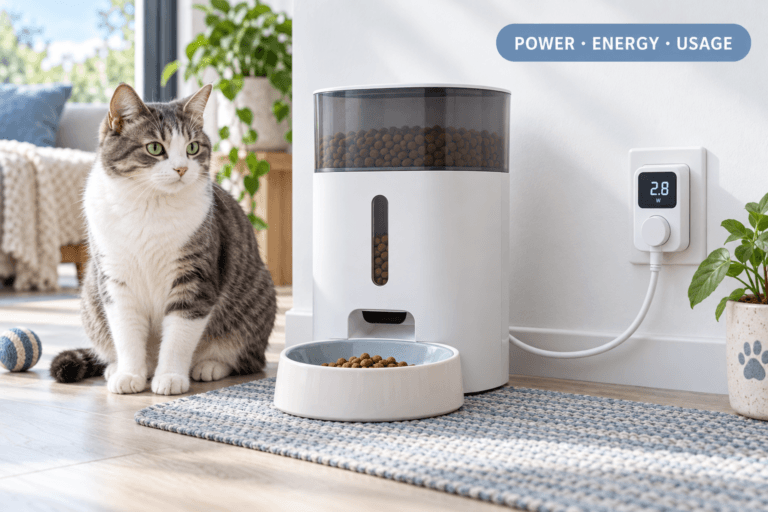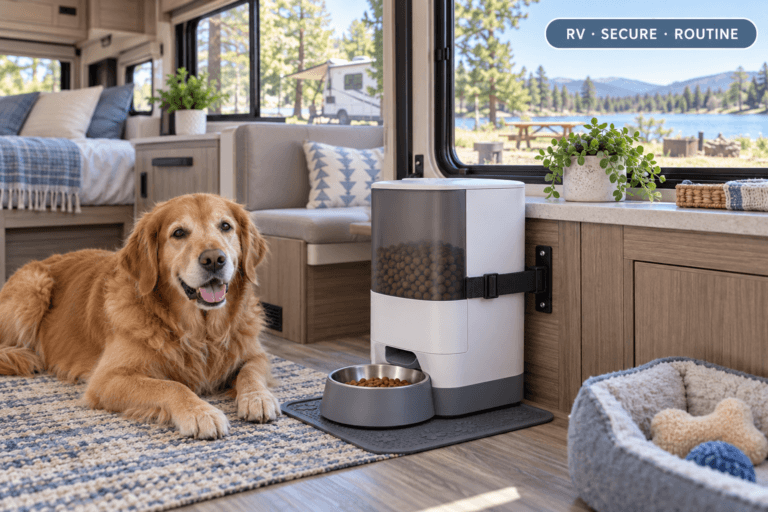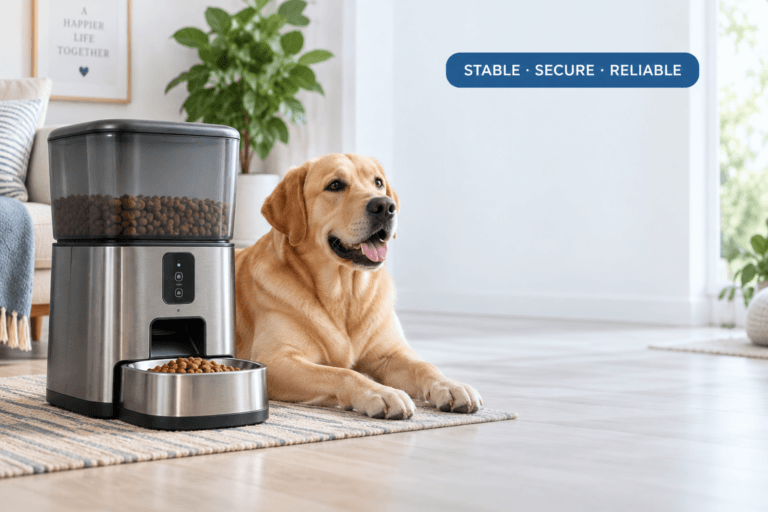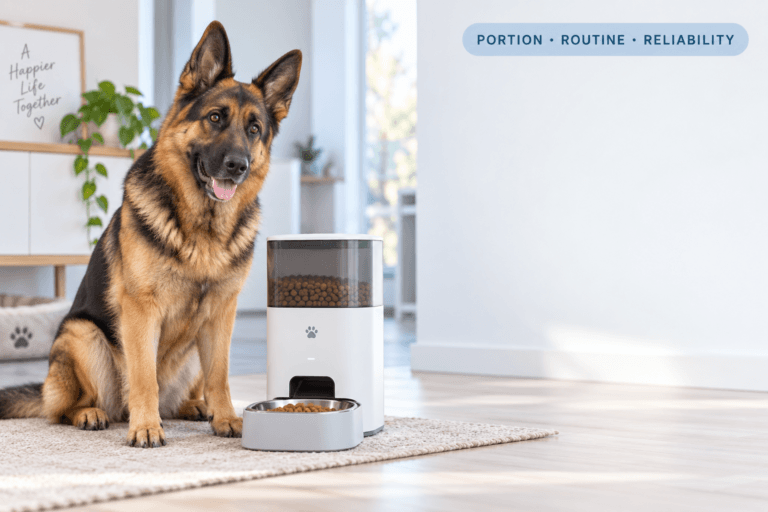

A pet feeder with battery backup protects more than the next meal. It protects the feeding routine your pet has learned to trust when the power flickers, the plug is pulled, the router fails, or you are away from home.
For homes where missed meals create stress, a 4L WiFi automatic pet feeder with button backup provides an additional control layer. The goal is not extra technology for its own sake. The goal is keeping meal timing, portion control, and feeding boundaries stable during ordinary household interruptions.
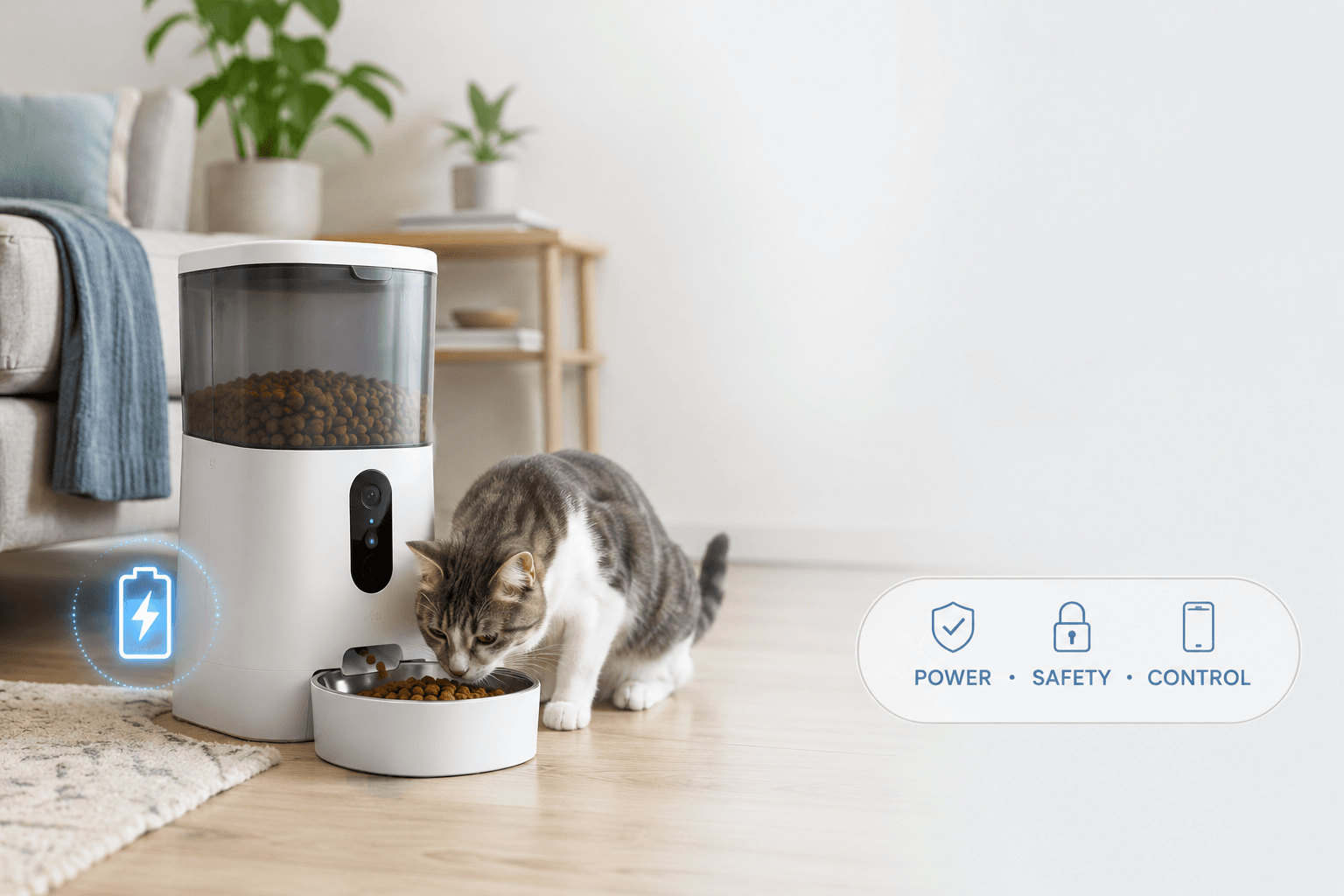
Direct Answer: Pet Feeder with Battery Backup
Yes, a pet feeder with battery backup can continue dispensing food during a power outage, but only when the backup battery is installed, charged, and supported by the feeder’s outage mode. A feeder connected only to a wall adapter stops when household power stops. A feeder with a working backup system can keep scheduled dry-food meals running for the period stated by its manufacturer.
Battery backup does not automatically guarantee that every feeder will remember its schedule, keep the correct time, or resume normally after power returns. Those functions depend on the model. Some feeders store schedules locally and continue feeding without WiFi. Others require the owner to reset the clock or reprogram the schedule after a complete power loss.
The safest approach is to treat backup power as a tested feeding system. Confirm that the feeder releases the right portion during an outage, confirm what happens when power returns, and check whether the app, local buttons, and notifications behave differently when the internet is unavailable.
Why This Happens
Pets learn feeding through repetition. They learn the time of day, the sound of the motor, the location of the bowl, and the amount that usually arrives. When the feeder works consistently, the pet stops treating food as a negotiation. When the feeder fails, the pattern changes.
The pet checks the bowl, circles the feeding area, vocalizes, scratches, paws at the feeder, or pressures the owner. If the owner responds with extra food after a missed meal, the animal learns that disruption can produce a larger reward. A single outage can therefore become the start of a repeated begging or bowl-checking pattern.
A pet feeder with battery backup protects the schedule from one common failure point: loss of electrical power. The pet does not understand a storm, a tripped breaker, a loose cable, or a dead router. It only experiences the result: food did not arrive when the routine predicted it.
Owners should connect backup reliability with a structured scientific pet feeding schedule. Backup power is useful when it protects a clear meal rhythm, not when it supports random refills.
What To Do
Choose a pet feeder with battery backup by screening for five controls: backup power, dispense accuracy, schedule memory, manual fallback, and food-path reliability. Backup power keeps the motor available during an interruption. Dispense accuracy protects portion size. Schedule memory determines whether meals continue without the app. Manual fallback gives the owner a local control option. A clean food path prevents a jam from defeating an otherwise strong backup system.
Battery type matters. Some feeders use replaceable alkaline AA, AAA, or D-cell batteries. For example, certain automatic feeders use four D-cell alkaline batteries as an optional backup source. Other models use rechargeable lithium-ion packs or sealed lead-acid batteries. A Whisker backup battery specification, for example, lists a 12-volt, 1.3 Ah sealed lead-acid battery and reports approximately 24 hours of use during a power interruption. These figures are model-specific, so they should never be treated as a universal runtime standard. Review the manufacturer’s backup battery specifications before buying replacement cells.
Test the feeder with the real food, real portion size, and real schedule. Program the next meal, allow the feeder to sync, disconnect the main power during a safe test window, and watch whether the scheduled portion is released. Restore power and confirm that the next meal remains scheduled, the clock is correct, and the battery begins charging when the model supports automatic recharge.
Run a second test with the router disconnected. Local feeding and remote control are separate functions. Some feeders continue the local schedule when WiFi is unavailable, while app commands, alerts, and live status remain inaccessible until the network returns. The smart pet feeder setup guide can help organize the initial schedule and placement checks.
Never use an unapproved battery type or voltage. Do not mix old and new batteries, mix different chemistries, or place damaged cells inside the feeder. Keep the battery compartment dry, inspect for leakage or swelling, and unplug the device before cleaning. Follow the storage and cleaning instructions in the manufacturer safety manual for the specific feeder.
The Feeding Loop Behind This Problem
The feeding loop begins with expectation. The pet expects food at a known time. If the meal arrives, the loop stays calm: wait, hear the feeder, eat, and leave. If the feeder fails, expectation becomes checking. Checking becomes frustration. Frustration becomes noise, pacing, or bowl fixation.
When the owner later provides extra food, the pet learns that pressure changes the outcome. Repeated outages can therefore create a feeding loop based on uncertainty rather than hunger. A pet feeder with battery backup breaks one major part of that loop by keeping the timing signal active when the main power source fails.
For cats that remain focused on food after eating, review why cats seem hungry after eating. Repeated food checking can reflect reinforcement and uncertainty, not only a need for more calories.
The Emotional Trigger Owners Miss
The emotional trigger is guilt after a missed meal. Owners often respond by hand-feeding, adding extra kibble, opening the food container, or leaving a larger portion “just in case.” That response feels protective, but it can teach the pet that a feeder failure leads to a bigger reward.
A pet feeder with battery backup reduces the need for guilt-driven feeding. The system handles ordinary power interruption before the owner turns one missed meal into additional calories. This helps protect weight control, digestion, and the feeding boundaries established during normal days.
Food reliability also needs water reliability. Automated dry-food feeding does not solve hydration. Owners should provide dependable water access and review these pet hydration tips when building a routine for workdays, overnight absences, storms, or short trips.
The Addiction Mechanism
The addiction mechanism comes from uncertain reward. When food arrives inconsistently, the pet keeps checking because the next check could produce a result. A delayed meal followed by begging and extra food makes begging more valuable the next time.
The same pattern appears when an outage causes the owner to refill the bowl early. The pet learns that pressure, noise, or persistent checking can change the feeding rule. A pet feeder with battery backup removes one major source of uncertainty by protecting the schedule from power interruption.
The best feeder routine is intentionally boring. The same place, the same sound, the same portion, and the same meal time give the pet fewer reasons to gamble against the bowl. Predictable feeding is useful because it makes pressure less rewarding.
A Practical Failure Pattern
Consider a household where a dog receives breakfast at 7:00 a.m. and dinner at 6:00 p.m. The family leaves for work before breakfast is fully finished, and the feeder controls both meals. During a storm, the wall power fails at 5:30 p.m. Without backup, the feeder stays silent. The dog checks the empty bowl, the family returns late, and someone adds a large extra portion.
If the feeder has a charged battery and a locally stored schedule, the evening meal can release at the planned time. If the feeder loses its schedule after power failure, the result is still a missed meal. This is why an outage test must check more than whether a battery symbol appears in the app.
Owners should record three results during testing: whether the feeder dispenses while unplugged, whether it preserves the correct portion, and whether the next scheduled meal remains intact after power returns. Those three checks expose most backup misunderstandings before the feeder becomes the only feeding source.
Real-World Impact
Feeder failure can appear as missed meals, anxious bowl checking, louder begging, early wakeups, pacing, food guarding, and owner overcorrection. If emergency feeding becomes routine, portion control weakens. Owners should align the system with healthy pet weight guidance because backup power should protect planned portions, not justify extra feeding.
A pet feeder with battery backup is especially valuable for households with frequent storms, unstable electrical service, long work shifts, early departures, late returns, or pets that depend on strict meal timing. It is also useful for cats on controlled portions and dogs that become unsettled when meals are delayed.
Multi-pet homes need additional caution. Backup power does not prevent one animal from stealing another animal’s meal. If pets share one bowl and one animal eats faster, the home needs access control or separate feeding zones. The automatic feeder guide for multi-cat households explains why one shared bowl can fail even when the feeder itself works correctly.
Weight control requires consistent portions. For cats following a structured plan, a cat weight reduction plan depends on measured meals rather than missed portions followed by emotional refills.
Can This Be Fixed?
Yes, feeder reliability can be improved when backup power is treated as part of the complete feeding system. The system needs a suitable battery, a stored schedule, accurate dispensing, a stable placement, clean food pathways, and a clear test routine.
Battery replacement should follow the manufacturer’s instructions and the feeder’s low-battery warning. There is no universal replacement interval because battery chemistry, capacity, temperature, charging design, and usage differ. Replace the battery before a long trip, after a failed outage test, when runtime drops noticeably, or when leakage, corrosion, swelling, or physical damage appears.
Rechargeable batteries should be charged and stored according to the product manual. Replaceable alkaline cells should be changed as a complete set using the specified size and chemistry. After installing a new battery, run another unplugged test instead of assuming the backup is ready.
Backup power does not solve stale kibble, damp food, blocked chutes, incorrect portions, or a feeder that pets can tip over. Use dry food that flows correctly, avoid overfilling the hopper, clean the dispensing path, keep the feeder away from water, and secure the bowl area.
Who Should Walk Away and Who Should Use This
Do not treat battery backup as the main solution for pets that eat wet food only, require direct supervision, destroy devices, guard food aggressively, or share a bowl with a faster animal. These homes need food separation, supervision, or a different feeding design.
Use a pet feeder with battery backup when the pet eats suitable dry food, follows scheduled meals, needs measured portions, and spends predictable hours without direct feeding supervision. The strongest candidates include homes with long workdays, frequent outages, short absences, strict weight-control plans, or pets that become distressed when meal timing changes.
When comparing smart feeders, screen for backup battery support, schedule memory, local controls, portion accuracy, capacity, cleanability, food-flow design, and the manufacturer’s stated runtime. For dogs, also check bowl stability and resistance to tipping. For cats, check portion precision and access control.
Mini FAQ
Can a pet feeder continue feeding during a power outage?
Yes, when the backup battery is installed, charged, and supported by the feeder. A feeder connected only to wall power stops during an outage. Battery operation still requires a suitable battery, correct installation, and a food path that remains free of jams.
What battery types do automatic pet feeders use?
Common options include alkaline AA, AAA, or D-cell batteries, rechargeable lithium-ion packs, and sealed lead-acid batteries. The correct type depends on the model. Use only the specified size, chemistry, voltage, and capacity.
How long can a battery backup pet feeder run?
Runtime is model-specific and can range from several hours to approximately 24 hours or longer. Hopper size does not determine battery runtime. Motor use, battery capacity, power-saving mode, and dispensing frequency all affect the result. Treat the manufacturer’s rating as a starting point and confirm performance with an unplugged test.
Will the feeder automatically restore its schedule after power returns?
Some feeders resume automatically, while others require the clock or schedule to be checked again. Feeders that store schedules locally often continue feeding during WiFi or power interruptions, then return to normal power and charging after restoration. A model that resets its clock requires manual correction. Test the exact feeder before relying on it.
Will the feeder work if the router is offline?
Local schedule operation and remote app control are separate functions. Some models continue a saved schedule without WiFi, while app commands, notifications, and live status remain unavailable. Confirm this behavior during setup rather than assuming an internet connection is required or unnecessary.
Is it safe to leave the backup battery installed?
It is safe only when the battery matches the manufacturer’s specifications and the compartment stays dry and undamaged. Do not mix old and new batteries or different chemistries. Inspect for leakage, corrosion, swelling, or unusual heat, and unplug the feeder before cleaning.
How often should the backup battery be replaced?
Replace it according to the manufacturer’s service guidance, low-battery warning, and actual test performance. Replace it before extended travel, after a failed outage test, or when runtime drops. A fixed universal replacement cycle does not apply to every battery type.
Which pet homes need backup power most?
Homes with frequent power interruptions, long work shifts, strict portion plans, early departures, late returns, or pets that rely heavily on scheduled meals benefit most. Backup is less suitable as a standalone solution for wet-food-only pets, destructive pets, food-aggressive pets, and animals that require direct feeding supervision.
Is battery backup enough for vacation feeding?
No, battery backup is only one layer of vacation feeding safety. The feeder also needs enough food capacity, tested portions, fresh water, stable placement, clean food flow, and a person who can check the home when the absence lasts beyond the tested runtime.
Can a battery backup feeder stop begging?
It can reduce begging when begging is caused by inconsistent feeding. Stable meal timing removes the uncertainty that encourages repeated checking. It cannot solve begging caused by excessive portions, medical problems, food competition, or an already reinforced behavior pattern by itself.
For owners who need a stronger fallback during outages or unplugged-cord events, a 4L WiFi feeder with button backup for cats and dogs provides a practical additional control layer.
A pet feeder with battery backup is the right choice when feeding cannot depend on perfect household power or constant owner availability. Select the correct battery system, verify its runtime, test schedule recovery, inspect it regularly, and keep backup power tied to a stable feeding routine.