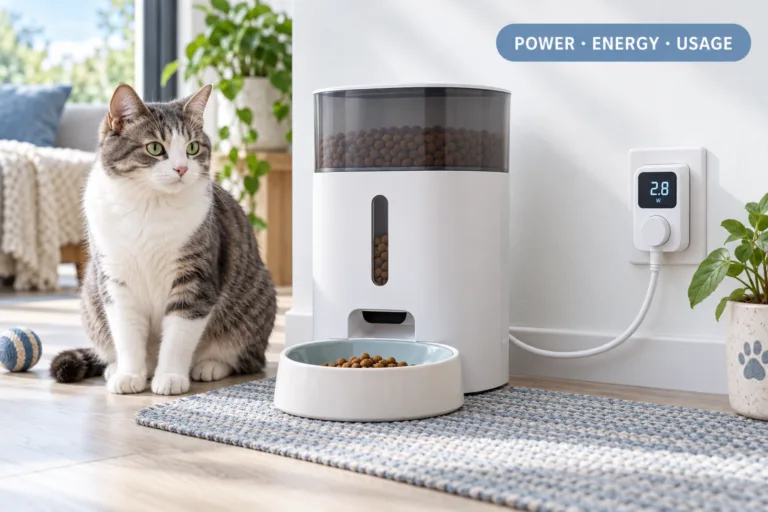
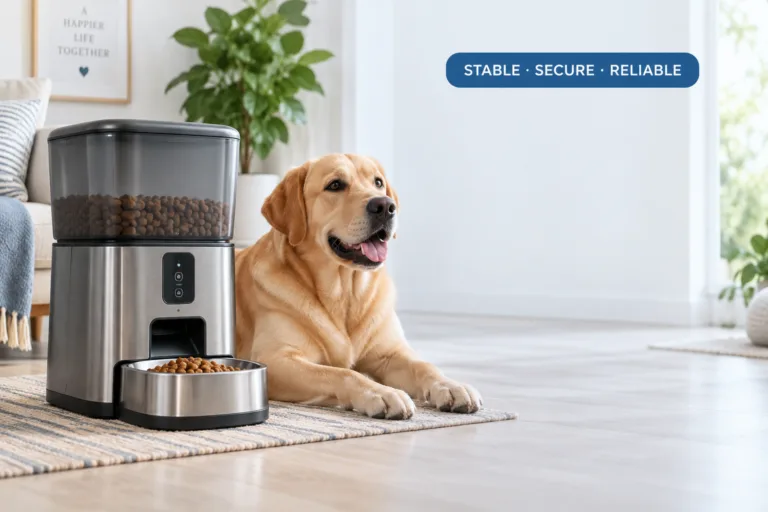
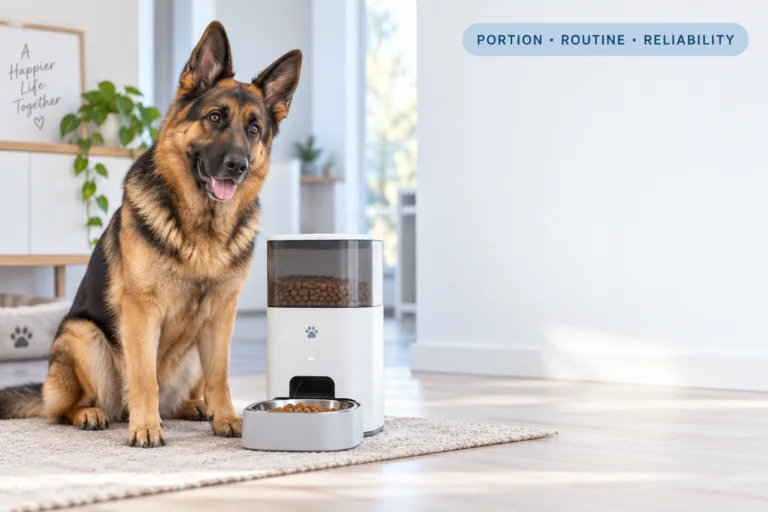
The benefits of smart pet feeder are not limited to convenience. A smart feeder changes how food enters the home routine: meals become scheduled, portions become measurable, and owner emotion stops controlling every bowl. That matters because feeding problems usually repeat when pets learn that begging, staring, barking, or meowing can still move food from the owner’s hand to the bowl.
For owners who need app-based control without a large setup, a smart automatic pet feeder with app control can create a cleaner feeding boundary. The device is useful only when it supports a real schedule, measured portions, and a household rule that stops random top-ups.
Direct Answer: benefits of smart pet feeder
The benefits of smart pet feeder are strongest when the goal is feeding schedule control, portion accuracy, missed meal prevention, and reduced overeating. It helps because food delivery moves away from emotional owner reaction and into a repeatable system. If the owner still overrides the schedule whenever the pet complains, the feeder loses most of its value.
Why This Happens
Feeding problems repeat because food is both nutrition and reward. A pet does not only learn that food tastes good. It learns which behavior makes food appear. When a cat meows and receives a scoop, or a dog paws the owner and receives a snack, the feeding system teaches pressure behavior.
The benefits of smart pet feeder start by breaking that connection. The feeder separates the owner’s attention from the food reward. Meals arrive at scheduled times, not after begging. Portions are dispensed by rule, not by guilt. Over time, the pet has fewer reasons to treat the owner as a food button.
This is why setup quality matters. A feeder is not finished when it turns on. It is finished when the schedule, portion output, food flow, and owner behavior all match the plan. A basic smart pet feeder setup should confirm those layers before the device becomes part of daily feeding.
What To Do
Start with the feeding problem, not the product photo. If the issue is missed meals, choose schedule reliability. If the issue is overeating, choose portion control. If the issue is owner anxiety during work, choose app visibility. If the issue is vacation feeding, add backup power, water planning, and human checks. The feeder should match the failure point in the home.
The benefits of smart pet feeder become practical when the household writes a simple rule: how many meals, what portion size, what time, who refills the hopper, and when manual feeding is allowed. A fixed scientific pet feeding schedule turns the feeder from a gadget into a routine-control tool.
For workdays, test several meals while you are home before relying on remote control. Check the bowl, confirm the app log, and measure the dispensed amount. Owners who feed during long shifts should connect the feeder to an automatic pet feeder work routine instead of using the app as a panic button.
The Feeding Loop Behind This Problem
The feeding loop has four parts: the pet signals hunger, the owner reacts, food appears, and the pet remembers the behavior that worked. This loop becomes stronger when the owner responds inconsistently. One ignored meow teaches little. One rewarded meow teaches more. A random reward schedule teaches persistence.
The benefits of smart pet feeder come from replacing that loop with a time-based system. The pet still receives food, but the trigger changes. The trigger becomes the schedule, not pressure behavior. That change reduces begging because the old behavior stops producing the same reward.
This boundary is especially useful in homes where food-seeking has become loud. SmartPetTools explains that pattern in cat hunger behavior after eating, where the visible problem looks like appetite but the deeper problem is often reinforcement and routine dependency.
The Emotional Trigger Owners Miss
The emotional trigger is guilt. Owners see a pet waiting near the bowl and assume the pet needs food immediately. The owner adds a little extra, then repeats it the next day. The pet learns the room, the time, the sound, and the human expression that predicts food.
A smart feeder reduces this emotional trigger because the owner no longer has to make every feeding decision in the moment. The portion is already defined. The time is already defined. The owner can check the system without rewarding pressure behavior. That is one of the most practical benefits of smart pet feeder for homes where feeding has become emotionally noisy.
The Addiction Mechanism
Food reward becomes sticky because it is fast, clear, and repeated. When the reward arrives after a specific behavior, the pet connects behavior to outcome. When the reward arrives unpredictably, the behavior becomes harder to stop because persistence sometimes pays.
Manual feeding often creates this pattern by accident. A pet begs for five minutes, the owner gives in, and the pet learns that longer pressure works. A smart feeder removes the owner from the reward timing. The feeder does not care whether the pet stares, whines, or paws the cabinet. It follows the schedule.
The health side matters as much as the behavior side. AAFCO’s pet food label guidance helps owners understand feeding information, while AVMA’s pet nutrition guidance reinforces that feeding choices should support health, not owner anxiety. The benefits of smart pet feeder are strongest when measured portions replace emotional scooping.
Micro Case
A common home example is a cat that wakes the owner at 5:00 a.m. for breakfast. The owner feeds early to stop the noise, and the cat learns that pressure works before sunrise. After a smart feeder takes over the morning meal, food arrives from the device instead of the owner. The noise does not disappear on day one, but the reward path changes, and the early-morning pressure loses its value.
Real-World Impact
The real-world impact is visible in daily control. A smart feeder reduces missed meals during busy hours, limits portion drift, lowers owner checking behavior, and creates a more predictable food environment. It also makes household responsibility clearer because feeding no longer depends on whoever happens to pass the bowl first.
The benefits of smart pet feeder also connect directly to weight management. Random scoops, extra treats, and double feeding can push calorie intake upward without looking dramatic. SmartPetTools explains this pattern in pet obesity prevention and pet nutrition routine. External healthy pet weight guidance supports the same boundary: daily feeding control matters before weight problems become obvious.
There is also a hygiene and refill impact. A feeder does not clean itself, but it creates a visible system for food storage, bowl cleaning, and refill timing. Owners who want fewer hygiene failures should connect feeding control with a clean smart pet feeder routine.
Can This Be Fixed?
Yes, unstable home feeding can be fixed when the problem is schedule drift, portion guessing, missed meals, or owner-rewarded begging. A smart feeder fixes these problems by creating a controlled delivery system. It does not fix empty hoppers, wrong food size, ignored cleaning, open snack bowls, or owners who keep feeding outside the plan.
For device-related feeding errors, the repair path is practical. Measure the portion output. Test the schedule. Confirm WiFi behavior when app control matters. Check the bowl after dispensing. Refill before the hopper runs low. The feeder creates control only when the owner maintains the system.
Who Should Walk Away and Who Should Use This
Walk away from a smart feeder if the household refuses to follow a schedule, keeps giving manual food after begging, or needs wet-food supervision that the device cannot provide. A feeder is not a replacement for all care. It is a tool for dry-food scheduling, portion control, and routine boundaries.
Use a smart feeder if the pet eats dry food, the household needs consistent meals, work hours interfere with feeding, overeating is driven by random portions, or owner anxiety causes extra food. Owners comparing options can start with smart feeders and then match capacity, app control, camera support, or backup features to the real feeding problem.
Mini FAQ
What are the main benefits of smart pet feeder?
The main benefits of smart pet feeder are scheduled meals, measured portions, fewer missed meals, and less emotional feeding. These gains happen because the feeder turns food delivery into a rule. Set the schedule, test the portion, and stop using manual feeding as a response to begging.
Does a smart pet feeder reduce overeating?
Yes, it reduces overeating when portions are measured and extra food is blocked. The feeder controls scheduled food, but open bowls and owner snacks still create calorie drift. Use fixed portions and one household feeding rule.
Is a smart feeder useful for workdays?
Yes, a smart feeder is useful for workdays because it protects meal timing when the owner is away. The benefit comes from tested scheduling, not from constant app checking. Run test meals at home before relying on remote feeding.
Can a smart pet feeder stop begging?
It can reduce begging when the owner stops rewarding pressure behavior. The feeder moves food away from human reaction and into a timed routine. Keep manual feed restricted so begging no longer produces food.
Are smart feeders good for cats and dogs?
Smart feeders are useful for cats and dogs that eat dry food on a schedule. The reason is that both cats and dogs learn feeding patterns quickly. Match the feeder capacity, bowl design, and portion range to the animal’s daily routine.
What is the biggest mistake with a smart pet feeder?
The biggest mistake is treating the feeder as a full feeding plan by itself. The device dispenses food, but it does not choose the right routine or stop owner overrides. Build a schedule, measure portions, and keep the household consistent.
For homes that need practical schedule control, a smart automatic pet feeder with app control is a useful tool when the routine is disciplined. The clear conclusion is this: the benefits of smart pet feeder are real when the feeder creates boundaries around time, portion, and owner behavior. Without those boundaries, it is only another food container.