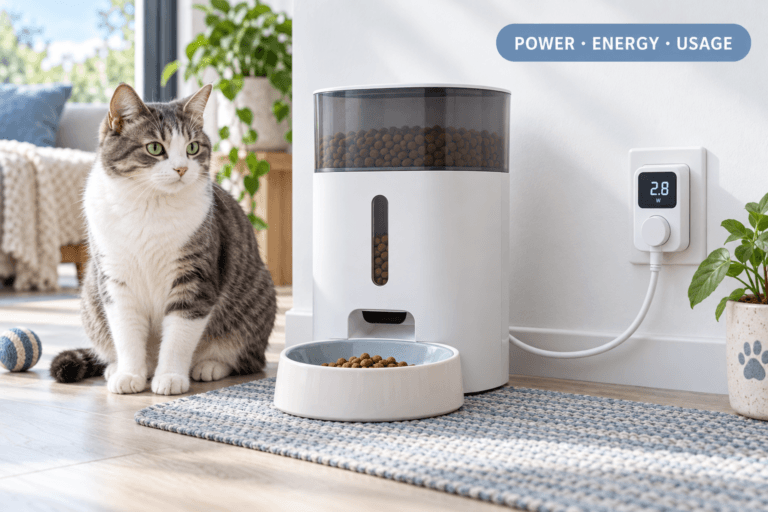

WiFi vs Bluetooth pet feeder is not just a connection preference. It decides whether the feeder can support remote control, schedule changes, feeding confirmation, and routine protection when the owner is away from home. The wrong choice creates weak control: the app looks smart, but the feeding system still fails when distance, signal, or household routine changes.
For owners who need remote schedule control and daily feeding visibility, a smart automatic pet feeder with app control is a stronger fit than a feeder that only works when the phone is nearby. The point is not to buy more technology. The point is to make feeding control hold when the owner is not standing beside the bowl.
Direct Answer: WiFi vs Bluetooth Pet Feeder
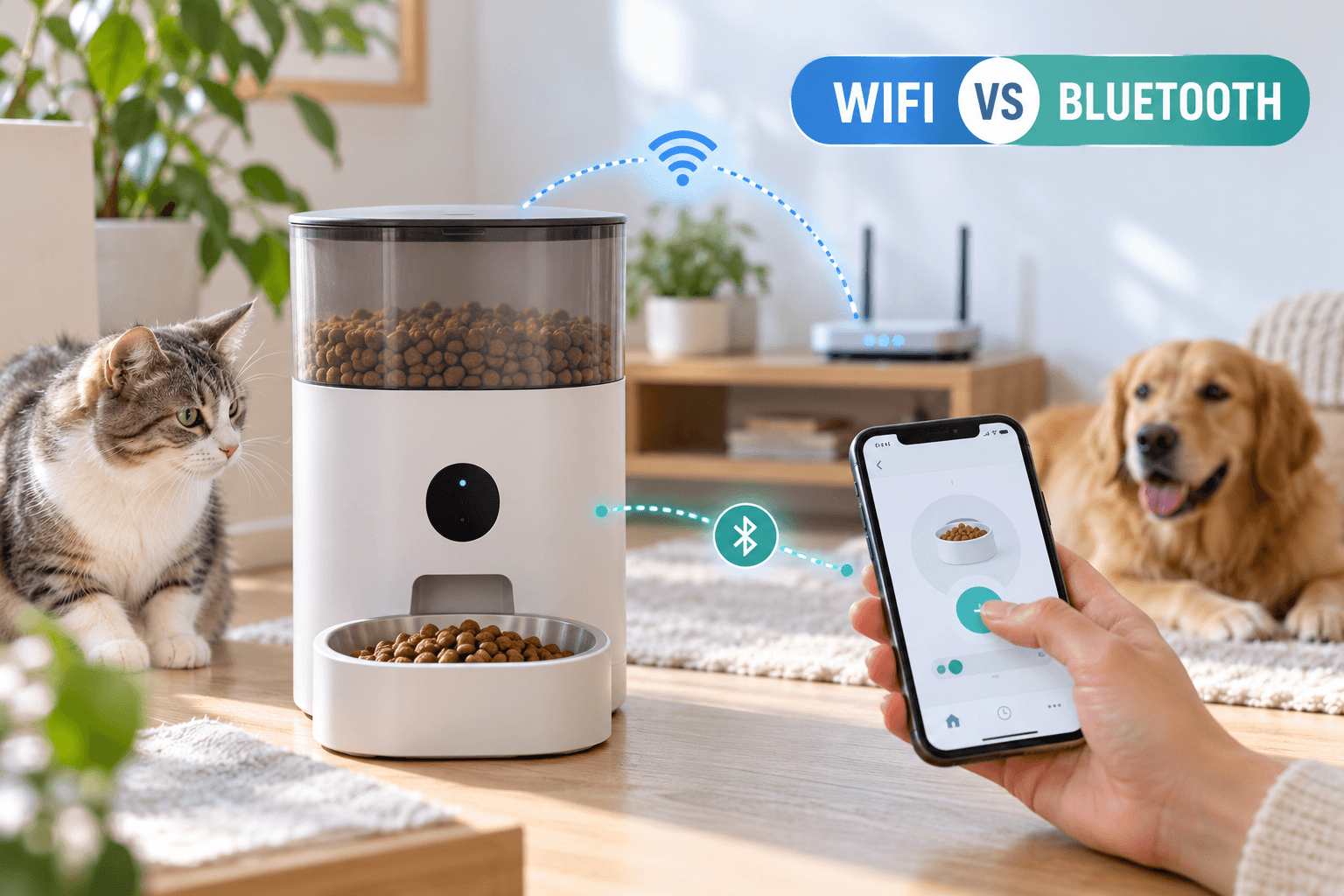
WiFi vs Bluetooth pet feeder comes down to remote control versus local control. A WiFi pet feeder is the better choice for workdays, short trips, schedule changes, feeding logs, and owner monitoring away from home. A Bluetooth pet feeder is better only for simple local setup where the owner is nearby and does not need remote access. If feeding timing matters when you are out, WiFi gives stronger control.
Why This Happens
The connection type changes the behavior of the whole feeding system. WiFi connects the feeder through the home network, so the owner can manage feeding from outside the house when the device and network are working. Bluetooth is local. It depends on nearby phone-to-device contact, which makes it weaker for remote feeding decisions.
WiFi vs Bluetooth pet feeder becomes important because pets do not care why a feeder cannot be adjusted. They only experience the result. Food arrives on time, arrives late, or does not arrive clearly enough to support the routine. When the connection limits the owner’s ability to confirm or adjust meals, the pet’s feeding pattern becomes more fragile.
Owners building a first smart feeding routine should start with how to use a smart pet feeder. Connection choice is only useful when the schedule, portions, food type, and placement are already set correctly.
What To Do
Choose WiFi when the feeder must work during work hours, travel, late returns, early mornings, or shared household routines. Choose Bluetooth only when the owner wants simple local control and does not need to adjust feeding from outside the home. The wrong choice is buying Bluetooth for a remote-feeding problem or buying WiFi without maintaining the home network and power setup.
A WiFi vs Bluetooth pet feeder decision should also include portion accuracy, tank size, cleaning access, food-path reliability, and backup control. Connection alone does not make a feeder safe. A WiFi feeder that jams is still weak. A Bluetooth feeder that cannot be reached remotely is still limited. The best choice is the one that protects the routine under real household pressure.
Before relying on any smart feeder, connect the device to a stable scientific pet feeding schedule. Remote access is useful only when it supports a clear feeding rule instead of creating random snack decisions.
The Feeding Loop Behind This Problem
The feeding loop begins with expectation. The pet expects food at a known time. If the feeder dispenses correctly, the pet learns to wait for the routine. If the feeder fails or the owner cannot adjust it when away, the pet checks the bowl, pressures the home environment, and waits for food uncertainty to resolve.
WiFi vs Bluetooth pet feeder affects this loop because remote access changes how quickly the owner can protect the schedule. With WiFi, the owner can manage feeding from outside the home when the device is online. With Bluetooth, the owner has to be near the feeder. That local limit creates a weaker fallback when the household routine is built around absence.
Cats that already act hungry after meals can become louder when feeding signals are inconsistent. The guide on why cats seem hungry after eating explains how repeated food checking can become a learned pattern rather than a true calorie need.
The Emotional Trigger Owners Miss
The emotional trigger is control anxiety. Owners buy smart feeders because they want to feel certain that meals are happening. That anxiety is strongest when they are at work, traveling, or unable to return home on time. A Bluetooth feeder can look smart during setup but still fail the emotional need if the owner cannot control it from a distance.
A WiFi vs Bluetooth pet feeder choice should be made around the owner’s real absence pattern. If the owner only wants a local timer, Bluetooth can stay simple. If the owner wants remote meal control, schedule editing, or feeding confirmation, WiFi is the stronger path. The purchase should match the actual stress point, not the cheapest app label.
Food control also has to sit beside water control. Remote feeding does not solve hydration. Owners should connect smart feeding with pet hydration tips so the home routine is not built around dry food alone.
The Addiction Mechanism
The addiction mechanism comes from irregular reward. If the pet receives food at unpredictable times because the owner changes meals randomly through the app, the animal starts treating the bowl as a source of uncertain payoff. That uncertainty increases checking, begging, and food pressure.
WiFi vs Bluetooth pet feeder does not remove this risk by itself. WiFi can protect a schedule, but it can also tempt owners into emotional remote feeding. Bluetooth limits remote overuse, but it also limits remote correction. The correct use is strict scheduling, measured portions, and no random feeding just because the owner feels guilty.
The feeder should create routine dependency in the useful direction. The pet waits for the meal time, hears the feeder, eats the portion, and leaves the bowl. The device becomes a rule. It should not become a remote snack button.
Real-World Impact
The real-world impact shows up on busy days. With WiFi, an owner who is delayed can check or adjust the schedule from outside the home. With Bluetooth, that same owner has no remote control once away from the feeder. For pets on strict portions, that difference matters because missed meals and owner overcorrection both damage routine stability.
A WiFi vs Bluetooth pet feeder decision also affects weight control. Remote feeding should not become remote overfeeding. Long-term meal discipline should stay aligned with healthy pet weight guidance, because app convenience can quietly turn into extra calories.
For cats on weight-control routines, measured feeding has to stay consistent. A structured cat weight reduction plan works only when meals are controlled, logged, and not changed by guilt. The same control logic applies to dogs that pressure owners before meals.
Can This Be Fixed?
Yes, a weak smart-feeder setup can be fixed by matching the connection type to the real feeding problem. If the issue is remote management, choose WiFi. If the issue is simple local scheduling, Bluetooth can work. If the issue is jamming, food stealing, wet food, or bowl guarding, connection type is not the main fix.
A WiFi vs Bluetooth pet feeder comparison should never stop at the app. Test the feeder with the real kibble, real portion size, real schedule, and real household routine. Check whether the bowl stays clean, whether the food path dispenses evenly, and whether the owner can manage failures without turning meals into random rewards.
For owners away during meal windows, the automatic pet feeder for work guide gives a practical next step. Workday feeding needs stable timing, not just a device that connects once during setup.
Who Should Walk Away and Who Should Use This
Walk away from Bluetooth as the main solution if you need remote feeding control, feeding confirmation outside the home, schedule changes during travel, or support for unpredictable work hours. Walk away from WiFi if your home network is unstable and you refuse to test power, signal, food flow, and backup plans before relying on the feeder.
Use a WiFi vs Bluetooth pet feeder comparison to choose by household risk. WiFi suits owners who travel, work late, manage early meals, or need app visibility. Bluetooth suits owners who want simple local setup and are usually home near feeding times. Cat owners can compare cat feeders, while dog owners should screen dog feeders by capacity, bowl size, and portion range.
For homes with more than one pet, connection type is only part of the problem. Access control can matter more than WiFi or Bluetooth. The automatic feeder guide for multi-cat households explains why one connected bowl can still fail when one pet controls the food.
Mini FAQ
Which is better in WiFi vs Bluetooth pet feeder?
WiFi is better for remote feeding control, while Bluetooth is better for simple local setup. WiFi supports owners who are away from home and need schedule access. Use Bluetooth only when nearby control is enough.
Does a Bluetooth pet feeder work when I am away?
No, Bluetooth control is local and limited by short-range connection. It does not solve remote feeding decisions during workdays or travel. Choose WiFi when outside-home access is required.
Is a WiFi pet feeder always safer?
No, WiFi is safer only when the feeder, network, power, and food path are reliable. Remote access does not fix jams, dirty parts, or wrong portions. Test the feeder before depending on it.
Can app feeding create bad habits?
Yes, app feeding creates bad habits when owners send random extra meals. Random rewards make pets check the bowl more often. Use the app to protect the schedule, not to feed guilt.
What should I check before buying a smart feeder?
Check connection type, portion accuracy, tank size, backup control, cleaning access, and kibble compatibility. A feeder succeeds when all of these support the same routine. Do not choose by app connection alone.
For most owners who need remote control rather than nearby setup only, a 2L automatic pet feeder with smart app control gives a clearer path than local-only control. WiFi vs Bluetooth pet feeder is ultimately a control decision: choose WiFi when absence is the problem, choose Bluetooth when local simplicity is enough, and make the feeder enforce a stable routine instead of turning feeding into another weak connection.