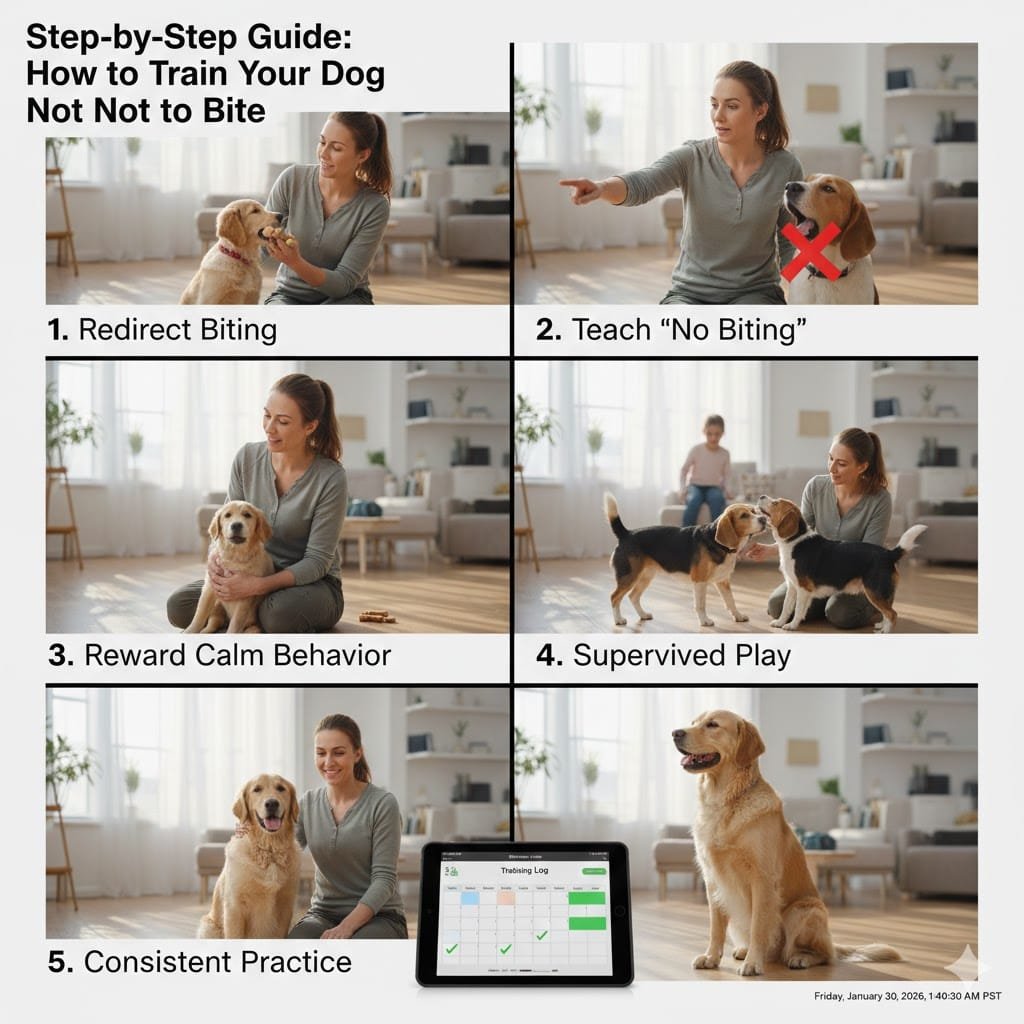

How to Train Your Dog Not to Bite: Essential Tips

A German Shepherd is chasing a ball in the park when a stranger approaches, and it immediately bares its teeth and growls. The owner quickly gives the command “sit,” and after a moment’s hesitation, the dog obeys, preventing a potential attack.

The behavior of a dog biting often stems from complex reasons. Statistics show that over 35% of biting incidents toward owners are due to confusion about family hierarchy, while approximately 67% of play biting comes from incorrect interaction methods.

Understanding and correcting this behavior is not only for the safety of others but also to protect the dog itself. Many places have strict regulations for biting dogs, with severe cases potentially facing euthanasia. This is why learning how to train a dog not to bite is a fundamental responsibility for every owner.

01 The Deep Reasons Why Dogs Bite

Dogs biting is not accidental but rather the result of multiple factors intertwined. Exploratory behavior during the puppy stage is a common starting point, as puppies aged 3-6 months explore their environment through their mouths, and teething discomfort can intensify their chewing instinct.

Emotional expression needs are equally crucial. Research shows that 45% of aggressive incidents stem from fear, as dogs trigger defensive aggression when scared. Resource protection behaviors like guarding food or toys are also common triggers.

The impact of social deprivation should not be overlooked. Dogs that have not completed basic socialization training have a 65% higher probability of overreacting to external stimuli. These dogs are more likely to bite out of self-defense when facing unfamiliar environments and people.

The breed characteristics also play a certain role. Herding breeds have a strong instinct to chase, while fighting breeds may require more emotional desensitization training. But remember, any breed needs proper training and socialization.

02 Immediate Intervention and Stopping Biting Behavior

When you notice a dog has a tendency to bite, immediate intervention is crucial. Giving a high-frequency command (such as “No” or “Stop”) at 0.5 seconds after the behavior occurs can effectively establish a conditioned reflex association. This is a key first step in how to teach a dog not to bite.

Stopping interaction is a strong feedback. When a dog bites, immediately stop playing and turn and walk away, maintaining a 10-15 second cold treatment. This mimics social feedback between puppies: bite too hard and you lose your playmate.

Providing alternatives can redirect biting impulses. When a dog wants to bite your hand, immediately offer a chilled chew toy or a dental toy as a substitute. Applying meat sauce to the toy before each interaction can strengthen the association between the toy and positive feelings. This method is central to understanding how to make your dog stop nipping.

Controlling the environment helps reduce biting opportunities. Set up a 50cm safety distance warning band, paired with a smart collar vibration reminder. This allows for timely intervention if the dog shows signs of aggression (such as a heart rate > 180 beats per minute).

03 Positive Reinforcement Training Methods

Positive reinforcement is the core method for changing a dog’s behavior. When the dog exhibits good behavior, reward it within 3 seconds, which can increase training efficiency by 40%. Rewards can be small treats, petting, or verbal praise.

“Swap games” can effectively build trust. Offer a toy when extending a friendly gesture, and immediately reward after contact is made. This method is particularly effective for correcting resource guarding behavior, helping dogs understand that human proximity means something good is happening.

Basic command training is fundamental. Spend 15-20 minutes each day practicing commands like “sit” and “stay.” When a dog shows a tendency to bite when facing strangers, immediately giving these commands can redirect its attention.

Desensitization training should be gradual. Conduct sessions three times a week, each lasting 10 minutes, with progressive exposure starting at 50% intensity of the trigger point. For example, with a dog afraid of strangers, begin with observing from a distance and gradually decrease the distance.

04 Tiered socialization training program

Socialization training should start with puppies. Exposing them to different people, animals, and environments during the puppy stage can significantly enhance their adaptability. The period between 2-8 months is the golden window for behavior shaping in breeds like the German Shepherd, and training during this stage can be three times more effective than with adult dogs. This is the ideal time to learn how to get puppy to stop biting other dog.

Implement graded exposure training: twice daily for 20 minutes each session. In the initial phase, observe passersby from a 5-meter distance. In the advanced phase, have an assistant wear protective gear for physical contact. In the reinforcement phase, simulate complex scenarios like children screaming or wheelchairs passing by.

Consistent family rules are crucial. All family members should use the same commands and reward/punishment methods. If one person allows the dog on the sofa while another prohibits it, the dog will feel confused and may even become more aggressive.

Regular social activities can reinforce training effects. Take your dog to a pet park or invite friends over for visits, allowing it to learn how to interact with people in controlled environments. Pay attention to your dog’s body language and intervene promptly if signs of stress appear. This controlled exposure is a critical part of how to stop puppy from biting other dogs.

05 Scientific Rewards and Moderate Punishments

The reward mechanism needs to be carefully designed. Use high-value rewards (such as dried chicken breast) to reinforce non-aggressive states. Giving rewards when the dog is calm is more effective than when it is excited.

The timeliness of rewards and punishments is extremely crucial. Correction must be implemented within 0.5 seconds after the behavior occurs, and rewards must be given within 3 seconds after the correct behavior. Delayed rewards will prevent the dog from understanding why it is being rewarded.

Cold handling is an effective and gentle punishment. Immediately leave the room and close the door when the dog bites, letting it understand that biting leads to social disruption. This method is suitable for dogs that enjoy play-biting their owners.

Avoiding physical punishment is a consensus among professional dog trainers. Research shows that 80% of abused dogs will develop post-traumatic stress disorder. The success rate of physical punishment training is less than 12%, and there is a 50% relapse rate.

06 Common Mistakes and How to Avoid Them

Using physical punishment to stop biting is a common mistake. This can easily lead to increased fear or aggression in dogs. Violent stimuli activate a dog’s defense mechanisms, causing continuous adrenaline secretion and triggering a vicious cycle of “attack-escape.”

Ignoring a puppy’s biting behavior is another misconception. Many people think it’s fun when small dogs bite without causing pain, but this can develop bad habits that are harder to correct when the dog grows up. The “no biting” rule must be established during the puppy stage.

Playing the “bite hands” game with dogs can have serious consequences. If owners habitually tease dogs by letting them bite hands as a game, dogs will think it’s acceptable to bite people. Toys should be used as intermediaries for interaction.

Taking away something a dog is biting directly is also dangerous. Directly snatching it may make the dog feel it has to defend the item more forcefully, or even develop aggression. Milder treats should be used as a trade.

07 Special Situation Handling Solutions

Correcting resource guarding behavior requires special methods. Use the “food replacement method”: Alternate placing regular food and high-value treats during feeding. Feed by hand to get the dog accustomed to human proximity. Gradually allow free access to the food bowl without overreaction.

Hereditary aggressive tendencies require targeted management. Sheepdog breeds should focus on controlling their chasing instinct, with 1 hour of directional obstacle training daily. Fighting breeds need enhanced emotional desensitization, using VR equipment to simulate confrontational scenarios.

The handling strategy for fear-based aggression differs. Use VR equipment to simulate stimuli (such as children running scenes). Combine this with “retreat training”: guide the dog to retreat and reward when stress signs appear.

Medical intervention may sometimes be necessary. Seek professional help in the following situations: continuous 3-week training ineffectiveness; physiological abnormalities during aggression (e.g., pupil dilation, salivation); or the emergence of unprovoked random aggressive behavior.

Training a dog not to bite is a gradual process. The American K9 Training Association tracked 500 cases and found that adopting the “toy+reward” model reduces biting incidents by 81%.

Data from the China Canine Behavior Research Association in 2024 shows that systematic obedience training can reduce aggressive behavior by 72%. Continuous 6-week training with positive reinforcement for 15 minutes daily, combined with 2 socialization sessions per week, can fundamentally change a dog’s aggressive tendencies.

Most importantly, patience and consistency are key. There are no naturally bad dogs, only instincts that need proper guidance. When you see a dog that used to bite people now calmly accepting strangers’ pets, that sense of achievement is irreplaceable.

The purpose of training is not to suppress a dog’s nature, but to teach it to live harmoniously in human society—that is the responsible way to raise a dog. Mastering how to train a dog not to bite is a journey that requires commitment, but the results are well worth the effort.

Leave a Reply

Your email address will not be published. Required fields are marked *