
A pet feeder with battery backup is not a luxury feature. It is a safety boundary for homes where meal timing cannot collapse every time the power flickers, the plug gets pulled, or app control becomes unstable. Feeding failure does not only create one missed meal. It breaks the routine your pet uses to understand when food is coming and when begging will not work.
For owners who need stronger feeding reliability, a WiFi automatic pet feeder with button backup gives a practical control layer when the main system faces interruption. The point is not to add technology for decoration. The point is to keep food release tied to a stable system instead of owner panic.
Direct Answer: Pet Feeder with Battery Backup
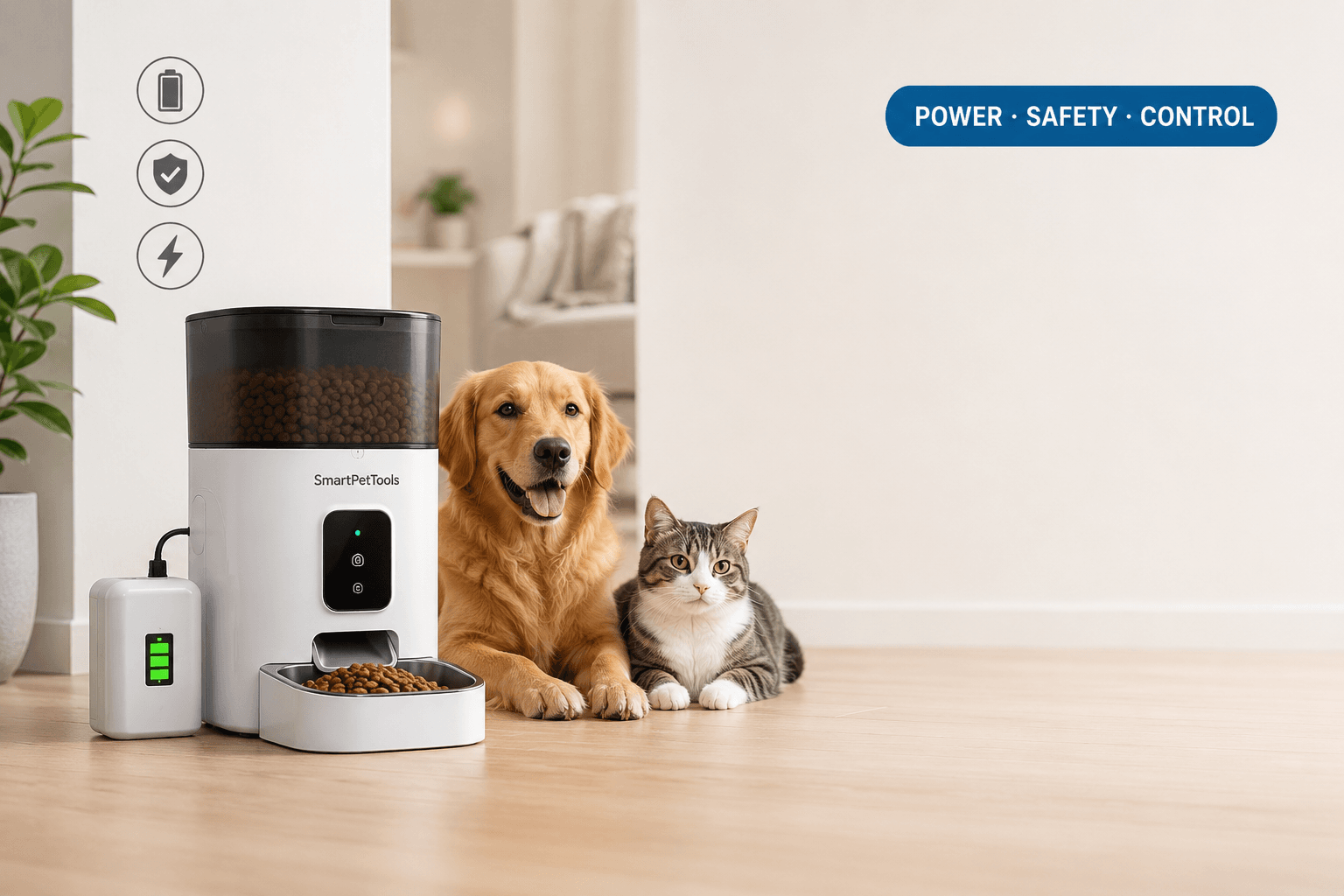
A pet feeder with battery backup is worth using when your pet depends on scheduled meals, portion control, or regular feeding while you are away. Power loss, unplugged cords, and app failure can interrupt feeding, and that interruption trains anxiety, begging, food checking, and overeating after the system returns. A backup power plan keeps meals predictable and prevents one technical failure from becoming a behavior problem.
Why This Happens
Feeding routines are built through repetition. Your pet learns the time, sound, bowl location, and portion size. When the feeder works every day, the animal stops treating food as a negotiation. When the feeder fails, the pattern breaks. The pet checks the bowl, waits, vocalizes, scratches, circles, or pressures the owner. If food later appears after enough noise or stress, the wrong behavior gets reinforced.
A pet feeder with battery backup protects the routine from technical weakness. The real issue is not electricity alone. The real issue is system trust. Pets do not understand a power outage, a loose cable, a router failure, or a dead app session. They only experience the broken result: food did not arrive when the routine said it should.
Owners building a stable feeding system should start with a schedule that matches the pet’s day. A scientific pet feeding schedule helps connect meal timing with energy, appetite, and weight control instead of relying on random refills.
What To Do
Choose a pet feeder with battery backup by looking at four controls: backup power, dispense accuracy, manual override, and food-path reliability. Backup power keeps the schedule alive. Dispense accuracy protects portion size. Manual override gives the owner a local fallback. Food-path reliability prevents jams from turning backup power into a false sense of safety.
Test the feeder before trusting it. Run the same food, portion, schedule, and power setup for several days. Unplug the feeder during a non-critical test window and confirm that the backup system behaves as expected. Do not assume a feeder is reliable because the app looks clean. Reliability is proven by repeated meals arriving at the right time, in the right amount, under normal household stress.
For setup discipline, use a clear process from the smart pet feeder setup guide. A feeder is only as good as the routine placed inside it.
The Feeding Loop Behind This Problem
The feeding loop begins with expectation. The pet expects food at a specific time. If the feeder fails, expectation turns into checking. Checking turns into frustration. Frustration turns into noise, pacing, or bowl fixation. When the owner later responds with extra food, the pet learns that pressure can change the feeding outcome.
This loop becomes worse when power failure is repeated. A pet that experiences inconsistent feeding starts watching the bowl more often. That behavior looks like hunger, but the mechanism is uncertainty. The pet feeder with battery backup breaks the loop by keeping the feeding signal stable even when the primary power source fails.
Owners who already see constant food pressure should review why cats seem hungry after eating. Many feeding problems are not caused by true hunger. They are caused by a reinforcement pattern that teaches the animal to keep asking.
The Emotional Trigger Owners Miss
The emotional trigger is guilt after a missed meal. Owners often compensate by giving extra food, hand-feeding, or leaving a larger bowl “just in case.” That reaction feels responsible, but it teaches the pet that system failure leads to bigger reward. The next disruption becomes louder because the pet has learned that pressure changes the rules.
A pet feeder with battery backup reduces the need for guilt-driven feeding. The system handles ordinary interruption before the owner turns one missed meal into overcorrection. This matters for cats and dogs because emotional feeding does not stay emotional. It becomes a repeated behavior loop with real weight, digestion, and routine consequences.
Food reliability also has to sit beside water reliability. Dry-food automation does not solve hydration. Owners should pair feeding plans with consistent water access and review pet hydration tips when they are designing a home routine for workdays, nights, or short trips.
The Addiction Mechanism
The addiction mechanism comes from uncertain reward. When food arrives inconsistently, the pet keeps checking because another check can produce a result. This is the same pattern that makes random reward powerful: the animal repeats the behavior because the next attempt has value.
Loose feeding systems create this pattern quickly. A delayed meal leads to begging. Begging leads to owner response. Owner response leads to extra food. Extra food makes the begging more valuable. The pet feeder with battery backup removes one major source of uncertainty by protecting the timing signal from power interruption.
The goal is not to make the feeder exciting. The goal is to make it boring. Food arrives on schedule, in measured portions, from the same place. The pet stops gambling against the bowl and starts trusting the routine.
Real-World Impact
The real-world impact of feeder failure shows up in behavior and body condition. A pet that misses meals through technical failure often becomes more intense around food. A pet that receives owner compensation after failure can gain weight and learn to demand larger portions. For long-term health boundaries, owners should align feeding routines with healthy pet weight guidance.
A pet feeder with battery backup is especially useful for owners who work long shifts, leave early, return late, or travel for short periods. It protects the normal day from small failures. The same logic appears in the automatic pet feeder for work guide, where the feeder succeeds only when it creates dependable routine rather than random convenience.
Weight control matters here because emergency overfeeding often becomes normal overfeeding. Cats on controlled portions need stricter structure, and a cat weight reduction plan works only when meals are measured consistently. A backup system protects that consistency.
Can This Be Fixed?
Yes, feeder reliability can be fixed when backup power is treated as part of the feeding system, not as an optional extra. The fix is to use a feeder with stable scheduling, tested portions, a secure power setup, and a backup layer. A feeder without a tested fallback turns one household interruption into a feeding failure.
A pet feeder with battery backup should still be checked. Backup power does not solve stale food, blocked kibble, wrong portion settings, or poor cleaning. Owners should use dry food that flows correctly, avoid overpacking the tank, clean the food path, and confirm the feeder is not placed where pets can tip or unplug it.
Who Should Walk Away and Who Should Use This
Walk away from battery-backup feeding as the main solution if the pet eats wet food only, needs direct feeding supervision, destroys devices, guards the bowl, or shares food with a faster animal in the same home. In those cases, the power source is not the main problem. The feeding environment needs separation or a different control design.
Use a pet feeder with battery backup if your pet eats dry food, follows scheduled meals, needs portion control, and spends predictable hours without direct feeding supervision. For homes with more than one animal, the problem is often access control rather than power alone. The automatic feeder guide for multi-cat households explains why one open bowl can fail when one pet eats faster than the others.
Owners comparing device types should start with the smart feeders category and filter by actual control needs: schedule, portion size, backup access, capacity, and household risk.
Mini FAQ
Is a pet feeder with battery backup necessary?
Yes, it is necessary when scheduled feeding matters. Power loss can break the meal routine and trigger food anxiety. Use backup power or a feeder with a tested fallback so meals stay predictable.
What problem does battery backup solve in a pet feeder?
Battery backup solves power interruption, not poor feeding design. It keeps scheduled meals from failing during outages or unplugged-cord events. Choose a feeder that also has accurate portions and a clean food path.
Can a pet feeder with battery backup stop begging?
It can reduce begging when the begging is caused by inconsistent feeding. Pets pressure the bowl and owner when meals become unpredictable. A stable feeder routine removes the uncertainty that fuels the behavior.
Should I still test the feeder before leaving home?
Yes, testing is required before relying on the feeder. Backup power does not prove dispense accuracy or jam resistance. Run the real schedule with the real food before trusting the system.
Is backup power enough for vacation feeding?
No, backup power is only one part of vacation feeding safety. The feeder also needs enough capacity, portion control, fresh water support, and a stable location. Use backup power as part of a complete routine system.
For owners who need a stronger fallback plan, a 4L WiFi feeder with button backup for cats and dogs supports routine control when normal access becomes unstable. A pet feeder with battery backup is the right choice when feeding cannot be left to power luck, owner guilt, or random bowl checking. Choose the feeder that protects the schedule, test it before relying on it, and keep the routine strict enough that technical failure does not train bad behavior.