
How to stop one cat from stealing another cat’s food is not mainly about teaching cats to “share.” In many homes, a stronger, faster, or more confident cat controls access to the feeding area while the quieter cat eats too quickly, waits nearby, or leaves without finishing. The real solution is to protect the weaker cat’s meal through better timing, distance, and physical separation.
When one cat repeatedly succeeds in taking another cat’s food, the behavior becomes part of the household routine. The food-stealing cat learns that rushing, blocking, or waiting near the bowl works. The other cat learns that eating is unsafe or unpredictable. A controlled feeding routine breaks this pattern without turning every meal into a confrontation.
For homes that need more consistent meal timing, a smart feeder for separate meal timing and feeding monitoring can make the routine easier to manage.
Direct Answer: How to Stop One Cat From Stealing Another Cat’s Food
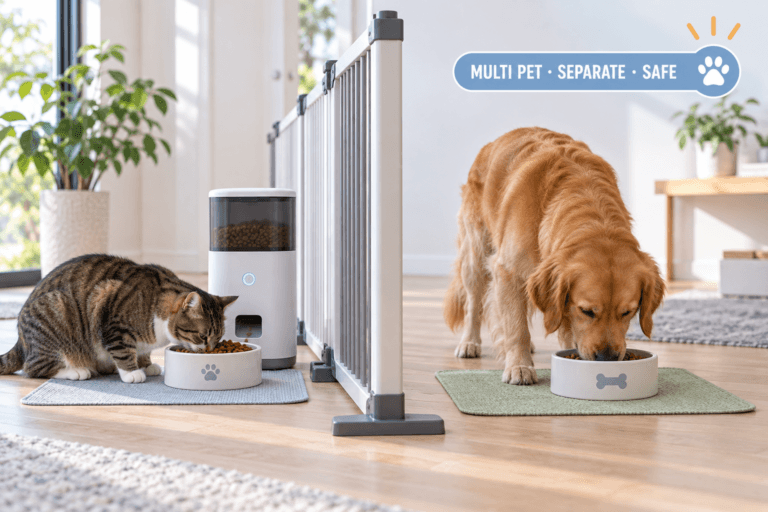
How to stop one cat from stealing another cat’s food starts with removing the opportunity to steal. Feed the cats at the same time in separate rooms or clearly divided zones. Use closed doors or visual barriers when necessary, serve measured portions, and remove leftovers after the meal period. If permanent separation is difficult, use timed or microchip-controlled feeders so the weaker cat can access its own food without being interrupted.
Do not wait for the stronger cat to finish first, and do not allow it to clean up the other cat’s bowl. Every successful theft rewards the behavior and makes the next meal harder to control.
Why the Stronger Cat Keeps Taking the Other Cat’s Food
The food-stealing cat is not always genuinely hungry. The behavior often develops because that cat has better access, moves faster, or has learned that the other cat will retreat. Common patterns include:
- The stronger cat finishes quickly and immediately approaches the other bowl.
- The quieter cat pauses, backs away, or waits until the area is clear.
- The stronger cat blocks the route to the bowl or stands close enough to create pressure.
- The household leaves food available, allowing the stronger cat to patrol and return repeatedly.
- Both cats are expected to eat side by side even though one cat is visibly uncomfortable.
The weaker cat may not hiss or fight. Stress can appear as eating only a few bites, watching the other cat instead of eating, hiding after meals, or waiting until late at night to approach the bowl. Feeding two cats in the same room can therefore look peaceful while one cat is still losing access to food.
What To Do When One Cat Controls Mealtime
Start with separate feeding zones
Use separate rooms whenever possible. A closed door is more reliable than asking a timid cat to defend its bowl. In an open-plan home, place the bowls far apart and use furniture, a doorway, or a visual screen to prevent direct staring and quick approaches.
The goal is not simply to give each cat a different bowl. Each cat needs a protected route to its own food and enough space to finish without being watched, blocked, or chased away.
Use the same schedule, but not the same space
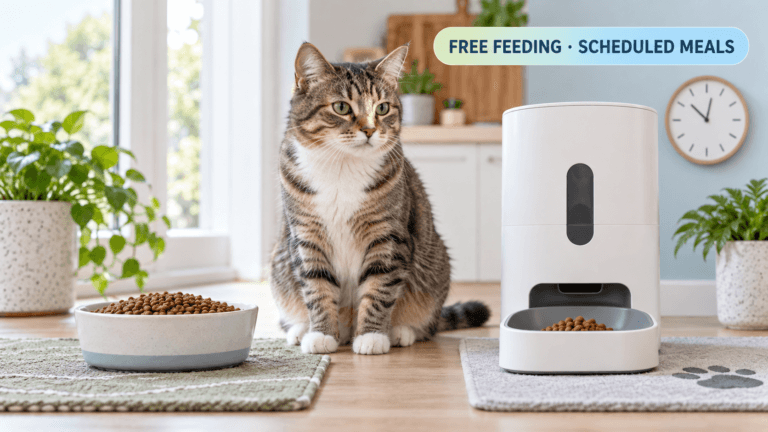
Feeding both cats at predictable times reduces the stronger cat’s need to patrol for opportunities. Start both meals together, but deliver them in separate zones. This prevents one cat from finishing early and immediately taking over the other meal.
Measured meals are usually easier to manage than food left out all day. The scientific pet feeding schedule approach can help you establish consistent portions and predictable meal windows.
Remove leftovers after a defined meal window
Give each cat enough time to eat, then remove the bowls. VCA recommends offering specific meals in separate locations and removing remaining food after a controlled period for cats that need weight management. Read the guidance in VCA’s cat weight-reduction plan.
This prevents the stronger cat from returning later to finish another cat’s portion. It also allows you to see whether the quieter cat actually ate enough.
Use isolated feeding for the vulnerable cat
If one cat regularly abandons food when the other appears, feed the vulnerable cat behind a closed door. Keep the cat in that room until the meal is finished and the bowl is removed. This is especially important when the cats eat different diets, when one cat needs medication, or when one cat is losing weight.
Do not force the weaker cat to remain beside the stronger cat as a “training exercise.” Repeated pressure usually creates avoidance rather than cooperation.
Use access-controlled feeders when separation is difficult
A timed feeder can prevent early access and divide meals into smaller portions. A microchip or RFID feeder provides stronger protection when one cat must eat a prescription diet, a weight-control diet, or a different type of food. The guide to microchip pet feeder vs. RFID systems explains how identity-based access differs from ordinary timed feeding.
Automatic equipment does not replace behavior management. The feeder must still be placed in a quiet, defensible location where the weaker cat can approach and leave safely.
The Feeding Loop That Keeps Food Stealing Alive
The pattern usually follows a simple loop:
- The stronger cat notices food or finishes its own portion.
- It approaches the other bowl or blocks the other cat’s path.
- The quieter cat retreats, eats faster, or abandons the meal.
- The stronger cat gets access to extra food.
- The behavior becomes more likely during the next meal.
This is why shouting after the theft rarely solves the problem. The important reward happened before the correction: the stronger cat gained food and control. The intervention must stop access before the theft occurs.
The Emotional Trigger for Owners
Many owners hesitate to separate cats because they worry that separate meals are unfair or that the cats should learn to eat together. That expectation can keep the problem going. Fairness does not mean identical feeding locations. Fairness means each cat receives the correct food, portion, and eating time without pressure from another cat.
Another common mistake is feeding the stronger cat extra food to keep it away. This rewards the very behavior the household is trying to stop and can accelerate weight gain. Calm structure works better than negotiation at the bowl.
Why Food Stealing Becomes a Habit
Food stealing is reinforced by occasional success. Even if the stronger cat is stopped most days, one successful theft can maintain the behavior. The cat continues checking because the reward is unpredictable but valuable.
The weaker cat can also develop a routine around avoidance. It may wait until the kitchen is empty, eat quickly, or stop approaching the feeding area altogether. This is not stubbornness. It is a learned response to repeated interruption.
Breaking the habit requires consistent access control. For several weeks, the stronger cat should not be allowed to complete the theft cycle. The household should also provide multiple separated food, water, resting, and escape areas, consistent with the FelineVMA guidance on setting up the environment for success.
Micro Case: The Cat Who Waited for the Kitchen to Clear
Consider a quiet cat that eats only a few bites while its housemate stands nearby. The assertive cat does not need to attack; simply approaching the bowl is enough to make the other cat leave. If the owner then allows the assertive cat to finish the abandoned food, the behavior is reinforced on both sides.
The practical fix is to feed the quiet cat behind a closed door, serve the assertive cat its measured portion in another room, and remove both bowls after the meal window. After the routine becomes predictable, the cats no longer need to compete for access.
Real-World Impact on a Multi-Cat Household
When one cat regularly controls the food, the visible problem is stealing, but the consequences can spread across the household. The stronger cat may gain excess weight while the other cat receives too few calories. The weaker cat may also experience chronic stress, rapid eating, digestive upset, or reluctance to approach food.
Group feeding can also hide important changes in appetite. The FelineVMA feeding guidance recommends separating cats when group feeding creates gorging, feeding aggression, or unequal intake. It also supports dividing the daily allowance into multiple small meals when appropriate.
Track each cat’s portion, eating speed, body weight, and behavior around the feeding area. A cat that suddenly stops eating, loses weight, vomits repeatedly, or hides during meals needs prompt veterinary assessment because medical problems can exist alongside food conflict.
Can This Be Fixed?
Yes. Most households improve when management changes before the cats are expected to change their behavior. Start with physical separation, then add predictable timing and measured portions. If the weaker cat has already developed strong avoidance, maintain the protected feeding area until it approaches and finishes meals normally.
Persistent chasing, cornering, growling, swatting, or blocking outside mealtimes signals a wider intercat tension problem. In that situation, food separation is necessary but not sufficient. Create separate resting areas, escape routes, water stations, and play opportunities so the stronger cat cannot control every important resource.
Who Should Use Separate Feeding and Controlled Feeders?
Separate feeding should be the default when one cat consistently leaves food because another cat approaches. It is also essential when cats have different diets, different calorie requirements, or a clear history of weight gain and weight loss.
A basic timed feeder works well when the main problem is schedule control. A microchip or RFID feeder is the better choice when one cat must be prevented from accessing another cat’s food. Multi-cat households can also review this guide on choosing an automatic feeder for a multi-cat household.
Do not rely on a shared bowl when one cat is faster, more assertive, or willing to take food from the other. Shared access is the problem, so the solution must create protected access.
Mini FAQ
Why does one cat keep stealing the other cat’s food?
The stronger cat has learned that approaching or blocking the other bowl produces extra food. Remove that reward by separating the cats before the theft happens.
How do I protect the weaker cat from food theft?
Feed the cat in a closed room or behind a secure visual barrier. Keep the cat separated until it finishes, then remove the bowl.
Should cats eat in separate rooms?
Yes, when one cat cannot eat normally in the other’s presence. Separate rooms provide the clearest boundary and reduce staring, blocking, and sudden rushing.
Can an automatic feeder stop one cat from stealing another cat’s food?
It can help by controlling timing and portions. For reliable identity-based access, use a microchip or RFID feeder and place it where the weaker cat can eat without being cornered.
What if the weaker cat stops eating?
Protect the cat’s meal immediately and arrange prompt veterinary assessment. Appetite loss should not be treated as a simple behavior issue when it persists.
For homes that need to combine scheduled meals with observation, review the guide to using a smart pet feeder before setting up the routine.
Final Takeaway
How to stop one cat from stealing another cat’s food comes down to controlling access before the stronger cat reaches the other bowl. Use separate rooms or zones, feed on a predictable schedule, remove leftovers, and choose identity-based feeder access when ordinary separation is not enough.
The weaker cat should be able to eat without watching the doorway or waiting for the stronger cat to leave. Once every cat has a protected meal routine, food stealing loses its reward and mealtime becomes predictable again.
multi-cat feeding solutions