
7 Proven Ways: How to Train Your Dog Not to Bite and Build Trust
Imagine a German Shepherd chasing a ball in the park. As a stranger approaches, the dog bares its teeth. The owner calmly gives a “sit” command, and the dog obeys instantly, preventing a potential incident. This level of control isn’t magic—it’s the result of knowing how to train your dog not to bite through consistent, positive guidance.
Statistics show that over 35% of biting incidents stem from confusion about family hierarchy, while 67% of play-biting is the result of incorrect interaction. Understanding how to train your dog not to bite is a fundamental responsibility that protects both your community and your pet.
1. Understand Why Dogs Bite
Before you can master how to train your dog not to bite, you must understand the root causes.
Teething: Puppies aged 3-6 months explore the world with their mouths.
Fear-Based Aggression: According to the American Kennel Club (AKC), nearly 45% of aggressive incidents are triggered by fear.
Lack of Socialization: Dogs without proper exposure are 65% more likely to overreact to strangers.
2. Immediate Intervention Strategies
Timing is everything when learning how to train your dog not to bite.
The 0.5-Second Rule: Correct the behavior within half a second of it occurring to establish a clear association.
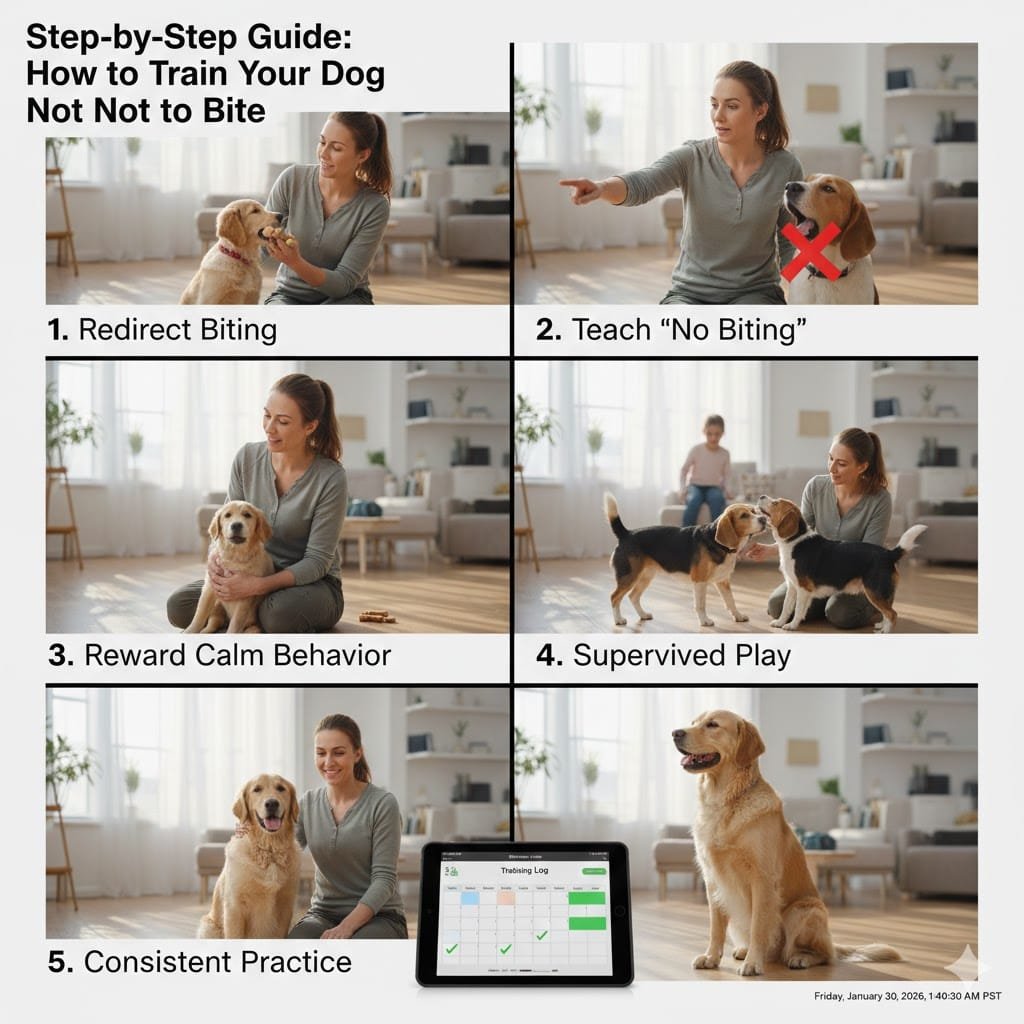
“Cold Treatment”: If your dog bites during play, immediately stop all interaction for 15 seconds. This teaches them that biting leads to a loss of their playmate—a core technique in how to train your dog not to bite.
3. Redirecting Biting Impulses with Alternatives
A key part of how to teach a dog not to bite is providing a better option. When your dog tries to nip your hand, offer a chilled chew toy instead. This redirection is essential for owners wondering how to make your dog stop nipping effectively. To make the toy more enticing, you can use treats from your automatic pet feeder as high-value rewards for choosing the toy over your skin.
4. Positive Reinforcement Training
Positive reinforcement can increase training efficiency by 40%. When your dog remains calm in a stressful situation, reward them within 3 seconds.
Reward Calmness: Use high-quality treats to reinforce non-aggressive states.
Command Training: Spend 15 minutes daily on “sit” and “stay.” These basic commands are vital tools in how to train your dog not to bite because they redirect the dog’s focus.
For the best results, ensure your dog is on a scientific pet feeding schedule, so they are motivated by food rewards during training sessions.
5. Graded Socialization Programs
Socialization is the “golden window” for behavior shaping.
Puppy Stage (2-8 months): This is the ideal time to learn how to get puppy to stop biting other dog.
Exposure Training: Gradually introduce your dog to new environments, starting from a safe distance. This controlled exposure is critical in how to stop puppy from biting other dogs.
6. Avoiding Common Training Mistakes
Many owners fail at how to train your dog not to bite because of these errors:
Physical Punishment: Research shows 80% of dogs subjected to physical force develop PTSD.
Ignoring “Play Bites”: Never ignore nipping in small dogs; it sets a dangerous precedent for adulthood.
Weight and Behavior: Surprisingly, weight can affect mood. Ensure you are preventing pet obesity to keep your dog’s energy levels balanced and stable.
7. Special Handling for Resource Guarding
If your dog bites to protect food, you need a targeted approach. Use the “trade” method: offer a higher-value treat in exchange for the item they are guarding. Managing these high-value rewards is much easier with a WiFi-enabled smart feeder that can dispense precise portions during “swap games.”
In multi-pet homes, aggression often peaks during mealtime. Using feeders for multiple pets can eliminate food-related stress and reduce the likelihood of biting.
Conclusion: Consistency is the Key to Success
Training is not about suppressing a dog’s nature, but helping them live harmoniously in human society. By adopting the “toy + reward” model, you can reduce biting incidents by over 80%. Mastering how to train your dog not to bite requires patience, but the bond you build in the process is irreplaceable.
Ready to reward your dog’s good behavior? Shop our Smart Pet Feeders today and make positive reinforcement training easier than ever!